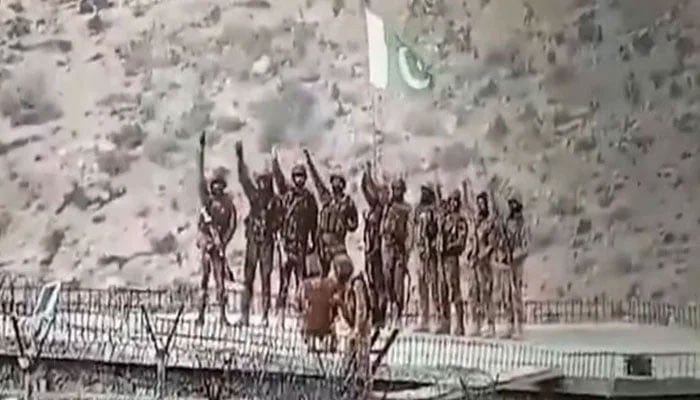
After years of TTP-led violence, enabled by an illegitimate neighbouring regime, Pakistan is finally pushing back.
With the blood of thousands of soldiers on its hands, the regime that has provided safe havens to militants is now facing the firm response it deserves. Regardless of internal political differences, credit must be given to both the civilian leadership and the military establishment for drawing a clear line in the sand: Pakistan is no longer willing to grant the Taliban regime further latitude.
However, beyond the successful military strikes supported diplomatically by regional countries and the US, the more important question is: what are our objectives in this war? The military operation launched today will not achieve its intended outcome if, after eliminating Taliban operatives and dismantling their checkpoints, we find ourselves back at square one once again facing a Taliban regime that enjoys impunity while challenging our national sovereignty.
For this operation to have lasting strategic value, Pakistan while maintaining a ‘no talks with terrorists’ policy must also move beyond short-term punitive strikes and adopt a durable security framework along the Durand Line. A hard buffer zone extending at least 10 kilometers inside Afghan territory should be established, where Pakistani counterterrorism forces maintain persistent security dominance to prevent militant regrouping.
This should be reinforced by a second, extended buffer zone stretching an additional 15–20 kilometers beyond the initial perimeter, designated as a strict no-go area. Enforced through coordinated oversight by the Pakistan Army and the Pakistan Air Force, such layered depth would deny hostile elements the operational space they have long exploited.
Meanwhile, it is important to note that Indian Prime Minister Narendra Modi concluded a high-profile visit to Israel just a day before Tel Aviv carried out strikes against Iran. The visible bonhomie between India and Israel reinforces the urgency of reshaping the regional security environment in our favor, particularly given that India has significant stakes in the regional power dynamic stakes that are clearly not aligned with our interests.
The opportunity created by the ongoing military operations must therefore not be squandered. If long-term stability is the objective, then a fundamental political transformation in Kabul potentially in the form of regime change should remain the ultimate strategic aim.
The success of this military operation against the Taliban regime will ultimately depend on how effectively the state anticipates and counters the tactics likely to be employed by the Afghan Taliban. Although there is no comparison in conventional military capability between the two sides, the Taliban’s ability to exploit porous borders gives them the capacity to infiltrate suicide bombers into Pakistan.
This conflict may therefore trigger a wave of retaliatory attacks targeting civilians and security forces alike. In response, the government working in close coordination with its allies must maintain the highest level of internal security while also shaping a clear national narrative: that a decisive blow to the militant leadership is essential, even if it entails painful sacrifices in the face of the Taliban’s brutal methods of warfare.
Last but not least, aside from an unnecessary and juvenile racist advertisement issued by the federal information ministry, Pakistan has largely maintained a coherent and firm narrative both domestically and before the international community. Particular credit is due to Mosharraf Zaidi for his strong and composed presence in international media, where he articulated Pakistan’s position confidently despite persistent propaganda efforts. At the same time, the Pakistani clergy deserves recognition for not undermining the state’s narrative during this conflict.
With kinetic operations underway inside Afghanistan, coupled with an ambitious strategic objective and a disciplined communication strategy, Pakistan has the opportunity to achieve its core military goals. The killing of our soldiers and civilians cannot be allowed to become a new normal. The state is finally asserting itself with clarity and resolve, supported by a coordinated military and strategic communications framework.
With unity of purpose and sustained political will, the geopolitical equation can be shifted in our favour. From Karachi to Khyber, the broader political class stands with the state and its institutions.
The writer is a senior member of Muttahida Qaumi Movement-Pakistan (MQM-P).