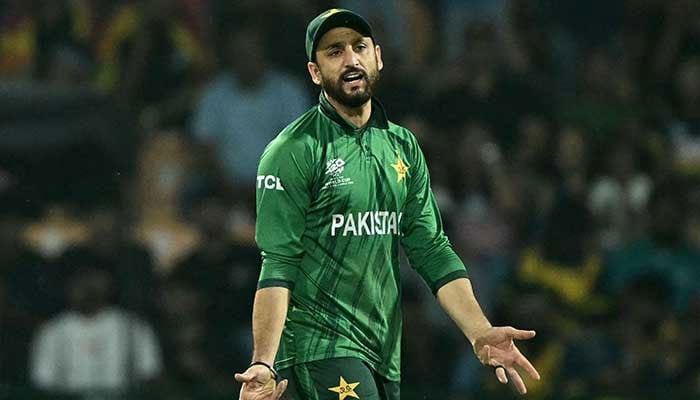
ISLAMABAD: A blazing start, a dramatic collapse, a nervy finish and ultimately, heartbreak. Pakistan’s T20 World Cup campaign ended in familiar frustration at Pallekele on Saturday despite a thrilling five-run victory that briefly kept dreams alive. For a moment, it appeared the Green Shirts were scripting one of the most remarkable comebacks in ICC history. The reset opening pair of Sahibzada Farhan and Fakhar Zaman turned the Power Play into a spectacle, dismantling the Sri Lankan attack with audacious stroke play and fearless intent. The duo stitched together a magnificent 176-run opening stand, one of Pakistan’s finest in T20 World Cup history laying the perfect platform for a mammoth total. Sahibzada Farhan was at his imperious best, smashing a scintillating 100 off 60 balls, peppered with five towering sixes and nine crisp boundaries. At the other end, Fakhar Zaman matched him stroke for stroke, hammering 84 with four sixes and nine fours, sending the Pallekele crowd into a frenzy. With more than four overs remaining and wickets in hand, Pakistan seemed poised to post an unassailable score. But what followed was a collapse that has become all too familiar. The middle order disintegrated under pressure, wickets tumbling in clusters as no batter from there on managed to cross double figures. From a commanding position, Pakistan staggered to 212 for 8, competitive, but short of the intimidating total it promised to be.
“Yes, the middle order has been our problem as we cannot manage to build on the score,” admitted a visibly dejected captain Salman Ali Agha after the match.
If the batting collapse dented hopes, the bowling had an even steeper task. Pakistan needed to restrict Sri Lanka to 147 to secure a semi-final berth, a mathematical mountain that demanded near-perfection. The bowlers started brightly, reducing the hosts to 33 for 2 and briefly igniting belief. But Sri Lanka, led by the explosive Dasun Shanaka, refused to surrender. Shanaka’s unbeaten 76 was a masterclass in counterattacking cricket, nearly snatching victory from Pakistan’s grasp. He found solid support from Pavan Rathnayake, who contributed a fighting 58, dragging the contest into a nail-biting finale.
Only Abrar Ahmad (3-23) and Naseem Shah (1-36) managed to maintain control. The rest of the attack lacked penetration, leaking crucial runs at critical moments. In the end, Pakistan held their nerve to win by five runs but it was a hollow triumph. The margin was insufficient to push them into the semi-finals.
Thus ended Pakistan’s 2026 T20 World Cup journey, another campaign falling short of expectations.
Alarmingly, this marks the fourth successive ICC event where Pakistan have failed to reach the semi-finals, after the 2023 ODI World Cup, the 2024 T20 World Cup, the Champions Trophy and now the 2026 edition. The pattern is too consistent to ignore.
The pressing question grows louder with every tournament: Are Pakistan equipped to compete with modern, well-drilled units that dominate global cricket today?
Contemporary cricket is driven by meticulous planning, advanced data analytics, elite fitness standards and clearly defined roles. Teams that embrace professionalism and accountability are flourishing. Pakistan, however, continue to oscillate between brilliance and breakdown-moments of genius overshadowed by systemic fragility.
Mega tournaments demand more than talent. They require mental resilience, strategic clarity and administrative vision. Unfortunately, Pakistan’s approach both on and off the field has often leaned on sentiment rather than structure. Selection controversies, inconsistent planning and reactive decision-making have eroded sustained momentum. Talent alone is no longer enough. If Pakistan cricket is to reclaim its stature among the elite, structural reform must replace cosmetic adjustments. Accountability must supersede favoritism. Selection must be merit driven. Preparation must be scientific, data-backed, and long-term. The road ahead demands courage not just from players in the dressing room, but from administrators in the boardrooms. Without a comprehensive professional overhaul, Pakistan risk remaining perennial contenders in reputation but perennial underachievers in reality. Saturday’s victory proved they still possess firepower. What they lack is consistency.
And until that changes, the semi-finals will remain a bridge too far.