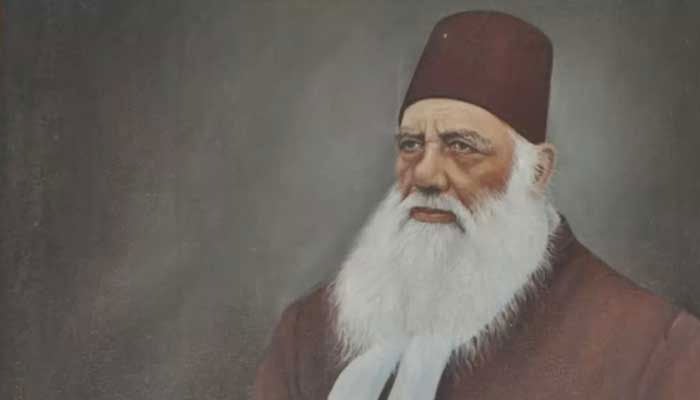
There are public lives and there are private ones. The former are chiselled into statues and syllabi; the latter lie buried in letters, account books and domestic quarrels. In ‘Sir Syed Ahmad Khan: A Private Life’, published by Oxford University Press, Iftikhar Alam Khan – translated and edited by Athar Farooqui – ventures into the interior corridors of one of South Asia’s most monumental figures and returns with something rare.
It is a biography that unsettles reverence without surrendering respect. Sir Syed Ahmad Khan (1817-1898) has long been embalmed in institutional memory as the founder of the Muhammadan Anglo-Oriental College in 1875, the seed that became Aligarh Muslim University in 1920. In Pakistan and India alike, he is invoked as the architect of Muslim modernity, the apostle of English education, the conciliator after 1857. Yet this book insists that the making of Aligarh cannot be understood without understanding the making of the man. Its organising structure – visible even from a glance – is chronological but psychologically alert.
Formative years (1817-1857), loyalty to the British (1858-1870), gentility (1870-1876), versatility (1876-1890), apprehensions (1890-1898) and the fraught aftermath involving his son Syed Mahmood (1898-1903). The early chapters reconstruct a world that was already fading when Sir Syed was born: a Mughal aristocracy living in the afterglow of imperial decline. The genealogical detail – maternal and paternal lineages, the figure of Khwaja Farid-ud-Din Ahmad, the cultural environment of the maternal household – does more than pad out ancestry. It situates Sir Syed within a culture of refinement, etiquette and Persianate learning that would later collide with the blunt utilitarianism of British rule.
The household was an archive of memory. The young Syed Ahmad absorbed stories of power even as power drained away. The trauma of 1857 divides the narrative like a fault line. It signals the density of treatment: postings in Bijnor, conditions in Delhi and Bijnor during the uprising, English occupation, the death of his mother, his own role. What emerges is neither the caricature of a collaborator nor the romance of a rebel. Sir Syed’s conduct during the uprising – protecting Europeans in Bijnor while later authoring Asar-us-Sanadid and writing on the causes of the revolt – was pragmatic, even anguished.
The book suggests that his much-debated ‘loyalty’ was less ideological submission than strategic survival. In the ruins of Delhi, he seems to have concluded that Muslim regeneration would require accommodation, not nostalgia. The period labelled ‘Restoration of Loyalty to the British, 1858–1870’ is telling. Restoration implies something broken. Posted in Moradabad and later Ghazipur, Sir Syed’s life becomes bureaucratic, almost prosaic: income and expenditure, transfers, domestic bereavements, the birth of a daughter, the death of his wife. Yet in Ghazipur, the establishment of a madrasa and then the Scientific Society marks the germination of a new ambition.
Translation, dissemination of scientific knowledge and the cultivation of English proficiency were tools for communal survival. The book’s treatment of Sir Syed’s Englishness is particularly intriguing. One finds chapters on his mastery of English, his attire, the Aligarh-cut pyjama and sherwani and even the controversy over the fez versus the Turkish cap. These details could have descended into trivia. Instead, they illuminate the politics of appearance. Dress, in colonial India, was argument. To adopt European styles was to signal modernity; to modify them was to negotiate dignity. Sir Syed’s sartorial experiments thus become a metaphor for his intellectual project: selective assimilation.
His journey to England, meticulously prepared and financially strained, occupies a substantial portion of the narrative. The application for the visit, the reply to William Muir’s book, arrangements for money, and the exposure to British institutions reveal a man eager to study the machinery of power at its source. England did not convert him into an Englishman; it confirmed his conviction that education, residential colleges and disciplined administration were the prerequisites of Muslim uplift. The later transplantation of these ideas to Aligarh was not mimicry but adaptation. The founding of the Muhammadan Anglo-Oriental College, described in the book under the ‘Period of Versatility’, reads almost like an administrative saga.
Preparations for the foundation ceremony, the workers involved, the role of Shibli’s bungalow, the transfer of authority from Samiullah Khan, the membership of the Viceroy’s Council and the Education Commission – these chapters render institution-building as a drama of personalities and procedures. One senses how precarious the enterprise was: dependent on donations, vulnerable to factionalism, scrutinised by colonial officials. The book does not flinch from internal conflict. The comparison between Syed Hamid and Syed Mahmood, the tensions with Samiullah Khan, the friction with Mr Beck and, later, the legal and financial troubles that haunted the family expose a reformer besieged not only by critics but also by kin.
The Aligarh project was entangled in marriage alliances, property disputes and generational disagreements. The private life intrudes relentlessly upon the public mission. Particularly poignant is the later period of ‘Apprehensions, 1890-1898’. Here Sir Syed is ageing, preoccupied and ill. Cheap boarding houses, trustee laws, intimate companions and the deteriorating health and behaviour of Syed Mahmood cast a shadow over the triumph of Aligarh. The narrative suggests that institutional success did not insulate him from personal anguish. His illness and diagnosis, the shifting of offices, the transfer of property, even the logistics of moving out of his own house are chronicled with a sobriety that resists hagiography.
What distinguishes this biography from earlier celebratory accounts is its insistence on ambiguity. Sir Syed emerges neither as an unblemished visionary nor as a colonial stooge. He is shown to be liberal in some respects – encouraging debate, supporting the performing arts, engaging British guests – yet cautious, even conservative, in others, especially when communal tensions sharpened around language controversies and the Nagari script. His opposition to certain political mobilisations stemmed from a fear that premature democracy would marginalise Muslims in a Hindu-majority polity. Whether that fear was prophetic or self-fulfilling remains contested; the book allows the reader to decide.
Athar Farooqui’s translation is lucid without being ornamental. The prose carries the cadence of scholarship rather than polemic. The inclusion of extensive notes underscores the archival labour underpinning the narrative. At times, the density of detail may test the casual reader. But for those interested in the granular texture of 19th-century North Indian Muslim society, the accumulation is revelatory. The biography’s most subversive achievement lies in its portrayal of vulnerability. The death of Sir Syed’s mother during the upheaval of 1857, the demise of his wife, the anxieties over his son’s career and conduct, the spectre of indebtedness – these episodes puncture the marble bust.
They remind us that reform is often born of insecurity. The desire to stabilise a community may originate in the instability of a household. In South Asia today, where Sir Syed’s legacy is claimed by competing national narratives – celebrated in Pakistan as a precursor to Muslim separatism, venerated in India as a moderniser within a plural society – this book performs a valuable service. By returning him to his rooms, his letters, his wardrobe and his dinner table, it complicates appropriation. The private life resists slogans. If there is a criticism, it is that the very commitment to intimacy sometimes dilutes analytical synthesis.
The reader is offered a wealth of material but occasionally yearns for sharper interpretive framing, especially on the broader intellectual currents of the time: the interplay with contemporaries like Hali, the theological debates that animated his Quranic exegesis, the evolving politics of representation. Yet perhaps this restraint is deliberate.
The book prefers to show rather than sermonise. The final sections, dealing with the aftermath of Sir Syed’s death and the troubled career of Syed Mahmood, carry a note of melancholy. Institutions outlive founders, but they also mutate. The Aligarh movement would later feed into strands of Muslim nationalism that Sir Syed himself approached warily.
To be continued
The writer is dean of the faculty of liberal arts at a private university in Karachi. He tweets/posts @NaazirMahmood and can be reached at: [email protected]