The global arms control architecture has entered a decisive phase. The expiration of New START on February 5, 2026, the recent statement by the US Under Secretary of State for Arms Control at the Conference on Disarmament (CD) in Geneva, public allegations regarding a possible Chinese nuclear test in 2020, and renewed Russian assertions on strategic stability collectively signal that the bilateral era of nuclear restraint has given way to a more contested, multipolar phase.
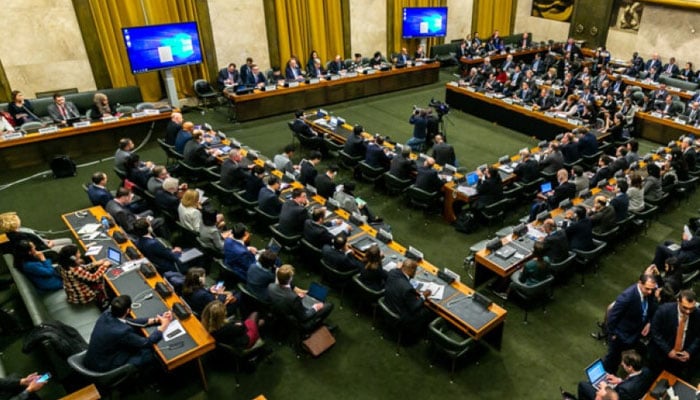
At the CD, Washington recently placed primary responsibility for the erosion of arms control on Moscow and Beijing. Russia was accused of violating New START. China was portrayed as rapidly and opaquely expanding its arsenal, potentially reaching parity with the United States within years. There was also a call for “modernised, multilateral” arms control discussions and a hint at flexibility regarding venues beyond the CD’s traditional framework.
These developments require careful evaluation, particularly as multilateralisation increasingly implies inclusion of non-NPT nuclear powers.
All major nuclear powers are modernising. India has the fastest-growing nuclear weapons program in the world. The US is undertaking a comprehensive recapitalisation of its nuclear triad. The Congressional Budget Office estimates approximately $756 billion for US nuclear forces over the 2023–2032 period alone. Lifecycle projections across three decades frequently exceed $1.2–1.5 trillion.
Russia has fielded new systems. President Putin has repeatedly described these as responses to missile defence and Nati expansion. The US claims that China’s arsenal is expanding, suggesting it may approach 1,000 warheads by 2030. Beijing maintains that its doctrine remains defensive and anchored in minimum deterrence and has long argued that the two largest nuclear arsenals bear primary responsibility for reductions before expecting others to enter limitation frameworks.
In this context, selective framing undermines credibility. Strategic modernisation is a systemic phenomenon. Treating it as unilateral destabilisation by some while presenting it as stabilisation by others complicates consensus-building. The US claims regarding a June 2020 event near Lop Nur reintroduced uncertainty around nuclear testing norms. Washington characterised the seismic event as a probable low-yield nuclear explosion. Beijing has rejected the claim. The CTBT has not yet entered into force, and several key states have not ratified it.
The danger lies less in the accusations than in the interpretive space that such exchanges create. The global moratorium on testing rests on political restraint and reciprocal confidence. If major powers begin publicly questioning compliance and transparency, pressure builds for hedging strategies. A return to testing by any major power would trigger rapid strategic recalibration elsewhere. Regions where deterrence stability depends on technological parity would feel immediate effects. The testing norm functions as a stabiliser. Preserving that norm should be a shared interest among all nuclear weapons states.
Frustration with the Conference on Disarmament was a prominent theme in the Geneva remarks. The CD’s consensus principle, however, functions as a structural safeguard. It ensures that treaties affecting core national security interests reflect broad agreement. Majority-driven arrangements in alternative venues risk marginalising states whose deterrence requirements are shaped by regional asymmetries rather than global power projection.
Flexible geometry may accelerate negotiations, yet durability flows from structural equity. Agreements negotiated outside inclusive consensus frameworks risk limited buy-in and uneven implementation. Past attempts to engineer side arrangements, such as expanded P5-plus dialogues. Those initiatives struggled precisely because they did not resolve baseline disparities. Calls for multilateral arms control reflect an attempt to address today’s multipolar order. Bilateral US-Russia arrangements alone no longer capture the strategic landscape.
Yet structural asymmetries complicate multilateralisation: warhead numbers vary widely, fissile material stockpiles differ substantially, missile defence architectures alter deterrence equations, and alliance commitments and extended deterrence arrangements create layered obligations.
Without meaningful prior reductions in larger arsenals, multilateral ceilings risk freezing disparities. It is unrealistic to expect the largest arsenals to converge rapidly toward South Asian levels. Equally, smaller nuclear powers cannot be expected to accept frameworks that lock in disadvantage. The debate over a fissile material cut-off treaty illustrates this tension. A production-only arrangement that ignores existing stockpiles would institutionalise asymmetry. Equitable disarmament principles require that both production and existing stocks form part of the discussion.
China’s longstanding position that deeper US-Russia reductions should precede broader negotiations aligns with this structural logic. That principle resonates across several non-NPT nuclear powers as well. A sustainable way forward requires calibrated steps that accommodate differing baselines while reducing systemic risk.
Several measures could command broad support across nuclear powers: Reaffirmation of testing moratoria, accompanied by enhanced transparency measures within existing CTBT verification mechanisms, could be a step that non-signatories would notice. De-targeting or de-alerting dialogues, reducing accidental or rapid escalation risks could build confidence among P5 states and revive some trust in NPT amongst its non-nuclear weapons states. Transparency exchanges on modernisation doctrines, clarifying intent without compromising operational security, could reduce nuclear risk. Incremental unilateral reductions by the two largest arsenals could create space for eventual multilateral engagement. Structured dialogue on missile defence and emerging technologies, including hypersonics and AI-enabled command systems, is quintessential in track 2 diplomacy forums, which can then be elevated to the governmental level. Such measures address global stability without imposing asymmetric obligations on regionally constrained states.
For Pakistan specifically, several guiding principles remain relevant. Continued engagement within the CD. Support for risk-reduction initiatives consistent with credible minimum deterrence. Advocacy for equitable arrangements for fissile materials, addressing both production and stocks. Participation in Track 1 and Track 2 dialogues to shape emerging norms. Constructive engagement preserves leverage. Strategic patience preserves balance.
The arms control order stands at a crossroads. The coming years will determine whether the next phase of arms control corrects asymmetries or codifies them. If emerging disruptive technologies like artificial intelligence and quantum technology are added to the nuclear domain, the forecast becomes bleaker.
Equity, transparency and graduated reduction remain the most viable anchors for strategic stability. Any new framework that internalises these principles will find wider acceptance across nuclear powers, including China and regional deterrence states.
An architecture built on selective framing and compressed timelines would struggle to endure. The stakes are systemic. The response must be measured, balanced and anchored in structural fairness.
The writer is an arms control adviser at the Strategic Plans Division and a former brigadier. The views are solely his own.