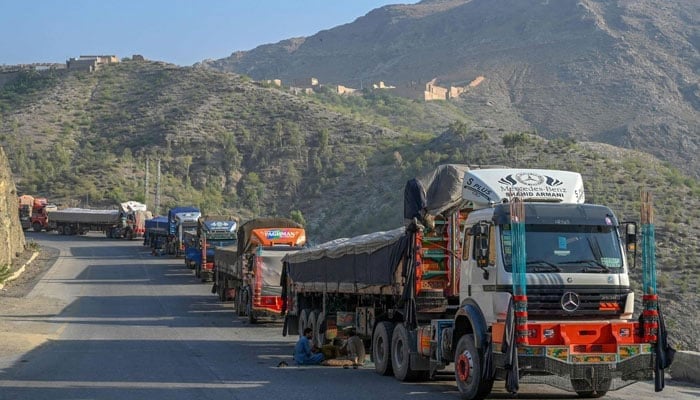
PESHAWAR: Participants at a policy dialogue on Friday stressed the need for early reopening and expansion of trade activities across the Pak-Afghanistan borders to strengthen regional economic ties.
The roundtable policy dialogue, titled “Pakistan-Afghanistan Border Economy: Balancing Security Challenges with Trade and Commerce,” was organised by the International Relations Students Association (IRSA) of the Department of International Relations, University of Peshawar. Academics, policymakers, business leaders and students attended the event and discussed ways to balance security concerns with sustainable cross-border trade and commerce.
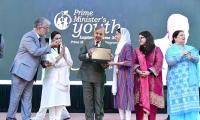
Khyber Pakhtunkhwa Governor Faisal Karim Kundi presided over the session. Speaking on the occasion, Governor Kundi said that Pakistan was committed to strong bilateral relations and enhanced trade with Afghanistan and other neighbouring countries.
He stressed that sustainable regional peace was vital for economic development and that border security and trade must be pursued through a balanced strategy promoting legal commerce and people-to-people contact.
Referring to the province’s security environment, he observed that the border belt adjoining Afghanistan had directly affected law and order in Khyber Pakhtunkhwa. He noted that the Soviet-Afghan war and the post-9/11 era had reshaped the region, fueling extremism and instability. He said that Pakistan, particularly KP had made immense sacrifices in the fight against terrorism.
He called for making the Pak-Afghan border fully functional to boost business activity and facilitate access to Central Asian markets, emphasising that identifying problems without practical solutions was insufficient.
Earlier, in his welcome remarks, Dr Syed Sami Raza, chairman of the Department of International Relations, highlighted historical examples where former rivals transformed conflict into cooperation through trade. Referring to cases such as Germany and France, the United States and Japan, and Brazil and Argentina, he said that economic interdependence raised the cost of war and paved the way for peace and mutual development.
Shahid Hussain Shinwari, who was the guest speaker on the occasin, shared insights from decades of cross-border commerce. He said that trade had historically continued even during periods of conflict, as economic stability remained essential for both countries. He called for the inclusion of local traders and border business representatives in trade negotiations between Islamabad and Kabul to ensure that ground realities inform policymaking. He urged that trade should be separated from politics, arguing that sustainable economic cooperation requires continuity, stability and mutual trust beyond political differences.
He claimed that mediation efforts by countries such as Turkey and Qatar had not produced lasting outcomes and expressed hope that Saudi Arabia could facilitate constructive dialogue to help resume daily cross-border trade.
Dr Noreen, a faculty member at the university, presented data showing that bilateral trade between Pakistan and Afghanistan had declined from $2.24 billion to $754 million over the past five years, resulting in a loss of nearly $1.5 billion in Pakistani exports. She attributed the downturn largely to mistrust and insecurity. The narcotics trade and opium production, she said, had damaged agricultural productivity in border regions and fueled militancy, further disrupting commerce.
To revive trade, she recommended shifting from excessive securitization to risk-based border controls, phased transitions for small traders, greater use of digital trade facilitation tools, and community engagement with those dependent on cross-border business.
Professor Dr.Hussain Shaheed underscored the importance of regional economic connectivity among Russia, Pakistan and Afghanistan, extending beyond trade to energy cooperation, transport corridors and shared security objectives. He referred to projects such as the Turkmenistan-Afghanistan-Pakistan-India (TAPI) gas pipeline and the proposed Uzbekistan-Pakistan-Afghanistan railway as transformative initiatives that could reduce transit costs and position Afghanistan as a regional trade hub.
However, he warned that terrorism emanating from ungoverned spaces and the activities of the Tehreek-i-Taliban Pakistan (TTP) posed serious threats to regional trade routes and Pak-Afghan relations. He emphasized the need for infrastructure modernization and secure environments to build investor confidence and promote corridor-based regional integration.