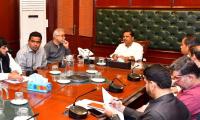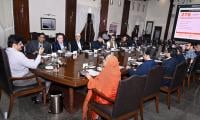
Stressing the need for population resourcing and human capital development, speakers at a programme orgnised by the Pakistan Women’s Foundation for Peace on Friday recommended that half the country’s population must be adequately resourced and empowered.
The talk titled “Recommendations for effective measures to protect the Pakistani woman from the calamitous impact of spiraling inflation and the continuing feminzation of poverty” was held at the Pakistan Medical Association (PMA).
The speakers recommended that to reduce poverty in Pakistan, taxation relief measures must transition from a regressive system—which disproportionately burdens the poor through indirect taxes—to a progressive system that protects lower-income households while taxing wealth and luxury consumption expanding the tax base. Bringing undertaxed sectors such as agriculture, real estate, and large-scale wholesale/retail into the tax net. They said all wasteful expenditure must be curtailed and the salary raise and perks of govt, officials and legislative Assemblies must be discontinued and that a greater amount should be allocated for poverty mitigation and human capital development.
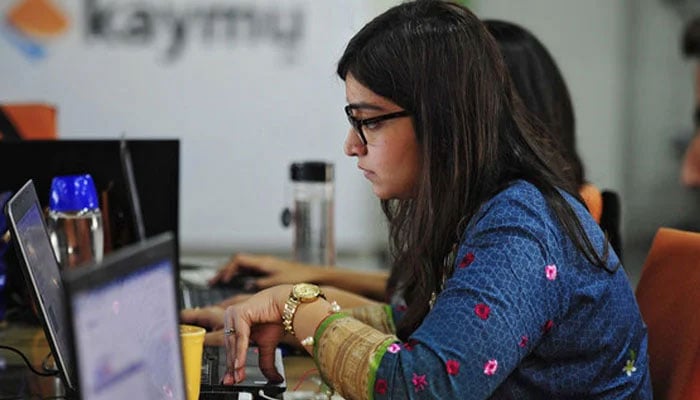
They called for expanding women access to microcredit, particularly through initiatives that combine loans with financial literacy training to ensure women have control over resources and formally recognizing and protecting the rights of home-based workers, who often work in unregulated, low-paid roles. Women should also be provided training in digital skills, entrepreneurship, and market linkages to help women transition from subsistence activities to sustainable, higher-income businesses. Support initiatives should be taken like the First Women Bank or similar institutions that facilitate access to capital, reducing dependence on male relatives.
They also stressed that the high dropout rates for girls be addressed and vocational training programs be enhanced to make women’s skills more marketable. They called for expanding access to banking services, mobile wallets, and financial literacy training, as 55 million women in Pakistan still lack access to financial services. They emphasized the need for providing direct access to microfinance, vocational training, and market linkages to help women transition from subsistence to sustainable livelihoods.
Speaking at the event, Nargis Rahman, the chairperson of the PWFP, said that based on recent reports, poverty in Pakistan has reached critical levels, disproportionately affecting women over decades of its 78-year-old history, resulting in what has become Women Generational Poverty, leading to the “feminization of poverty in Pakistan”.
Citing 2025 World Bank reports, she said that approximately 45% of Pakistan’s population lives below the poverty line. “This translates to roughly 11 crore (110 million) people based on a population of around 240-250 million...Disaggregated data indicates that over 75% of the extremely impoverished population in Pakistan are women and girls,” she highlighted.
“While the exact, current, figure for women specifically in financial poverty is not stated as a single “crore” number, calculating 75% of the “extremely impoverished” sector and considering the general 45% poverty rate among women, several crore women are impacted by severe, multidimensional poverty.”
Rehman said that subjecting a massive portion of Pakistan’s female population to dire poverty stalls national progress. “Spiralling inflation in Pakistan, hitting over 48-year highs with food inflation exceeding 34%, has crippled poor women by destroying their purchasing power, forcing them to skip meals, and reducing access to healthcare and education. BISP, PBM, OWSP initiative and other such programmes help but have not succeeded in allowing women to a sustainable dignified life or capability or livelihood. And Indirect taxation in Pakistan—primarily in the form of General Sales Tax (GST) has created a regressive economic environment that disproportionately affects poor women, reducing their purchasing power and exacerbating poverty. Because these taxes are applied to goods and services rather than income, they place a heavier burden on low-income households, where women are often responsible for managing household expenses.”
“How can poor women heavily concentrated in unpaid family labour or low-value, home-based work with little to no legal protection for those with very limited means, survive in this regressive state order?”
She highlighted that dire poverty leads to lack of access to healthcare and consequent malnutrition…incidence of high HIV and tuberculosis, malaria along with the abnormal rates of stunting in their children, plus high rates of maternal and infant mortality, adding to their mental stress, ill health and low productivity. “Women in poverty have low literacy rates (around 46.5% compared to 69.3% for men). Furthermore, 71% of parents in poor households cite financial constraints as the main reason for daughters dropping out of school, she added. “They are the hardest hit by natural disasters, such as the 2022 floods, which pushed millions more into poverty and destroyed the livelihoods of women who were already struggling.”
“Women in Pakistan’s agricultural sector form the backbone of rural livelihoods, with over 74% of the female labour force engaged in farming. Despite working up to 15-18 hours daily, their labour is largely unrecognized, unpaid, and informal.”
Economist Shahid Wizarat said Pakistan was a very prosperous country, adding that till 1960s Pakistan was doing extremely well as growth rate was very high, employment was increasing, and agriculture sector was growing. “There was also betterment in the lives of woman.”
She said that the country started having problems after the governments started going to the International Monetary Fund for budgetary support. “For example, in the 1990s, when Pakistan embarked upon the IMF policies, 20 million people were rendered unemployed, and 5,000 units were closed.”
“According to Asian Development Bank, poverty increased to 50% in the overall Pakistan. This was the 1990s”. “But now, if you look at the situation, it was much worse,” she said, adding that the successive governments kept going to the IMF, leading to more poverty and inflation in food products.
She lamented that when the government are mandated by the IMF to cut expenditure, all they do is to cut the expending on the health and education, which directly affects the poor. “As a result, the poor do not have access to education, which in return accentuates poverty.”
She said that the consumption of the genetically modified organisms (GMO) has also increased, which also contributed to health issues, thereby increasing burden of health expenditure on people.
Nuzhat Shirin, former chairperson of the Sindh Commission on the Status of Women, stressed the need to raise awareness among women working in homes and the private sector about their rights so they can speak up about the problems they face. She said that Sindh takes credit for enacting more laws than any other province. “That legislation is of no use if it is not implemented.”
She noted that although laws had been enacted for home-based workers, rules of business for their implementation were still missing. “It has not been decided till today which organisation will register them.”
Mahnaz Rahman, former resident director of Aurat Foundation, Akram Khatoon, former president of First Women Bank, Jahan Ara Hai, vice president of APWA, Pushpa Kumari of the Human Righs Commission of Pakistan, and others also spoke.