For decades, I believed Milton Friedman’s line, “only a crisis, actual or perceived, produces real change”, did not apply to us. Pakistan has lived through one crisis after another, yet the root causes of these crises often seemed stubbornly unchanged. And then, unexpectedly, Friedman became relevant.
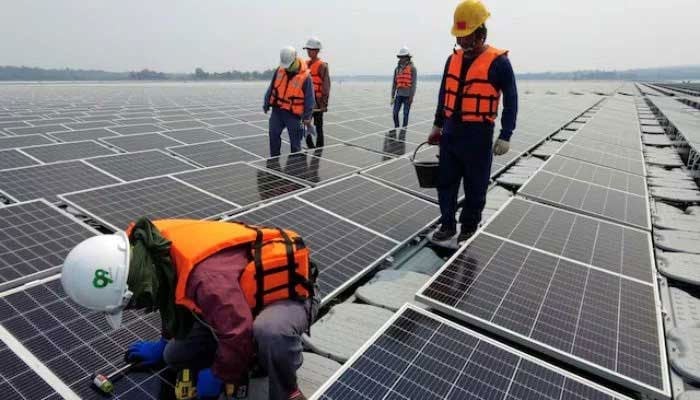
I am referring to Pakistan’s solar revolution. Between 2022 and 2025, imports of Chinese solar panels surged at a remarkable rate. Annual imports rose almost fivefold to around 16 gigawatts by 2024. In the first nine months of 2025 alone, another 16GW arrived at Karachi’s ports. By the end of last year, cumulative imports were approaching the country’s total installed grid capacity. This transformation was not centrally planned. It was driven by the crises facing Pakistani consumers and Chinese manufacturers.
Global trade patterns shifted. As the US and parts of Europe tightened tariffs on Chinese solar products and manufacturing overcapacity in China drove module prices to historic lows, exporters redirected surplus panels toward emerging markets. Pakistan became a natural destination. Panel prices fell sharply and their affordability improved. Technology costs reinforced that trend. Solar modules and batteries continued to decline in price, shortening payback periods and lowering entry barriers. What once seemed aspirational (and a status symbol) became financially sensible.
At the same time, domestic electricity tariffs rose steeply under IMF-supported stabilisation programmes. Cost-recovery adjustments, fuel-price pass-through and legacy capacity payments drove retail tariffs higher. For households and businesses whose electricity bills had doubled within two years, installing solar was less about environmental idealism and more about a practical hedge against volatility. Panels now sit atop homes in Lahore’s middle-class colonies, workshops in Faisalabad and Hyderabad, cultivated fields in Punjab and Sindh and modest neighbourhoods where families pooled savings to escape load-shedding. A decentralised energy transition unfolded quietly, rooftop by rooftop.
Yet structural change rarely leaves existing systems untouched. Grid demand has fallen by roughly 12 per cent since 2022. The cost structure of the power sector, however, has barely shifted. Utilities remain bound by rigid capacity payments under long-term, take-or-pay contracts, many indexed to the exchange rate. Those obligations increased with the expansion of rooftop generation.
Wondering why? Let me explain: When fixed costs (including capacity payment charges) must be recovered from fewer units sold, tariffs rise for those who remain fully dependent on the grid. Higher tariffs encourage more consumers to install solar. The pattern feeds on itself and is known as the ‘utility death trap’, a dynamic observed in several countries where decentralised generation collided with legacy systems.
It is tempting to treat rooftop solar as the culprit. The sequence suggests otherwise. Structural imbalances preceded the solar surge. High tariffs to contain capacity payment charges (CPP), currency depreciation and unreliable power supply were already burdening the grid consumers. Solar adoption followed those pressures. Solar prosumers got some relief, but the Power Division came under pressure. At the request of the Power Division, the regulator shifted new consumers from net metering to net billing. New prosumers now export electricity at Rs8.13 per kilowatt-hour, the national average energy price. They will purchase power from the grid at night at slab rates between roughly Rs28 and Rs44 per unit. Following the prime minister’s order, the Power Division has since sought a review to allow existing prosumers to retain the higher Rs25.32 benchmark, but new entrants face a markedly different calculation.
Under the earlier regime, households on net meters could install systems up to 1.5 times their sanctioned load, sign seven-year contracts and offset solar exports against grid consumption. Those exported units were credited at a rate that included both energy and capacity charges. The revised rules reduce installation limits for new consumers, shorten contracts to five years and remove the capacity component from export compensation.
On accounting grounds, this addresses a distortion, since rooftop solar does not reduce the system’s fixed legacy obligations. However, selling at Rs8.13 while buying at Rs30 or more will widen the price gap between units sold to and bought from the grid. That will not halt solar adoption. Rather, new prosumers will prioritise self-consumption. Those with financial capacity are increasingly likely to add storage batteries to avoid selling cheap and buying dear. If more consumers rely on storage and reduce their dependence on the grid, the revenue squeeze could intensify, worsening capacity payment charges.
Pakistan is not alone in facing this tension. Some countries reacted defensively. South Africa imposed a 10 per cent tariff on imported solar panels as rooftop adoption accelerated amid grid instability. Brazil raised import tariffs on modules to 25 per cent. Nigeria debated a ban on solar panel imports. Their measures slowed imports but left structural cost rigidities intact. Others focused on adapting their systems. Germany’s early solar surge unsettled utilities, yet tariff restructuring, balancing markets and transmission expansion gradually absorbed the shock. South Australia, after early instability, invested heavily in grid-scale batteries and system-strength measures. Renewables now supply a dominant share of its electricity demand without systemic collapse. California adjusted export pricing, introduced time-based tariffs and accelerated storage deployment to manage midday surpluses and evening peaks. China expanded transmission capacity when renewable build-out outpaced grid infrastructure, reducing curtailment rather than restraining solar deployment.
One is mindful of the argument that the above countries would have made policy decisions best suited to their respective realities. Pakistan’s ground realities are quite challenging. IMF-supported programmes require full cost recovery and reduction of untargeted energy subsidies. Circular debt must not resume its climb. Capacity payments are contractual commitments and must be paid. Within that framework, ‘net billing’ appears fiscally defensible.
Yet broader considerations remain. The direction of global trade is shifting towards greater carbon transparency. Even if Pakistan’s current exports are not immediately affected by the EU and other trading partners’ carbon border mechanisms, buyers are increasingly scrutinising carbon emissions throughout the supply chain. Rooftop and captive solar installations help Pakistani firms reduce their carbon footprints and mitigate energy risks.
Our climate commitments also rely on renewable expansion. Distributed solar has been the fastest mitigation action. Slowing it will adversely affect our climate ambition and NDC implementation. Then, there is also the balance-of-payments dimension. Solar generation displaces furnace oil and reduces its import bill, decreasing pressure on foreign exchange reserves. In a dollar-constrained economy, lower fuel imports carry macroeconomic weight.
Pricing reform may have been necessary to prevent solar energy exporters from affecting the tariff for those who are fully dependent on grid electricity. But the culprit is legacy charges, rooted in decisions taken years ago, not the rooftop panels. No one installed panels to undermine the grid. Neither is it a contest between solar owners and grid consumers. The panels are on the rooftops because they make economic sense, and that reality will not reverse. Storage is now central to what comes next.
The system should accept the reality and encourage prosumers to pair solar with batteries, store surplus electricity during the day and export it in the evening when demand and system value are higher. Utilities should also invest in grid-scale storage to absorb distributed solar energy during daylight hours and release it during peak periods.
If the system moves in that direction deliberately, storage strengthens the grid. If it does not, households and firms will install batteries regardless and rely less on the network, thereby narrowing the customer base and intensifying pressure from legacy capacity charges.
The writer heads SDPI, chairs the board of the National Disaster Risk Management Fund, and serves on the ADBI’s Advisory Board. He posts on LinkedIn @Abidsuleri