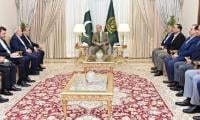
ISLAMABAD: Chairman Senate Standing Committee on Defence Senator Talha Mehmood reiterated on Wednesday that the committee will continue to closely monitor aviation infrastructure, passenger facilitation and security standards to safeguard public interest, improve operational efficiency and ensure compliance with national and international aviation requirements. The committee, led by Senator Mehmood, conducted a comprehensive on-ground inspection of Islamabad International Airport to review infrastructure readiness, passenger facilitation, operational efficiency and security arrangements.
During the visit, detailed briefings were presented by the Pakistan Civil Aviation Authority (PCAA), Pakistan Airports Authority (PAA), Airport Manager Islamabad and Airport Security Force (ASF).
The CAA informed the committee that currently Islamabad International Airport has the capacity to handle nine million passengers annually, which will be increased to 25 million under a comprehensive expansion plan, besides managing cargo operations of up to 100,000 tons per year. The condition and maintenance of runways and taxiways were reviewed, with assurances provided that regular inspections and maintenance protocols were in place to ensure operational safety. Authorities informed the committee that the passenger terminal building was equipped with a seating capacity of 5,343 and 3,250 baggage trolleys.
According to them, there are nine designated prayer areas, 90 sets of toilets comprising 370 units, 17 baby changing rooms, two children play areas and six charging facilities.
The passenger facilitation is further supported by 26 golf carts, including 19 in the departure area and seven in arrivals, along with six passenger bridges, four serving departures and two for arrivals. The committee was also briefed on the terminal’s structural and processing facilities, which include 17 structural levels comprising 11 international and six domestic areas.
The airport has 112 departure lounges, including 80 international and 32 domestic lounges, and 35 briefing counters, with 15 for departures and 20 for arrivals. Immigration processing is supported by 10 counters -- seven international and three domestic. Baggage security includes 12 hold baggage scanning machines, with seven for international and five for domestic use, and eight hand baggage scanning machines -- five international and three domestic. The airport operates 17 baggage belts and has a car parking capacity for 2,200 general vehicles, 150 cargo vehicles and 200 vehicles for functionaries. It was further shared that a separate lounge for Chinese passengers has been established to facilitate diplomatic, business and commercial travel.
On security arrangements, the ASF briefed the committee on existing passenger screening systems, access control mechanisms, and coordination with other security and law enforcement agencies. The ASF authorities reported that so far in January this year alone, recoveries worth Rs10 million were made, total seizures amounted to Rs655 million, 18 kilogrammes of gold recovered, and 1,370 arms seized. The ASF also informed the committee about a major security enhancement project involving the installation of 3,000 new surveillance cameras integrated with artificial intelligence-based monitoring systems to further strengthen airport security.
The committee was also briefed on major development projects at Islamabad International Airport and their respective timelines, which include development of a general aviation area, line maintenance facilities, MRO and allied infrastructure scheduled for completion by June 2028. The rehabilitation of the State Lounge is scheduled for January 2026, while the upgradation of VIP Lounge is planned for February 2026. The replacement of the PYC roofing system in the concourse area of the passenger terminal building is scheduled for June 2026.
Committee chairman Senator Mehmood stressed the importance of maintaining regional air connectivity and directed non-operational routes, including flights to Gilgit and Dera Ismail Khan, should be made operational at least once a week, irrespective of passenger load, in the national interest.