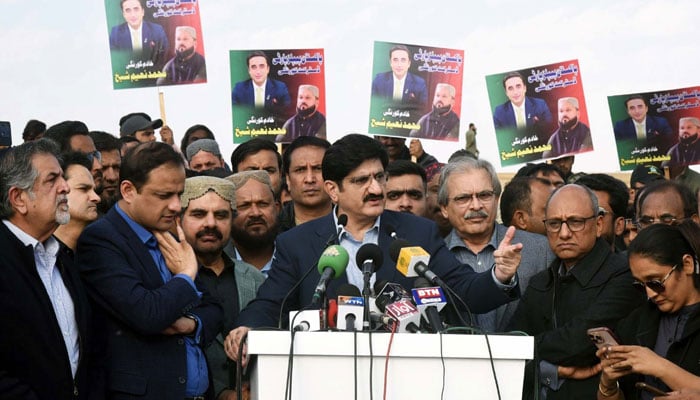
Sindh Chief Minister Syed Murad Ali Shah on Monday inaugurated the Rs6.1 billion Korangi Causeway bridge and reaffirmed his government’s commitment to enhancing Karachi’s infrastructure, while unveiling comprehensive relief, rehabilitation and reconstruction initiatives for those affected by the recent Gul Plaza tragedy.
Speaking to the media at the inauguration ceremony, Shah began by offering prayers for those who lost their lives in the Gul Plaza incident. He said the tragic event has deeply saddened the entire province, and reiterated that no compensation can ever truly compensate for the loss of human life.
Underscoring the importance of the Korangi Causeway project, he said the bridge was a longstanding commitment, especially to the residents and industrial stakeholders of Korangi and the surrounding areas.
“This area used to be cut off whenever it rained, effectively dividing the city into two parts. To address this difficulty, we committed nearly three years ago to building a bridge here.”
He said construction on the bridge commenced around one and a half years ago, but faced delays due to design-related issues. The newly inaugurated bridge is approximately 1.4km long, has six lanes (three on each side) and was built at a cost exceeding Rs6.135 billion, he added.
He also said the project would greatly benefit the Korangi and Landhi industrial areas, daily commuters and nearby facilities, including the Indus Hospital, the SIUT, educational institutions and residential communities. According to him, nearly five million people are expected to use the bridge daily.
The CM said the Korangi Causeway bridge is part of a broader initiative to rehabilitate Karachi’s deteriorating infrastructure. He noted that some ancillary construction work is still ongoing, including efforts to connect Shahrah-e-Bhutto with Korangi Road.
“We aim to open Shahrah-e-Bhutto by Eid or immediately afterwards. Although there has been a delay of about one and a half to two months, the road will be operational from Korangi Road to the M-9 after Eid.”
He was also briefed on the connecting loops and the grade-separated interchange being constructed under the Shaheed Bhutto Expressway project, which will link Korangi, DHA and the Kathore (M-9) Highway.
Two entry and two exit ramps have been built for Korangi and Qayyumabad to ensure conflict-free traffic movement and reduce pressure on inner-city roads. Shah said the Shaheed Bhutto Expressway would serve as Karachi’s economic lifeline and help resolve chronic traffic issues through controlled-access corridors.
Gul Plaza
The CM said that over a week has passed since the Gul Plaza incident, and he has outlined the government’s response in detail. He reiterated that his government had announced compensation of Rs10 million for the family of each deceased on the very first day, acknowledging that no amount can truly compensate for the loss of life.
He recalled that during his address on the floor of the provincial assembly, he had also announced financial assistance for the shopkeepers affected by the incident. “Until the shopkeepers can stand on their own feet again, the Sindh government will not leave them alone,” he said, adding that the cabinet’s approval for these measures would be obtained shortly.
He announced that each affected shopkeeper would receive Rs500,000 as immediate subsistence support to help them manage household expenses, including food, school fees for children and utility bills, over the next two months.
He said the government, in collaboration with the Karachi Chamber of Commerce & Industry (KCCI), has already begun assessing and compensating for business losses. He made the assurance that his government would compensate shopkeepers for the goods and inventory destroyed in the fire, with the KCCI playing a key role in verification and disbursement.
He added that several building owners have voluntarily offered space to temporarily accommodate the displaced shopkeepers. “I am aware of at least two buildings: one with around 500 shops and another with about 350 shops. Additionally, the government’s own parking plazas and other buildings have capacity.”
He said that approximately 1,300 affected shops would be given alternative locations within two months, enabling traders to resume their businesses during that period. Additional payments will be made during this interim phase to help shopkeepers recover their losses, he added. He also announced that through the Sindh Enterprise Development Fund, each affected shopkeeper would be offered an interest-free loan of up to Rs10 million. The government will act as guarantor, cover the interest costs and facilitate the loan process without requiring recommendation letters, he said.
Shah said the Sindh government would reconstruct the Gul Plaza with a revised design to prevent similar tragedies in future. The corridor will be widened where necessary to ensure safe evacuation and movement during emergencies, he added.
“There will be no additional saleable or rentable area in the rebuilt structure,” he clarified, stressing that safety would take precedence over commercial considerations.
He confirmed that an inquiry into the Gul Plaza incident is under way, and that an FIR has already been registered. “More than 80 precious lives were lost. I will not name anyone at this stage, but whoever is found responsible through the inquiry will be punished.” Acknowledging institutional shortcomings, he said that certain lapses on the government’s part have also come to light. He noted that fire safety audits are being conducted across the country, including in Islamabad, but admitted that the overall results so far are “not satisfactory”.
He said he had convened two to three high-level meetings specifically on building fire safety, adding that implementation of the decisions taken has already begun.
“Every building will be audited. We will start with buildings having higher occupancy, particularly commercial centres, as people step out in large numbers for shopping during Ramazan.” He explained that priority would be given to measures that can be completed within a week, including the installation of fire alarms, portable firefighting equipment, clearly identified emergency exits, unobstructed evacuation routes, and backup lighting to guide people in case of power failure.
He said that once a building is surveyed, owners would be given a week to instal essential safety equipment. “We will not act abruptly. A reasonable grace period will be provided to rectify deficiencies, but if there is no compliance at all, the building will be sealed without hesitation.”
He added that within six months, all commercial buildings would be required to fully comply with fire and disaster safety regulations, noting that the legal framework already exists, and that civil defence institutions are mandated to oversee such matters.
Calling for collective responsibility, he urged traders, chambers of commerce, associations, industrialists and building owners to cooperate with the government. “We all must work together to ensure that tragedies like this never happen again.”
He concluded by saying that the Gul Plaza would be reconstructed in consultation with the affected shopkeepers. “The number of shops will remain exactly the same — not a single additional shop will be built,” he said, reaffirming transparency and fairness in the rebuilding process.