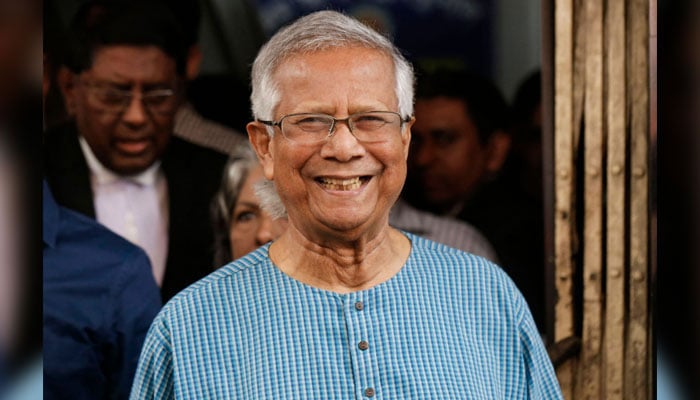
Chief adviser of the Bangladesh interim government Dr Muhammad Yunus assumed office with the mandate of the July 2024 revolution, and he has fulfilled that responsibility successfully.
Senior figures within former fascist ruler Sheikh Hasina’s Awami League had warned that if they were removed from power, hundreds of thousands of their activists would be killed in popular retribution. Yet, in the aftermath of the July Revolution, Dr Yunus’ interim government skillfully prevented any such descent into chaos.
When Dr Yunus took charge, the police force stood accused of crimes against humanity committed under Hasina. Maintaining law and order with a discredited police force and relying largely on army support was undoubtedly a formidable challenge. The army shared in this achievement. By neutralising the influence New Delhi had cultivated within the military through Hasina’s defence adviser, General Tarek Siddique, the army reaffirmed its institutional commitment to Bangladesh.
Meanwhile, the India-backed Awami League’s influence in Bangladesh’s media and cultural spheres continued to shape narratives. Indian and Bangladeshi outlets relentlessly attacked and defamed Dr Yunus. Cultural groups went so far as to label a proven liberal like Yunus an Islamist. Bangladeshi citizens, however, ignored such defamatory campaigns.
Indian media and social media continuously attempted to portray Yunus as a failure. Even though Bangladeshi fact-checkers exposed these falsehoods, the chief adviser’s press wing was forced to step into a fact-checking role itself.
India’s Hindutva government, media and intellectual circles repeatedly tried to manufacture the illusion of an inevitable rise of militant Islamism in Bangladesh. Awami League-aligned media and cultural networks sought to substantiate this false Indian narrative. But Dr Yunus’ strength lies in his communication skills. By consistently and clearly articulating his position, he ensured that the Western world viewed Bangladesh through their own eyes rather than through India’s Islamophobic lens.
Throughout his tenure, Dr Yunus has held regular consultations with major political parties – the BNP, Jamaat and NCP – to keep them engaged and confident. Ongoing, inclusive discussions on state reform have sought to craft a roadmap for establishing Bangladesh’s future democratic institutions on a firm foundation.
India, the Awami League and their cultural allies in Bangladesh have been trying to recast the BNP as an alternative to the Awami League. Consequently, the BNP initially opposed the suspension of Awami League activities, and several BNP leaders began echoing narratives to win over Awami League voters. Disoriented by its loss of shadow-colonial influence, India sought to regain leverage through the BNP. Indian media openly signalled support for BNP leader Tarique Rahman, while New Delhi publicly indicated that it now viewed Bangladesh’s future in Tarique.
Just as the Indian administration from 2009 to August 5, 2024 publicly signalled support for Sheikh Hasina before every election by mobilising its favoured media, civil-military operatives, business interests and civil-society assets in Bangladesh, so too did Modi by sending signals through the Indian High Commission in Dhaka that Delhi now sees Bangladesh’s future in Tarique Rahman.
By reclaiming Bangladesh’s geographic, political and cultural sovereignty, Dr Yunus dismantled India’s shadow-colonial leverage and became, in the Indian strategic imagination, Bangladesh’s most vexing political adversary.
The July uprising erupted against the suffocating weight of Indian overreach that loomed over Bangladesh like the suffocating demon of Arabian Nights. Thus, Yunus, chosen as chief adviser by the mandate of that revolution, and the revolutionary youth of July have become thorns in India’s side. Bangladeshi citizens value sovereignty above their own lives; consequently, Yunus and the July youth are revered as cherished symbols of sovereignty.
The political vehicle of the July youth, the National Citizens’ Party (NCP), initially prepared to contest the upcoming election alone. But the murder of anti-India cultural leader Osman Hadi changed the calculus. Indian media’s celebratory response to the killing, attempts to defame Hadi as a hardline Islamist and similar tendencies among certain domestic circles led the NCP to form a strategic electoral alliance with Jamaat, based on unity over the India question and state reform. This alliance, which combines religious and centrist forces, has emerged as the principal challenger to the BNP in the upcoming election.
Dr Yunus continues to maintain regular and cordial communication with BNP leader Tarique Rahman, Jamaat leader Shafiqur Rahman and NCP leader Nahid Islam in pursuit of a united Bangladesh. Alongside the parliamentary election, a referendum on state reform is also set to take place; Awami League supporters are campaigning for a ‘No’ vote.
Meanwhile, Sheikh Hasina – sentenced to death for crimes against humanity committed during the July Revolution – and her associates, operating from a safe haven in India, are desperately trying to sabotage the election. Through directives and funding, they have orchestrated acts of sabotage inside Bangladesh, including conspiracies and false flag operations to set fire to the homes of minority Hindus.
Whether the sovereign and democratic values reborn through the July Revolution endure into a new Bangladesh, or whether the country collapses back into the darkness of a new fascism under India’s shadow-colonialism, will depend on the choices made by the Bangladeshi people.
In this sense, the February 12 parliamentary election and referendum represent a continuation of the July 2024 uprising; a ballot revolution. Bangladesh’s destiny will be determined by the thoughtful choices of its citizens.
The writer is the editor-in-Chief of E-SouthAsia. He can be reached at: [email protected]