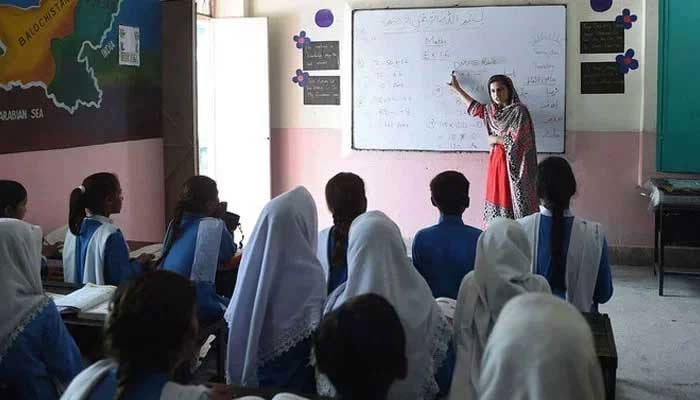
Pakistan’s education crisis doesn’t start in secondary school; it becomes evident there. When students struggle with algebra, scientific reasoning or analytical writing in Grade 9, it prompts one to question the foundations of their learning.
In Pakistan, primary and middle school are often taken for granted, so much so that grade 8 doesn’t exist in many private schools, having morphed into pre-9th. Many private institutions accelerate students through middle school, prioritising early board preparation over skill mastery. This divergence isn’t just a policy inconsistency; it’s an equity fault line. Students with access to private tutoring and academic support manage to keep up, while those without are promoted with fragile foundations. The result is a system that rewards marks over actual learning, allowing educational inequality to solidify long before students reach the high-stakes secondary years.
Nevertheless, the government of Punjab has reintroduced centralised exams for classes 8 and 5 to address declining education standards. Classes 8 and 5 serve as the final checkpoint in the system to identify and address learning gaps before students move on to higher education. However, in Punjab, this role has been overlooked for a long time. Years without standardised middle-school assessments have allowed many students in government schools to advance without mastering the basics, thereby contributing to poor performance in later board exams.
Meanwhile, many private schools in the province have shortened the Class 8 curriculum to a few months to focus on early Grade 9 preparation, highlighting their prioritisation of marks over actual learning as students spend two years going over the same curriculum instead of learning new concepts. The consequences of these choices are already visible in classrooms across Punjab. Teachers at the secondary level frequently report that students enter Grade 9 unable to solve fundamental algebraic problems, analyse texts or explain scientific concepts, even after passing earlier grades.
These gaps are not due to individual failure but stem from a system that prioritises exam achievement over learning, either by assessing learning too late or by skipping it altogether. This breakdown at the transition point has renewed focus on Classes 5 and 8 as a possible corrective stage. Moreover, the lack of a clear, learning-centred assessment system means that students from low-income families, who lack access to private tutoring or academic support, are pushed forward without the chance to solidify core skills. This deepens learning poverty and broadens educational inequality.
For these reasons, reintroducing the Class 8 and 5 board examinations in Punjab is a positive step. When thoughtfully implemented, it can serve as a vital transitional tool between education levels by testing students’ foundational skills. Standardised assessment at this stage can strengthen basic concepts and identify learning gaps early. When used as diagnostic tools rather than punitive measures, the Class 8 and 5 board exams can ensure that students gain the essential school knowledge that is often neglected.
However, the enforcement of the Class 8 board examination is riddled with inconsistencies that risk doing more harm than good. The government of Punjab announced the examination in August, after the school term had already begun, disrupting students’ and teachers’ learning pace and planning and encouraging rote-learning rather than conceptual understanding. Implementing the examination in the following academic year would have given schools and students adequate time to adjust, fostering meaningful learning rather than a narrow focus on marks.
At the same time, this critical transitional bridge is being bypassed by a large segment of the private education sector. Private schools are exempt from PECTA’s centralised Class 8 examination and may rely on internal assessments. Thus, this selective enforcement is not merely an equity concern; it exposes a deeper structural flaw in the assessment system.
Private school students may appear to progress faster on paper. Still, comparisons of public and private school learning outcomes do not show a significant difference between the two, indicating that allocating additional time and resources to Grade 9 often comes at the expense of basic knowledge. As a result, students rely more on rote learning rather than on clarifying core concepts. In the absence of a standardised transition point, student readiness remains inconsistent and often superficial.
More importantly, this lack of regulation deepens inequality: students in government schools are held to an external standard, while private school students advance through internal benchmarks that may prioritise speed over substance. If Class 8 is to function as a genuine bridge between middle and secondary education, that bridge must be uniform across all systems, not selective and not designed to favour acceleration over learning. In this way, academic acceleration in private schools does not eliminate learning poverty; it merely delays its discovery.
Thus, while recent efforts by national authorities signal an intent to align Grade 5 and Grade 8 assessments across Pakistan, alignment without enforcement remains ineffective. A transition cannot function if participation is optional or flexible. When the examination is compulsory in some parts of the system and optional in others, the assessment framework loses coherence. For the examination to genuinely serve as a bridge between education, it must be governed by clear, enforceable rules that apply uniformly across public, private, and non-formal schools.
Without effective enforcement, the idea of a unified assessment system quickly collapses. When private schools advance students into ‘Pre-9’ classes while government schools complete a standardised eighth-grade cycle, students are no longer evaluated at the same learning stage. Any comparison, whether through national assessments, provincial reports, or overall benchmarks, becomes inherently unreliable. Government students are assessed after completing a specific academic year, whereas private students are evaluated along an accelerated, inconsistent path. In this situation, national assessments may produce data, but not fair comparisons. Instead of decreasing learning poverty and inequality, the system risks reinforcing them by allowing different standards of readiness to exist under the guise of alignment.
At its core, strengthening Class 8 involves restoring credibility to the transition from middle to secondary education. Making attendance at the Class 8 board exam a mandatory prerequisite for moving on to Class 9 would send a clear signal that middle school learning is as essential as secondary school and that advancement depends on demonstrated learning rather than speed or institutional privilege.
When combined with aligned national assessments and meaningful remedial support, this strategy can reduce unchecked academic acceleration, enhance comparability across public and private systems and address learning gaps before they become irreversible. If Pakistan is to tackle learning poverty and create equitable pathways to secondary education, Class 8 should be seen not as a mere formality to bypass but as a crucial bridge where learning is verified and futures are justly determined.
The writers are members of the Systems Research Group at the Sustainable Development Policy Institute in Islamabad, Pakistan. The views they share are their own and do not necessarily represent the organisation’s official position. They can be reached at: [email protected] and [email protected]