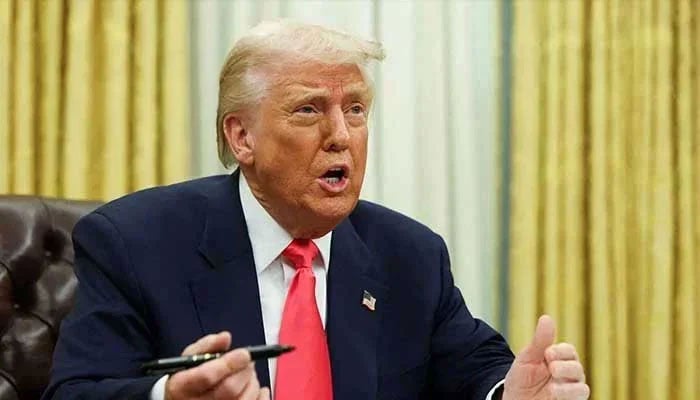
Riddled with irony, President Trump’s New Year’s promise of peace reads like an oxymoron. This year (2026) has brought forth darker war clouds under the guise of peace, as the US under Trump continues to flex its military muscle through coercion while branding the outcome as stability.
Trump’s vision of peace appears to encourage escalation, reviving imperialism at a moment when America’s superpower status is clearly contested by Russia and China.
For much of the post–cold war era, force worked in the favour of the US because it was backed by overwhelming authority. It was an era marked by weak adversaries and strong alliances, when American intervention carried systemic legitimacy. That order has now eroded. The US remains powerful, but it no longer operates in a vacuum. China is an entrenched global actor, Russia an enduring disruptor and regional powers increasingly autonomous. Yet Trump’s strategy still behaves as if the unipolar moment never ended.
Trump’s invocation of the Monroe Doctrine, which he rebranded as the ‘Donroe Doctrine’ following the capture of Venezuelan President Nicolas Maduro on January 3, quintessentially explains this shift. The return of interventionism in Latin America, as seen in Venezuela, signals a revival of hemispheric dominance and has left governments across the region little time to recalibrate. US allies have responded positively, but the three biggest countries, Mexico, Brazil and Colombia, have all condemned the actions of the US government. Trump’s remarks on Cuba and Mexico have already alarmed South American governments.
Ironically, US policy in the Middle East departs even from the spirit of the Monroe Doctrine. In Syria, retaliatory strikes have expanded into a sustained air campaign, with over a hundred targets hit since December, blurring the line between response and occupation. In Yemen, the illusion of a stabilising force has collapsed entirely. A war launched by American partners to restore order has fractured into rivalry between those very allies. Saudi Arabia and the UAE, once presented as a unified front, now back competing factions.
Trump’s escalatory rhetoric towards Iran, following US strikes on three nuclear facilities in June 2025 and renewed threats the past week, is equally troublesome and can pose serious risks to world peace, as the US openly weighed military, cyber and economic action in response to domestic unrest in Iran. Yet even within Washington, officials acknowledged the risks: intervention could provoke broader unrest in the Middle East if Tehran retaliated.
Trump’s neo-imperial adventures clearly overlook an underestimated foe: China. His strategy fails to fully account for China’s emerging dominance in the Far East and the South China Sea, or for Beijing’s capacity for patience rather than provocation. China has shown immense resilience in recent years, particularly under pressure from Trump and his aides. It did not retreat under tariffs; it escalated them, while deploying its own punitive measures on critical elements where it holds a structural advantage.
Beijing’s restraint should not be mistaken for passivity. The November 2025 trade deal secured temporary concessions from Beijing, but only after China demonstrated its willingness to absorb punishment and retaliate in kind, a dynamic that constrains rather than confirms American dominance. By normalising coercion as a tool of ‘peace’, Washington weakens the very norms it invokes on sovereignty, creating strategic ambiguity that benefits long-term Chinese calculations rather than deterring them. Across the system, states hedge rather than choose sides, exploiting cracks in an order that no longer commands automatic obedience.
Even regions long treated as strategically settled are now being reopened by this logic. Greenland, governed by Denmark but hosting the US under a 1951 defence agreement that already grants Washington extensive military access, was never a contested territory within the Western alliance. Under Trump, it has been recast as an asset to be acquired outright, discussed openly in terms of minerals, Arctic shipping routes, and strategic positioning. Sovereignty of other countries under Trump’s new doctrine is no longer respected as a norm but treated as negotiable when power permits. Competing visions persist not because restraint has prevailed, but because no single power can impose its will outright. The world is no longer organised around one uncontested centre of gravity. Power today is fragmented and contested, and no state can impose order by force alone.
What links Venezuela, Mexico, Greenland, Yemen, Iran is a shared strategic assumption about power. Trump’s worldview treats power as cumulative and obedience as stabilising. One year into his term, the world is confronting the reality that his ‘America First’ slogan was never rhetorical; it was literal. Influence is enforced through leverage rather than built through consent. Sovereignty is treated as conditional, respected only when it serves US interests. This logic once functioned when American power was unrivalled and credible alternatives were weak. Today, it collides with a world that pushes back.
This is not an argument against American power, nor a plea for passivity. It is an argument for strategic realism. In a contested global order, peace cannot be coerced into existence; it rests on legitimacy, alliance cohesion, economic leverage, and restraint, tools that recognise limits as much as strength.
Trump’s peace is not insincere, but it is outdated. It belongs to a world where force still organised outcomes and rivals lacked credible alternatives. In an era shaped by an assertive China, an emboldened Russia and increasingly autonomous regions, that logic no longer holds. The danger is not that the US is acting forcefully. The danger lies in calling it peace while the world calls it something else.
The writer is an economist and educationist.