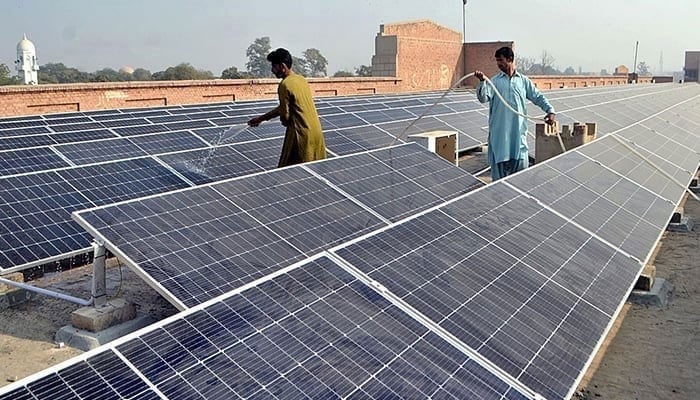
In recent years, Pakistan has experienced an unprecedented surge in solar adoption, with rooftop solar power emerging as one of the country’s fastest-growing energy sources, accounting for over one-third of utility-supplied electricity by 2025.
The data on solar uptake indicates that it has reached approximately 22 GW over the last 18 months, predominantly driven by domestic and Small and Medium Enterprises (SMEs). This solar boom is not merely a response to climate commitments but also an economic shift towards a sustainable, reliable, and affordable clean-energy transition. Recently, Nepra introduced the Prosumer Regulations (2025), which aim at a decisive shift in how distributed solar will interact with the national grid, raising critical questions about policy innovation and the long-term sustainability of the sector.
The heart of this transition lies in a gradual step towards a Competitive Trading Bilateral Contract Market (CTBCM), where electricity is expected to be traded through bilateral contracts rather than a single-buyer model. The CTBCM framework provides a critical opportunity to lay the foundation for Green Bilateral Contracts (GBC) between renewable energy producers and end consumers. These contracts allow domestic consumers and SME to procure electricity directly from solar, wind or hybrid renewable energy plants.
The CTBCM framework, if aligned with a clear regulatory pathway for GBC, could provide a foundational mechanism for addressing upcoming European Union’s Carbon Border Adjustment Mechanism (CBAM) related risks. By enabling contractual linkages between renewable energy generators and industrial consumers, CTBCM could support the development of auditable green electricity supply chains.
This further enables the organic growth of distributed solar integration, particularly rooftop solar systems installed by end consumers, which have had a significant impact on peak demand, recurring system losses and the support for decarbonisation. However, the upcoming prosumer regulations appear as an opposing force by narrowing the economic and regulatory framework for grid-connected solar consumers.
The existing agreements are partially protected, but no clear long-term transition roadmap or compensation mechanism is provided, which contradicts the objectives of promoting renewable energy. The most significant challenge introduced by prosumer regulation is the replacement of net metering with the net billing regime, in which the electricity exported by prosumers is compensated at the National Average Energy Purchase Price (NAEPP). In Pakistan, this price reflects a marginal fuel cost of approximately Rs9 per unit, while consumers continue to purchase power at around Rs33 per unit.
This critical missing element is the absence of price signals that reflect the location and temporal reflections. Distributed solar generation enables the system-level benefits that cannot be represented under NAEPP compensation. This location-based approach will provide a more accurate picture of transmission and distribution losses, grid reinforcement, voltage stability and reduced congestion during peak hours. Ignoring these values not only undervalues distributed renewables but also distorts investment decisions across the grid. Therefore, this structural misalignment imposes economic constraints on grid-connected solar consumers and continuously discourages them from connecting to the national grid in the future, particularly for the commercial and SME sectors that generate surplus power during the daytime.
Rather than encouraging new consumers to shape their future under GBC, the regulations unintentionally accelerate grid demand defections. Facing a less competitive environment, low export compensation, and regulatory uncertainty, consumers are increasingly interested in Battery Energy Storage Systems (BESS) or moving toward partial or complete off-grid solutions. Despite global advancements, regulations have neglected hybrid systems that combine solar and BESS. Internationally, BESS-enabled prosumers are increasingly recognised as grid assets capable of providing peak shaving, backup power, and ancillary services. In Pakistan, where evening peak demand and grid instability persist as significant concerns, consumers equipped with batteries could help support the grid during critical hours.
The major outcomes of the regulations fundamentally discourage GBC by restricting prosumers from selling electricity to any third party other than the licensee using distribution interconnection facilities, thereby reinforcing the monopoly of DISCOs and creating hurdles to collective self-consumption models. The regulatory framework disproportionately protects DISCOs’ short-term revenue without overseeing long-term system efficiency and stability. The ‘utility death spiral’ is mitigated by discouraging prosumers, rather than by shifting to active market participants who can contribute to grid services, balancing and capacity management.
If robust measures are not implemented to address this uncertainty and to avoid the improper injection of surplus renewable energy into the grid at reduced rates, even when nearby commercial demand is present, this model disrupts the local demand-supply balance. Technical restrictions on further participation, up to the 80 per cent transformer capacity threshold for distributed generation, without dynamic hosting capacity analysis or real-time load forecasting for the consumer’s vicinity, also reflect a traditional grid management approach rather than adapting to modern, robust grid upgrades.
International experience is a useful example of transitioning to renewable resources, beginning with pilot programmes, sandbox regulations and regional testing. These mechanisms enable regulators to evaluate new models, such as peer-to-peer trading, community solar and Virtual Power Plants (VPPs), while maintaining system reliability. The most important concern is to provide incentives to end consumers who remain connected to the grid, rather than to those who seek to disconnect completely. This will substantially increase solar rooftop adoption. Pakistan’s regulatory framework currently lacks such experimental space and imposes uniform restrictions that may suffocate innovations.
The regulatory uncertainty surrounding export tariff revision through the net billing mechanism also has macroeconomic consequences. Financial institutions currently rely on stable cash-flow projections to finance renewable energy assets. Frequent or variable tariff adjustments will increase multiple risk factors, including the rise in Capital Expenditure (CAPEX) and the elimination of financing for distributed solar projects. This excessively affects SME and mid-scale commercial users, slowing formal investment while encouraging informal and unregulated deployment.
Institutionally, the current approach places excessive operational responsibility on DISCOs without corresponding accountability mechanisms. DISCOs are empowered to reject applications, disconnect systems and enforce transformer thresholds, without a parallel requirement for transparency, independent audits or performance benchmarks. In the absence of such checks, regulatory disproportionateness undermines trust and weakens compliance.
From a broader policy perspective, the Prosumer Regulations, 2025 appear misaligned with Pakistan’s Nationally Determined Contributions (NDCs) and Alternative & Renewable Energy (ARE) Policy, both of which emphasise scaling renewable energy and improving energy efficiency. The new solar import projections may accelerate unregulated and inefficient deployment rather than enabling an orderly transition.
To realign the solar boom with the clean energy transition, several regulatory recalibrations are needed. First, Nepra should consider permitting pilot-scale GBC, particularly within industrial clusters and commercial zones, subject to defined technical and safety standards. This initiative can be supported by VPP and export compensation mechanisms, which not only reduce marginal fuel costs but also mitigate transmission losses, capacity deferral benefits and climate vulnerabilities. This scheme will also generate revenue for DISCOs while diversifying their business as aggregators, enabling them to actively bundle hundreds of domestic consumers or SMEs into a VPP and thereby sell these benefits to the grid.
Second, the regulations ensure validation checks for monitoring the unlawful extension of distributed generation, which can be improved by analysing the consumer area’s vicinity through accurate load forecasting to efficiently accommodate more prosumers. Finally, another overlooked prospect is data governance and digitalisation. In that case, Advanced Metering Infrastructure (AMI) provides real-time monitoring of consumption data, feeder loading and grid constraints, thereby enabling effective distribution-level grid management.
The solar boom is already underway and will continue regardless of policy friction. The question is whether this transition will occur with the grid, through transparent green bilateral markets, or against the grid, through fragmented and inefficient defection.
The Prosumer Regulations, 2025, in their current form, are pushing the country towards being less competitive in the global market. A forward-looking regulatory framework that embraces distributed renewables as market participants rather than revenue threats is essential for a stable, affordable and low-carbon electricity future.
The writer is an energy policy analyst and serves as a research associate at the Sustainable Development Policy Institute (SDPI). He can be reached at: [email protected]