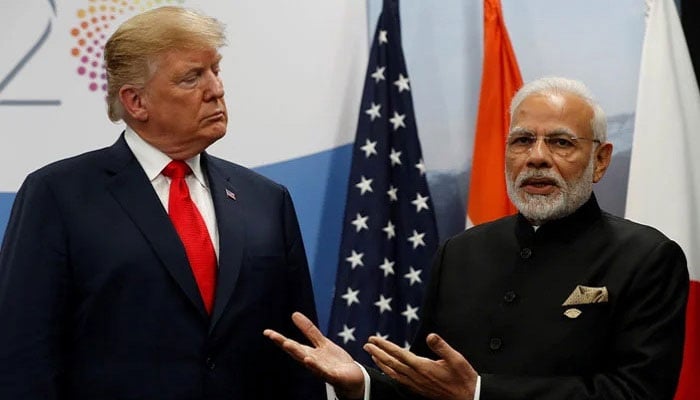
On August 6, 2025, US President Donald Trump signed an executive order imposing an additional 25 per cent ad valorem tariff on all Indian imports into the US, raising the overall tariffs to 50 per cent.
The White House’s official justification was India’s ongoing purchases of both direct and indirect Russian oil, which Washington argues undermines US-led efforts to isolate Moscow over its conflict with Ukraine.
While official justification has targeted the oil trade, the move seems driven by a broader, more punitive aim of pressuring India. The real US concern is not just India’s Russian oil imports, but also its growing audacity in pursuing foreign policy choices, especially those that challenge US dominance and favour a multipolar world. This indicates that India’s ‘multi-alignment’ strategy is now facing a major stress test.
While it seems ideal to not put all eggs in one basket, the way India has pursued this strategy in today’s sharply divided geopolitical climate has made it increasingly difficult for New Delhi to sustain. Trump’s recent tariffs and threat of more tariffs, as well as India's response, is more proof of such an environment.
So far, New Delhi has avoided direct countermeasures like reciprocal tariffs. Rather, soon after the additional tariffs were imposed, India rallied the support of countries equally targeted by Washington’s trade policies. This has brought renewed diplomatic energy to forums such as the BRICS and the SCO.
BRICS, for instance, is seeing a new momentum. Brazilian President Luiz Inacio Lula da Silva proposed a BRICS-level discussion to counter Trump’s tariffs. This is because both Brazil and India face 50 per cent tariffs from Washington. President Lula and PM Modi’s phone call, as well as the confirmed state-level visit of President Lula to India in early 2026, indicate convergence on subjects beyond trade. This hints at BRICS' potential transformation from an economic bloc into a political counterweight to the West.
Analysts have warned that penalising the ‘least anti-US’ BRICS member could prompt India to be even less cautious in its engagement with the bloc and advancing its de-dollarisation agenda. This may also push India closer to China despite longstanding Sino-Indian tensions, they argue.
In light of this, Indian Prime Minister Narendra Modi’s first visit to China in seven years to attend the SCO meeting is widely read as a signal to Washington and as an expression of impudence toward its strategic partner. China, too, has endorsed India’s position, claiming that “India’s sovereignty is non-negotiable” and its foreign policy choices cannot be “manipulated” by other countries.
New Delhi and Beijing’s rapprochement might provide a temporary tactical respite for India; however, it remains unlikely that India and China can find common ground at the SCO forum. India remains opposed to China’s key regional interest such as the BRI, CPEC, and India-backed proxies. This indicates that moving toward China will not fill the foreign policy gaps created by India’s ‘multi-alignment policy.’
Lastly, despite the US's strict measures, India is going about business as usual with Russia. Amid the chaos, Indian National Security Adviser Ajit Doval met with Russian President Vladimir Putin, and External Affairs Minister Jaishankar’s upcoming Moscow visit underscores New Delhi’s determination to disregard American measures and reinforce ties with Russia.
Rather, the two sides reportedly are engaged in talks on Russian oil, the S-400 missile defence system and the upcoming Modi-Putin Summit. This indicates a growing Indo-Russia convergence. While Russia can provide political cover and energy resources, it cannot match the US in terms of market access, advanced technology, or global clout. This would make it challenging for India to juggle the ties between the US and Russia and ignore Washington’s measures so easily.
This is because both Washington and New Delhi are relevant in others’ capitals due to Washington’s assigned role for India as a counterweight to China, and India’s need for advanced defence technologies from the US and the Western partners. However, the recent episode could leave lasting scars and feed into US scepticism about New Delhi as a reliable partner.
For Washington, mistrust towards India deepened after the foiled plot to assassinate a Sikh separatist leader on US soil was linked to Indian operatives. More recently, New Delhi’s constant refusal of Trump’s role in the ceasefire between India and Pakistan in the May 2025 conflict has agitated President Trump. For India, President Trump’s offer to resolve the Jammu & Kashmir dispute and the revival of US-Pakistan relations have had an unsettling effect in New Delhi.
History suggests that India and the US have weathered such storms, but this one could be different due to India’s growing defiance and inflexibility. While it remains unclear if India can garner enough support for its agenda at the SCO forum, BRICS could be a potential rallying point for India, not because it might offer an alternative to US partnership, but because it provides comparatively more diplomatic leverage due to convergence with Russia and Brazil.
In the near term, the Indo-US partnership may not collapse due to the large stakes, but it will operate under an additional layer of mistrust. The memory of tariffs and threats may fade, but India’s alignment with the anti-US bloc may continue to demonstrate that it is an unreliable partner.
The writer is a research analyst in emerging technologies and international security based in the US. She tweets/posts @MaheenShafeeq