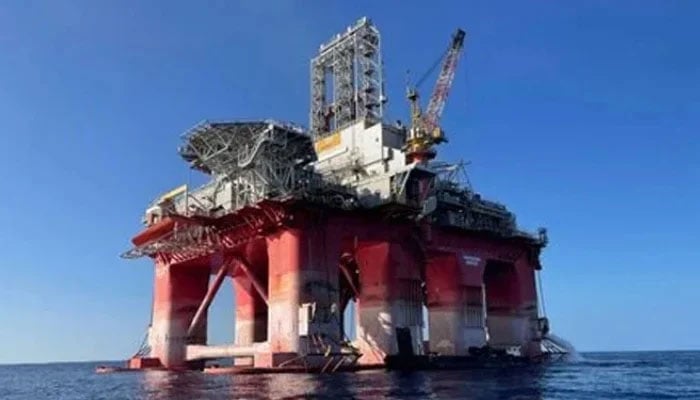
Pakistan’s oil and gas potential remains vast and underexplored, with the recently offered offshore exploration blocks in the Makran and Indus basins standing out as some of the most exciting opportunities in years.
If international companies commit to these projects, the resulting foreign direct investments could be transformative, not only for investors but for Pakistan’s energy security and economy. With the right approach, these projects could catalyse a new era of upstream growth.
The upstream sector remains a cornerstone of Pakistan’s energy economy. Domestic natural gas production stands at around 2.6-2.7 billion standard cubic feet per day (mmscfd), contributing roughly 30 per cent of the country’s total energy supply. Any decline in this output has immediate consequences for industry, power generation and households. Production has already been on a clear downward trend over the last five years, reflecting both natural decline and insufficient new exploration activity.
The sector is under financial strain, with receivables owed to exploration and production (E&P) companies now estimated at over $600 million. Addressing these pressures is essential to sustaining production and unlocking the next wave of investment.
Foreign direct investment (FDI) is not just desirable for Pakistan; it is essential. Large-scale exploration and production projects require capital, advanced technology and operational expertise that cannot be mobilised locally at the required scale. International companies bring these capabilities, but they also need confidence in a stable and predictable business environment. That environment is underpinned by long-term Petroleum Concession Agreements and Gas Pricing Agreements, which are intended to provide certainty on costs, revenues and returns.
In recent years, however, investor confidence has been tested by delayed payments, shifting fiscal terms and unilateral policy changes. Recent IMF assessments have also pointed out governance gaps, pricing distortions and the need for more predictable sector policies – all areas directly linked to investor confidence in oil and gas.
According to State Bank data, net FDI in oil and gas exploration averaged just $6 million to $14 million as of June 2025, far below the levels needed to drive meaningful new activity. The departure of major players such as BP, BHP, Tullow, OMV, ENI over the past two decades highlights this decline. In the downstream sector, global companies such as Shell and TotalEnergies have exited Pakistan as part of broader global portfolio rationalisation.
While these decisions were framed as strategic in official disclosures, they occurred against a backdrop of persistent macroeconomic volatility, currency pressures, regulatory uncertainty, and unresolved circular-debt constraints in the energy sector.
Some exits were due to global portfolio adjustments or disappointing exploration results but the overall trend reflects the need for a stronger and more consistent partnership between the government and industry.
The Special Investment Facilitation Council (SIFC), as a one-window platform for investors, has significant potential to create an enabling environment to attract the required level of FDI, especially in energy. Strengthening its mandate, timelines and coordination could significantly improve investor outcomes.
Two issues stand out. Payment delays by state-nominated buyers, particularly SSGC and SNGPL, have become entrenched. These arrears, rooted in structural challenges such as circular debt, unrecovered subsidies and delayed tariff adjustments, disrupt operations, stall projects and ultimately impact the government’s own revenues when companies struggle to meet statutory royalty and training fund obligations.
Contractual stability is equally important. Retroactive policy changes, such as the unilateral insertion of the Windfall Levy on Oil into already executed agreements, risk deterring future investment and exposing the state to costly disputes. Global investors accept exploration risk, but they need assurance that fiscal and contractual terms will remain consistent once agreed.
These challenges, however, are not insurmountable. Pakistan has the resource base to compete with other emerging exploration frontiers, particularly in Balochistan, Khyber Pakhtunkhwa and the offshore basins. Many companies are prepared to invest in complex and high-risk environments when the resource potential justifies the risk, provided there is credible assurance that agreements will be honoured and payments made on time.
If the government works with E&P companies to resolve payment delays, uphold contractual sanctity and offer competitive incentives, especially for offshore and frontier onshore areas, Pakistan can position itself as a serious contender for upstream capital.
The recent push for offshore exploration is a step in the right direction, but it must be accompanied by a stable, predictable framework that inspires investor confidence. Stability and good faith engagement are not optional extras; they are the foundation of a thriving energy market.
With a cooperative approach, Pakistan can ensure that its new offshore opportunities become a success story for both the country and its investors.
The writer is a former adviser to the United Nations.