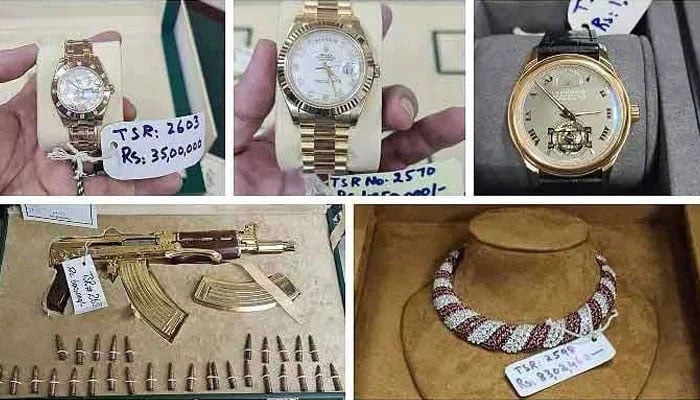
At its core, the Toshakhana 2 judgment issued two weeks ago does not concern hidden offshore accounts or kickbacks. It revolves around something far more mundane: valuation.
A gift was declared. A valuation was assigned through the state’s official Toshakhana mechanism. Payment was made. The state accepted it. Years later, that valuation is deemed insufficient, and the difference is transformed into a criminal conviction carrying a 17-year prison sentence for both an ex-prime minister and his wife, a person who may have signed off on several valuations based on expert opinion regarding billions of rupees in spending.
If a pricing disagreement can be converted into criminality, then no administrative decision is ever final and no citizen safe from hindsight prosecution. Valuation is not a black-and-white fact. It is an exercise of judgment. Two competent appraisers examining the same object may reach different conclusions. That is why, under the Qanun-e-Shahadat Order 1984, valuation disputes are treated as civil or administrative matters.
Expert opinion under the order assists the court; it does not, on its own, constitute proof of a crime. And in criminal law, the prosecution must prove guilt beyond reasonable doubt, a principle repeatedly upheld by the Supreme Court of Pakistan. The idea that a court can convict on something less is antithetical to criminal jurisprudence and to the constitution itself.
What makes this case legally uneasy is not just the floating valuation but the prosecution’s own structure. The individual who actually carried out the valuation was pardoned by the state and converted into a witness. Criminal liability does not reverse flow that way. Responsibility follows action. If undervaluation were truly a crime, the person who valued the item would be the central figure in the case, not a witness and certainly not someone immune from prosecution.
The prosecution’s narrative depends heavily on a claim that the appraiser was pressured to undervalue the gift. But criminal convictions are not built on narratives. They are built on evidence. And in this instance, there are no records, no contemporary complaints, no emails, no documents from the time indicating pressure or inducement. The sole allegation arises long after the valuation was accepted and after a pardon was granted. Under our law, suspicion and accusation are not substitutes for proof. Where doubt exists, it must benefit the accused; that is rule of law.
Another fundamental principle of our criminal justice system is that a person cannot be convicted solely on the basis of another person’s statement, especially where that other person is an accused or an approver. Article 43 of the Qanun-e-Shahadat Order specifically treats confessions by a co-accused as circumstantial evidence and insists on independent corroboration before conviction can follow. Simply put, one accused’s word cannot convict another without other reliable evidence pointing in the same direction. Pakistani courts have repeatedly reiterated this principle.
Even the judgment itself acknowledges a critical point that should have ended the criminal aspect of the case. The Toshakhana rules themselves do not prescribe criminal punishment for breaches. They set out administrative duties and penalties. When a legal scheme provides administrative remedies, courts lack the authority to impose penal consequences. If the state believed a valuation was flawed, the lawful remedy was reassessment or recovery. Governments reassess taxes and duties every day. They do not lock people up over differences of opinion about pricing.
The idea of ‘loss to the state’ in the judgment also collapses under scrutiny. Luxury items do not trade on fixed price lists. Their worth shifts with market demand and timing. Loss in criminal law must be real, demonstrable and precise. Courts have stressed that evidence must form a seamless chain linking the accused to the offence.
Process matters as much as substance. Fair trial is not about form alone. It is also about a genuine opportunity to contest evidence, to cross-examine witnesses, to present one’s case without undue restraint. Even a correct conclusion cannot survive the stain of a flawed process.
There is also a constitutional concern regarding the risk of multiple prosecutions. Article 13 of the constitution provides that no person shall be prosecuted or punished for the same offence more than once. This is the second Toshakhana conviction based on overlapping facts and the same period of conduct. The constitution protects against double jeopardy and abuse of process. The state is not permitted to prosecute the same conduct solely to increase punishment.
Perhaps for the first time in Pakistan’s history, a politician is being imprisoned for actually depositing an amount with the state. But perhaps what is most shocking is that the state is prosecuting a former prime minister for a little over three crores and 80 lakh rupees, when only the Prime Minister’s House budget for this year is a little under 86 crores rupees.
Context matters. This conviction appears amid a pattern of rapid prosecutions, repeated convictions and procedural shortcuts involving the same political figure. Courts do not and should not decide politics, but they cannot pretend patterns do not exist. Justice must not only be done. It must also be seen to be done.
Seventeen years for a valuation dispute is disproportionate by any standard of criminal justice. Punishment should reflect culpability. Here it reflects something else entirely. The damage extends far beyond a single case. It weakens the very idea that law restrains power rather than serves it.
The writer is a barrister.