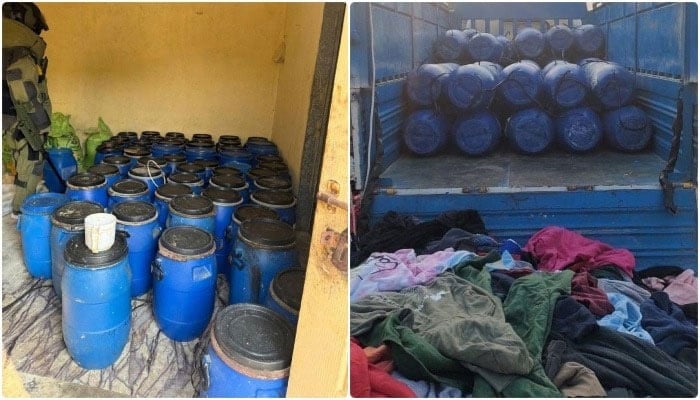
The recovery of more than two tonnes of explosives in Karachi at the beginning of the week is a sobering reminder of how close Pakistan’s largest city came to another mass-casualty attack. That the Counter Terrorism Department acted in time, arresting three suspects and dismantling a plot of such scale, deserves unambiguous recognition. Intelligence-led operations remain the most effective defence against networks that thrive on secrecy and surprise, and this operation highlights the value of sustained vigilance. At the same time, the details revealed by investigators are deeply disturbing. The alleged link of the arrested militants to the Balochistan Liberation Army, the consolidation of explosives at a single location and indications that planning was conducted abroad point to a sophisticated and well-resourced network. That such a group would contemplate an attack of this magnitude in Karachi exposes not only its operational reach but also its utter disregard for civilian life.
It is important to draw a clear distinction that is too often deliberately blurred: the legitimate political and economic grievances of the Baloch people have nothing to do with terrorism. Armed groups that target civilians and public infrastructure do not advance any just cause. Instead, they instrumentalise genuine discontent to pursue violent agendas that ultimately harm the very communities they claim to represent and hand propaganda victories to Pakistan’s adversaries. The Karachi operation also fits into a wider and more troubling pattern. Since the Afghan Taliban returned to power in Kabul, Pakistan has seen a marked uptick in terrorist incidents. Groups such as the TTP and the BLA have found space to regroup, recruit and plan. Islamabad has repeatedly raised concerns that these outfits operate from Afghan territory with impunity, a claim that has been reinforced by international assessments. The head of the UN Security Council’s Daesh and Al-Qaeda Sanctions Committee has warned that Afghan soil is being used to stage attacks and that the TTP poses a serious threat to regional security. Yet denial has remained the default response from Kabul. This posture is neither credible nor sustainable. Afghanistan’s re-emergence as a sanctuary for multiple militant groups has consequences far beyond Pakistan’s borders, as recent attacks in the wider region demonstrate. It is little surprise that countries including Pakistan, China, Iran and Russia have jointly expressed alarm over the presence of transnational terrorist organisations operating from Afghanistan.
Domestic research institutions have also raised concerns. Recent reports by the Pakistan Institute for Conflict and Security Studies and the Centre for Research and Security Studies document a sharp rise in terror incidents, underscoring that this is not a matter of isolated plots but a systemic security challenge. Pakistan’s security forces will, and must, continue to disrupt and dismantle such networks at home. But there are limits to what can be achieved through kinetic and intelligence measures alone. The international community cannot afford complacency. Diplomatic and economic leverage must be used to press the Afghan Taliban to take verifiable action against militant groups operating from their territory. Equally, states accused of sponsoring or facilitating proxy violence must be held to account through sustained international scrutiny. The Karachi plot was thwarted, but the threat it represents remains real. Preventing the next attempt will require not only professional counterterrorism at home but also a coordinated regional and international effort to ensure that no country is allowed to export violence with impunity.