The unfolding arc of the higher military-diplomatic engagements comes at a moment when Pakistan’s external environment is both unusually fluid and unusually unforgiving.
From a tense eastern frontier to an unstable western neighbourhood, and amid a rapidly fragmenting global order, the country’s strategic bandwidth is under relentless strain. Yet paradoxically, just as Pakistan appears to be clawing its way back into serious geopolitical relevance, a familiar and deeply troubling pattern has re-emerged at home.
Each overseas visit by the country’s military leadership – particularly those carrying diplomatic or strategic weight – is now almost predictably followed by a surge of online insinuation, mockery, selective outrage and speculative ‘analysis’. This digital barrage creates a cumulative impression that Pakistan’s military diplomacy is either illegitimate, overly personalised, or suspect. The danger here is not merely reputational. At a critical juncture, such narratives risk eroding domestic confidence and diluting external credibility.
It is increasingly difficult to dismiss this pattern as coincidence.
The irony is stark. The May 2025 confrontation with India marked a decisive moment in Pakistan’s contemporary security calculus. Beyond battlefield outcomes, the episode showed restored deterrence credibility, disciplined command-and-control and an ability to manage escalation without strategic drift. It was a rare instance in recent memory where military preparedness, political signalling, diplomatic engagement and public unity aligned to Pakistan’s advantage.
In international capitals, the shift was palpable. Conversations that had long revolved around crisis management quietly broadened into discussions of regional stability and strategic balance. Pakistan was no longer being treated as a peripheral problem to be managed, but once again as a consequential actor whose choices mattered. Even Washington – long ambivalent and often transactional – appeared to recalibrate its posture, engaging Pakistan with renewed seriousness rather than habitual suspicion.
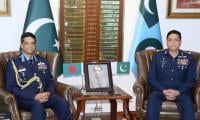
It is against this backdrop that the military leadership’s recent visit to Libya assumes particular significance.
Libya, fractured since the 2011 ouster of Muammar Gaddafi, remains effectively divided between rival power centres. The eastern half, under the control of Khalifa Haftar’s Libyan National Army, has long been a focal point for competing regional and global interests. The US, Egypt, France, Italy, Russia, Turkiye and others have all shaped the Libyan theatre to suit their own strategic calculations. Pakistan, in this context, is hardly an outlier. It is simply the latest state seeking to explore defence cooperation, influence pathways, and attain strategic advantages in an increasingly contested region.
Yet a single photograph from the visit – circulated and amplified by certain journalists and commentators – triggered a predictable cycle of vlogs, tweets, breathless commentary, and speculative analysis. Within hours, an entire narrative ecosystem emerged, detached from facts but rich in insinuation. That some of the loudest voices belonged to individuals with long-standing access, institutional familiarity, or presumed proximity to power made the episode all the more disturbing.
To be clear: this is not an argument for silencing debate or insulating authority from scrutiny. Robust societies require informed criticism and accountable institutions benefit from oversight. But there is a profound difference between scrutiny that strengthens statecraft and performative outrage that weakens it. What we are witnessing today is not investigative journalism. At best, it is digital signalling; at worst, deliberate distortion.
The more uncomfortable question is not merely who is speaking, but why, and for whom.
Social media has become the most efficient vehicle for disseminating speculation, half-truths and propaganda. Algorithms reward provocation, not verification. Negative narratives travel faster, wider and deeper than nuanced analysis ever can. In Pakistan’s case, this structural bias is compounded by the absence of meaningful regulatory frameworks that require platforms to monitor, flag or remove demonstrably false or misleading content.
In such an accountability vacuum, personal rivalries, stalled ambitions, ideological resentments and political partisanship can easily masquerade as public concern. When internal frictions spill into the public domain through indirect messaging and calculated leaks, the damage is real even if attribution remains conveniently elusive.
This is particularly reckless at a time when Pakistan faces simultaneous pressure along its eastern and western borders. Military diplomacy today is not ceremonial tourism; it is an extension of national security. Engagements across North Africa, the Middle East, Central Asia and beyond are part of Pakistan’s broader effort to diversify partnerships, hedge dependencies and reposition itself in a multipolar world. It is a delicate balancing act that Pakistan appears to be navigating remarkably adeptly under the current regime.
Undermining these efforts sends confusing signals to allies and adversaries alike. Whisper campaigns and digital sniping embolden those who benefit most from internal discord. They also risk unsettling recent strategic gains by creating the illusion of instability where none exists.
Pakistan has paid a heavy price in the past for allowing internal fissures to be exploited during moments of external vulnerability. History offers no shortage of cautionary tales. The current moment – one of rare strategic leverage – demands greater maturity from those who shape public discourse.
Political disagreement is legitimate. Personal opinion is inevitable. But when political allegiance blinds individuals to the national interest, the line between dissent and sabotage becomes perilously thin. Undermining the military leadership through insinuation, speculation about appointments or deliberate misreading of diplomatic engagements is not speaking truth to power but rather self-inflicted harm.
Strategic gains can be reversed not only by hostile powers abroad, but also by internal actors who mistake personal score-settling for patriotism. Pakistan cannot afford that luxury.
In an era in which wars are fought not only on the battlefield but also in information spaces, restraint is not weakness. but statecraft. And history, as always, will be unforgiving to those who chose noise over national interest.
The writer works as a governance expert for a local consultancy.