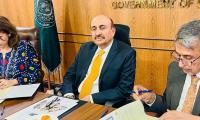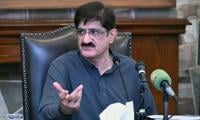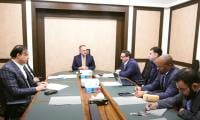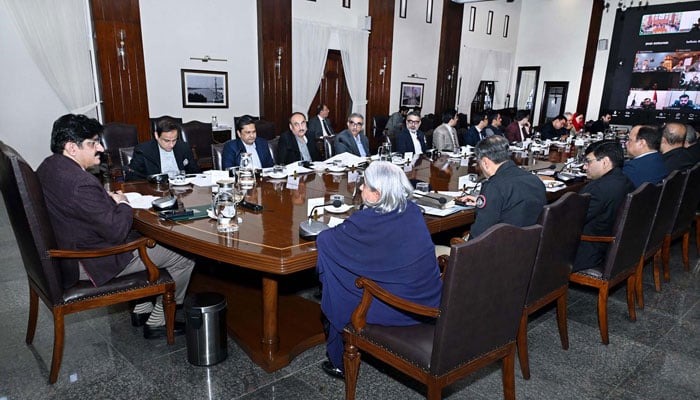
Sindh Chief Minister Syed Murad Ali Shah presided over a Provincial Task Force on Polio Eradication meeting at the CM House on Tuesday to review their progress.
Health Minister Dr Azra Fazal Pechuho and Emergency Operations Centre (EOC) Coordinator Shaharyar Memon briefed the meeting on the latest national and provincial updates. Discussions covered epidemiological updates, environmental surveillance, district performance, frontline worker preparedness and operational planning for the National Immunisation Days (NIDs) scheduled for December 15 to 21.
The meeting was informed that Sindh recorded nine polio cases this year: three in Badin, two in Thatta, and one each in Hyderabad, Kamber, Larkana and Umerkot. The most recent Karachi case was reported in December 2024 in Gujro, District East.
The meeting was told that environmental surveillance is a major concern: according to EOC data, 10 of 12 sites in Karachi and 11 of 17 sites in other divisions tested positive for poliovirus in November.
Over 75 per cent of the samples have tested positive since mid-2023, an unprecedented rate in the past decade. Calling the findings “deeply worrying”, Shah said: “This widespread presence of the virus is unacceptable. Only a high-quality, disciplined campaign can break this transmission.”
Reviewing district-wise performance, he expressed dissatisfaction where lot quality assurance sampling results remained intermediate. The October NIDs showed that 87 per cent of lots passed, but 27 of 206 lots (13 per cent) did not meet the standards.
The CM issued clear instructions: “The deputy commissioners must ensure 100 percent focus on field activities. No administrative pull-outs will be tolerated during the campaign.” He stressed that morning assemblies must be strong, frontline workers motivated and every child reached during campaign days, not in extended catch-ups. He told the district health officers to enforce zero-tolerance for data manipulation and absenteeism, and ordered union council support teams to resolve on-ground challenges immediately.
The meeting learned that 10.6 million under-fives will be vaccinated across 1,345 UCs in 30 districts. Over 80,000 frontline workers will participate, with over 21,000 law enforcers, including around 400 female constables, supporting security and access.
“Police must ensure timely deployment at morning assemblies. Lady constables must support access in high-refusal areas,” Shah said. He commended district innovations, with District Central, Karachi, arranging transport and lunch for 4,000 polio workers with the help of NGOs and town administrations.
In Sukkur, 100 percent assessment of 300 area in-charges (AICs), removal of 13 low-performing AICs, enhanced monitoring and improved coverage in high-risk UCs were reported. “These districts have shown initiative. Others must replicate such models for quality improvement,” the CM added.
The meeting was told that 85 per cent of zero-dose children have now been vaccinated, but about 12,000 still remain. “All refusal children must be vaccinated during the campaign,” Shah stressed.
He ordered local bodies and the administration to personally follow up. Emphasis was placed on stronger community engagement, interpersonal communication, involvement of local influencers and coordinated mass media messaging.
Reiterating his government’s commitment, the CM said: “Sindh has the strongest polio infrastructure in the country. What we need now is discipline, accountability and a sense of community trust. No child in Sindh should remain unvaccinated.”
He also called for easier data collection, supportive supervision and public recognition of frontline workers. The meeting concluded with directives for daily dashboards, real-time reporting, and strict monitoring at provincial and district levels.