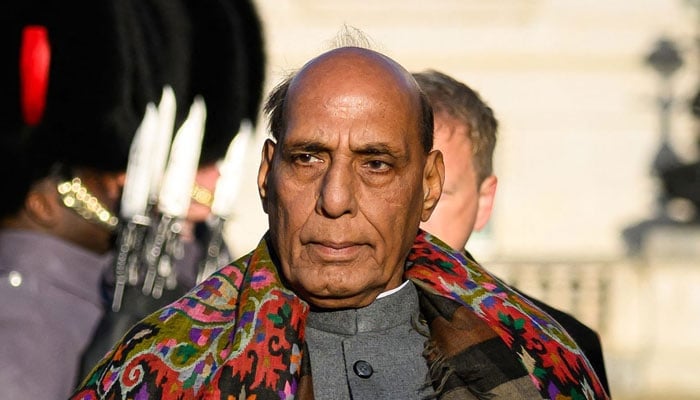
The irresponsible statement made by Indian Defence Minister Rajnath Singh regarding Sindh has deeply hurt every patriotic Sindhi Hindu living in Pakistan. While addressing a so-called 'Sindhi Samaj Sammelan' held in New Delhi, the Indian minister expressed his desire to see Sindh “reunited with India”. This illogical ill-thinking not only reflects his ignorance of history but also contradicts fundamental Hindu religious teachings.
In Hindu religious traditions, sacred scriptures and Vedic literature, Sindh is described with exceptional respect, sanctity and dignity. The Rigveda speaks of seven great rivers, the very first of which is the Sindhu, honoured as the 'Mother of Rivers and Canals'. In the Vedic age, the Indus River held most sacred, powerful, and central significance.
In the Mahabharata, the bravery of Sindhi soldiers is praised. In the Ramayana, Sindh is presented as a commercial business hub. Other Hindu scriptures and shastras describe Sindh as a fertile land blessed with full of waters, a cradle of trade and civilisation, a centre of knowledge and a symbol of hospitality and human dignity.
Among its crown jewels is Tharparkar, whose timeless desert beauty, religious diversity and thousands-year-old history make it remarkable. For the Hindu community, Tharparkar carries deep spiritual, cultural and civilisational sanctity. It was once one of the great centers of the Saraswati Civilisation and Sanatan Dharma – an era when the sacred Saraswati River used to flow in the land that is now Thar.
From a religious and cultural perspective, Hindus across the world regard Sindh as a sacred river, a blessed land, an ancient civilisation and a distinct cultural identity. However, historical research clearly shows that geographically and politically, Sindh (present-day Pakistan’s province) and Hind (present-day India) were never ever identical regions. Sindh has never, at any point in ancient history, been under the direct rule of any major Hindu imperial power and was always governed by local rulers, Rajput clans and indigenous chiefs.
Even at the time of the Arab arrival, Sindh was a sovereign state, with its capital at Aror. Under Raja Dahir, Sindh had its own administration, diplomacy, economy and defence. Raja Dahir was not subordinate to any Indian empire, which is why ancient literature describes Muhammad bin Qasim’s military success not as the conquest of 'India', but specifically of 'Sindh'.
When Muhammad bin Qasim took control, he declared the people of Sindh to be “our brothers”, promising justice and peace to everyone. Hindu temples, priests and religious practices were protected. Local traders and farmers were allowed to continue their work freely while Hindu officials were allowed to perform their administrative duties.
Let me correct the widespread confusion regarding the terms 'Sindh' and 'Hind'. Though they sound similar, their roots, meanings, history, and geography are completely different. Sindh refers to the great river and the lands around present-day Pakistan, whereas Hind (before the British arrival) referred to the various kingdoms, states and rajwadas located east of Sindh in the scattered form.
Researchers explain that Sindh comes from the Sanskrit word Sindhu, meaning 'a great river'. The term applied not only to the river but to the entire civilisation, its language, and people. Persians replaced the 'S' with 'H', calling it Hindu. The Greeks transformed it into Indus, and later linguistic derivatives such as India, Hindustan and Hind emerged. Yet historically, Sindh was never part of any Hindu Indian empire or 'Akhand Bharat' in the past.
When British rule merged Sindh into the Bombay Presidency, Quaid-e-Azam Muhammad Ali Jinnah demanded Sindh’s separation – a demand strongly supported by many Sindhi Hindu leaders. The ancient Indus Valley Civilisation also confirm that Sindh’s civilisational identity belongs to this region, not to India. Therefore, the Indian defence minister’s claim is historically false. How can something 'return' to a place it never belonged?
Being a patriotic Sindhi Hindu, I strongly condemn the Indian minister’s irresponsible and provocative remarks. Our elders chose Pakistan based on the assurances given by Quaid-e-Azam, and we proudly consider this land our Dharti Mata.
The writer is a member of the National Assembly and patron-in-chief of the Pakistan Hindu Council.
He tweets/posts @RVankwani