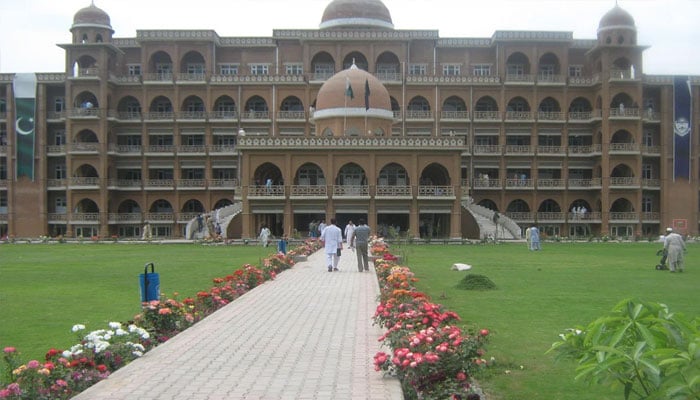
Recent reports on the possible closure of nine departments at the University of Peshawar, including development studies, social anthropology, geography, statistics, geology, history, human development and family studies, logistics and supply chain analytics, signal a deepening crisis in Pakistan’s higher education system.
These closures, attributed to low student enrolment, speak volumes about how young people are losing confidence in the very idea of a university education. Generally, the decision to pursue higher education is shaped not by intellectual curiosity or social contribution, but by employability and in Pakistan, employability increasingly lies abroad.
In many cases, these programmes attract those who could not secure admission elsewhere – often women whose educational paths are largely shaped by social restrictions and who pursue degrees mainly to avoid remaining idle at home.
The Labour Force Survey (2021–22) shows a worrying trend: 16.4 per cent of graduates in Pakistan remain unemployed. Many who do find work are underpaid or working below their qualifications, while others start small businesses just to get by. Many keep searching, hoping their degree will eventually lead to a stable job. For those who can afford it, leaving the country seems like the only option. According to the Pakistan Bureau of Emigration and Overseas Employment, 22,760 highly qualified and 45,687 highly skilled people left Pakistan in 2023 alone and this does not include those who migrated for studies and settled abroad after graduation. It is a steady, silent drain on talent.
The problem goes beyond unemployment; it is a crisis of purpose. A university degree once symbolised a path to social mobility, dignity and intellectual growth. Today, it often represents debt, disappointment and delay. With the rise of high-speed internet and freelancing opportunities, many women who once filled classrooms in the humanities are now choosing more productive and independent ways to use their time, applying their skills and creativity directly to income-generating work.
This shift reflects changing aspirations – where women are redefining what meaningful work and learning look like, valuing flexibility, self-reliance and real-world outcomes over symbolic credentials. It is also a lesson for universities: unless they evolve to connect learning with purpose and opportunity, they risk becoming irrelevant to the very people they aim to empower.
Globally, young graduates are having fewer opportunities as technology reshapes job markets and renders many university-taught skills obsolete. In Pakistan, however, the national priority appears to be opening a university in every district and filling classrooms rather than ensuring quality and relevance.
According to recent data, Pakistan now has around 270 recognised universities, many of which have been established in just the past few years. While this expansion may appear as progress on paper, it often serves political interests more than educational ones. Many universities have become vehicles for political patronage, with appointments of vice-chancellors, faculty and administrative staff driven by affiliation and influence rather than merit.
Some institutions are even used to promote a particular school of thought or political narrative, doing little to advance research, innovation, or the real development of youth. Consequently, universities continue to rely on outdated curricula, rote learning, and exam-based evaluation, offering limited exposure to real-world problem-solving. The result is a widening gap between what universities teach and what employers, both at home and abroad, actually demand.
If this trajectory continues, Pakistan risks not only losing its brightest minds but also its capacity to build a skilled, future-ready workforce. The implications go far beyond individual livelihoods; they threaten national productivity, innovation, and even remittance inflows, which remain a crucial economic lifeline. During July 2024–April 2025, remittances reached $31.2 billion, marking an impressive 30.9 per cent increase compared to the same period last year. These inflows have provided a much-needed cushion against persistent trade deficits, volatile export performance, and limited foreign direct investment, helping to stabilise the country’s external sector.
However, the volume of labour we export comprises low-skilled workers; only 12-15 per cent of migrant workers are skilled, whereas India exports highly skilled workers, followed by Bangladesh. Low-skilled jobs are generally directed to GCC or Middle Eastern countries, where regional conflicts and regulatory reforms are creating a plethora of challenges for Pakistani workers, who are least trained to cope with changing job-market conditions, raising future uncertainty in remittance inflows. With the current reasonably high dependence on remittance inflows, that is 9.4 per cent of the GDP in 2024, it’s high time to encourage investment in education and skills.
Pakistan must invest in teachers who inspire, curricula that respond to market demands, and systems that prepare students for real-world job challenges, not just exams. Otherwise, we will continue to risk reducing higher education to a numbers game: opening new universities, launching programmes, filling classrooms, and hiring faculty without strengthening quality, motivation and academic rigour.
The writer teaches development economics at the Institute of Business Administration (IBA), Karachi.