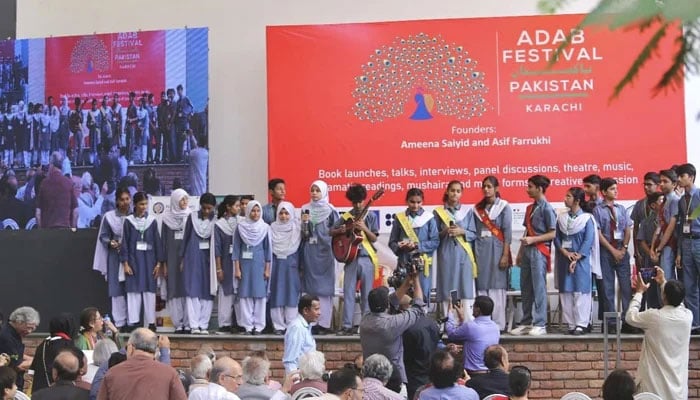
Karachi’s cultural calendar has grown crowded, but even in this city’s clutter of exhibitions, seminars and corporate-branded conferences, the Adab Festival continues to carry an oddly irresistible charge. Not because it is the most polished of Karachi’s cultural offerings, nor because it is flawlessly curated, but because it is – perhaps uniquely – driven by conviction rather than convenience.
This year’s edition at Habitt City once again transformed an urban commercial block into an improbable intellectual square, filled with overlapping sessions, brisk arguments, impromptu reunions and an unmistakable sense of urgency that literature, debate and performance still matter in a society tempted by perpetual distraction. The democratic impulse remains its defining gesture. Entry is free – an increasingly radical stance in a city where inflation has shrunk the public sphere. Its organisers, Ameena Saiyid supported by Raheela Baqai and team, insist that literature must remain available to all. Saiyid reiterated her hope of making rock stars out of writers; Baqai framed the festival as a modest rebellion against cultural amnesia.
Neither assumes transformation is imminent, but both refuse cultural resignation. Book launches and literary conversations were at the heart of the festival. Zahid Hussain’s ‘A Dialogue with History’ and ‘Face to Face with Benazir’ drew an attentive crowd as Dr Omair Ahmed Khan and Dr Nafisa Shah probed the tensions of political biography in a country where history is both weapon and wound. Amber Zaffar Khan’s ‘My Friend Maya’, discussed with Khurram Koraishy, offered a rare exploration of friendship and psychological vulnerability; the room fell into an unusual, almost tender silence.
The Book Talk on Syed Muhammad Taqi’s ‘The Future of Civilization’, newly translated by Sumera Naqvi and discussed with Zafar Masud and Kazim Saeed under Lubna Jerar Naqvi’s poised moderation, brought philosophical unease to the surface – a reminder that anxieties about civilisational decline are now truly global. And a brisk but engaging conversation on Shabbar Zaidi’s ‘32 Onkar Road’ cut through familiar commentary to articulate the structural paradoxes of Pakistan’s political economy. But the festival’s range expanded well beyond politics. A song by Usama Israr Ahmed, delivered with gentle precision, reminded listeners that oral traditions often carry emotional truths lost in literary exegesis.
A different but equally textured nostalgia animated the evening’s tribute in tarannum, where Usama Israr Ahmed honoured Tina Sani and Nayyara Noor – and the poetry they ennobled – casting a spell that briefly suspended the city’s noise. Other book launches deepened the festival’s engagement with identity and memory. Zubeida Mustafa’s ‘Chatting with Daadi’ was brought alive through dramatic readings by Asma Mundrawala and Shama Askari, with a panel featuring Ameena Saiyid, Baela Raza Jamil and Rumana Husain under Shazia Hasan’s thoughtful moderation. Shama Askari later returned for the launch of her English translation of Hayat Roghaani’s ‘Queen Zarqa: A Transgender’s Odyssey’.
Joined by Nisha and Naila Mahmood and moderated by Hoori Noorani, the conversation explored the politics of trans identity beyond the courtrooms and headlines – a rarity in mainstream literary spaces. Farhatullah Babar’s Beyond the Bomb: Munir Ahmed and Pakistan’s Nuclear Odyssey’, discussed with Mazhar Abbas, Ameena Saiyid and Azaz Syed under the moderation of Omayr Aziz Saiyid, blended political history with institutional memory, illuminating the uneasy coexistence of scientific ambition and national insecurity.
The festival’s interdisciplinary turn continued through the ‘Karachi Biennale: Connecting Art, the City and Its People’, a documentary screening and discussion with Noor Ahmed, Amin Gulgee and Bushra Hussain moderated by Syed Hasnain Nawab.
It revealed the city’s aesthetic anxieties: disappearing neighbourhoods, contested public spaces and the fragile survival of artistic expression in a city that reinvents itself through erasure. One of the most resonant sessions was devoted to place itself: ‘The Cultural Relationship of Sindh with the River and the Sea’, featuring Saif Samejo, Naseer Memon and Zubaida Bhirwani, moderated by Noor-ul-Huda Shah. Samejo traced the Indus in the region’s music; Memon mapped the ecological violence inflicted on the delta; Bhirwani spoke of livelihoods eroded by rising seas and extractive development. The conversation avoided romanticism and instead articulated how Sindh’s cultural identity is inseparable from its ecological precarity.
Meanwhile, the festival’s political and journalistic conversations carried a sharper edge. ‘Truth, Trust and Tenacity: The New Media Paradigm’, featuring Fazil Jamili, Amber Rahim Shamsi, Azhar Abbas and Azaz Syed with Nadia Naqi moderating, unfolded like a collective exhale from journalists accustomed to trolling, surveillance and manufactured virality. Abbas described a media environment where misinformation is engineered faster than accuracy can respond; Jamili warned of an internalised censorship far more corrosive than formal bans. Yet technology, rather than politics, generated some of the most animated debates.
In ‘Designing Tomorrow with AI’, Dr Salman Khatani and Sadaf Bhatti explored algorithmic power, machine learning and the uneasy future of work in Pakistan. Conversations about ethics, access and inequality echoed off the walls; the session felt like a dispatch from a future arriving faster than institutions can cope with. The festival also confronted the future of learning in its own way. ‘The Future of Learning, Tech & Teaching: School Education’, featuring Dr Fauzia Khan, Dr Naveed Yousuf, Salma Alam and M Hassan Khan under the moderation of Dr Anjum Halai, wrestled with inequities in digital access and the pedagogical confusion created by rapid technological change. Later, parallel discussions on the future of higher education continued the theme, reminding audiences that educational reform remains caught between aspiration and bureaucratic inertia.
Perhaps the most joyous assertion of linguistic plurality came through the Mushaira ‘Pakistan ki Zubaanain’. Poets representing Siraiki, Balochi, Sindhi, Punjabi, Pashto, Burushaski and Balti – Sadia Lashari, Ishaq Khamosh, Masroor Pirzado, Shoukat Kamal Cheema, Sarwar Shamal, Ali Ahmed Jan and Qamar Kazmi – performed under the moderation of Waheed Noor. It was a reminder that Pakistan’s polyphony is richer than its politics often allows. Later in the evening, a grand Mushairah presided over by Zehra Nigah, with chief guests Dr Pirzada Qasim, Raza Siddiqui and Anwar Shaoor, and a roster of poets including Afzal Ahmed Syed, Tanveer Anjum, Kashif Raza, Wajih Sani, Kishwar Naheed and many others, reaffirmed poetry’s enduring hold on Pakistani cultural life.
Children, too, remained central to the festival’s ethos. The Tree Garden’s theatre games, storytelling circles and Taha Kehar’s ‘Storymakers Studio’ offered teenagers and younger children a rare opportunity to build narratives of their own world. In a country where libraries often exist only on school brochures, such sessions amounted to cultural triage. Yet the festival could not entirely escape Karachi’s inequalities. Attendance was dominated by private-school families; government-school groups appeared mostly through organised visits. Linguistic diversity, though proudly advertised, remained uneven in practice. Corporate logos dominated the visual space, underscoring how cultural life survives not through public investment but private sponsorship.
Still, Adab Festival resists dismissal. For two days, it creates a fragile civic square where writers meet readers, where young people encounter debate unmediated by social media outrage, and where ideas – tentative, contested, sometimes fragile – circulate without apology. It is, briefly, the city’s conscience. Whether anything endures after the lights dim remains uncertain. Karachi excels at producing spectacles that vanish without institutional memory. Festivals cannot repair a collapsing education system or revive reading habits eroded by economic and technological pressures. They function, at best, as oxygen masks. Yet the festival persists – and so does its audience.
The crowds, varied if not representative, suggest a stubborn appetite for ideas. The sessions – from Zahid Hussain’s political excavation to Amber Zaffar Khan’s introspective storytelling, from Taqi’s civilisational warnings to Farhatullah Babar’s historical inquiries, from the Sindh river-sea dialogue to the Mushairah’s multivocal chorus – prove that Karachi’s intellectual metabolism remains alive. Perhaps the fairest reading is that the Adab Festival remains a negotiation: between aspiration and reality, between cosmopolitan ambition and structural fragility, between elite presence and public yearning. Like Karachi itself, it is unfinished. But under Ameena Saiyid and Raheela Baqai’s stewardship, it has gained persistence, memory and a determined public unwilling to let literature disappear into private silence. In Karachi, that is no small achievement.
The writer holds a PhD from the University of Birmingham, UK. He tweets/posts @NaazirMahmood and can be reached at: [email protected]