UN Security Council Resolution 2803 marks a historic diplomatic moment, not because it delivers justice to a long-oppressed people, but because, for the first time in decades, it signals just a minimal pushback against Israel’s ongoing genocide in Gaza.
Passed without a veto and with 13 votes in favour, including abstentions from two of the major powers – China and Russia – the resolution does not condemn Israel’s genocide, nor does it halt the occupation that the world recognises as a crime against humanity. Yet, in the strange choreography of global diplomacy, its passage reveals something new: a subtle shifting of the tectonic plates beneath the long-frozen Palestine question.
Which way will this unfreeze take the Palestinians and the Arab world – towards a slow-moving process away from Israel’s atrocities and excesses against the Palestinians and the Arab people of Syria, Lebanon, etc or will it facilitate and reinforce the greater Israel plan? Much depends on how the eight Muslim states act – as declaratory supporters, with multiple reservations, of the Trump plan.
Clearly, Palestinians need a process set in motion that can help convert their iconic resistance into a victory that delivers to them their homeland. The onus is on Trump’s eight Arab-Muslim supporters. None of these eight can provide troops for the International Stabilisation Force proposed in the resolution unless Israel is out, there is an end to Israeli attack and there is peace in Gaza. The onus for peace clearly lies with Israel. Pakistan has made it completely clear that its troops cannot be involved in disarming Hamas , as is Hamas’s position, unless Israel fully withdraws from Gaza. Equally, Pakistan cannot in any capacity be expected to engage Israel, as mentioned in Trump’s plan, a country it does not recognise. For Pakistan, the confusions and contradictions are serious and multiple.
Pakistan was in the lead, demanding an UNSC umbrella for any international engagement in Gaza, which the US has provided, but other critical questions remain unanswered. Pakistan’s top diplomat at the United Nations openly reiterated Pakistan's unanswered questions and reservations regarding the UNSC resolution text. Our reservations and concerns have not been fully addressed, as Pakistan's Deputy PM Dar has also publicly stated. Undoubtedly, when Trump’s Middle East envoy Steve Witkoff arrives in Islamabad on November 27, Pakistan's concerns will be raised. He will be told that the required clarity, which can actually take forward Trump’s peace plan for Palestinians, is still missing.
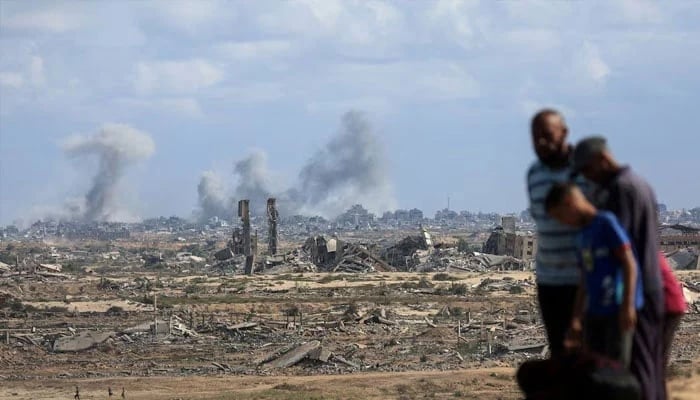
Meanwhile, the significance of UNSC 2803 lies not in content but in the politics of its passage. It reflects both the US-led power-play still tilted in Israel’s favour and the increasing weariness, even if docile, of numerous nations, including the Muslims, towards this unqualified active US-led support for Israel. This compelled the US, however reluctantly, to mildly water down its unconditional backing of Israel. After all, for months, the world saw unrelenting images of devastation: entire neighbourhoods razed, hospitals and schools bombed, tens of thousands killed and an entire population pushed toward famine. The scale of destruction created a moral and political cost for Israel’s allies that could no longer be deflected through familiar narratives of 'self-defence'.
The resolution, despite its limitations, emerges from this shifting international landscape. It grudgingly acknowledges Palestinian self-determination and implicitly challenges Israel’s claim to absolute impunity. That alone marks a departure from past UNSC dynamics, where even the mildest criticism of Israel would trigger an instant American veto.
UNSC 2803 neither condemns Israel’s genocide – an atrocity acknowledged by numerous human rights bodies and legal experts – nor demands accountability. Its language remains cautious, even timid, in the face of overwhelming evidence of war crimes. The gap between reality and the resolution’s language remains wide. Still, once initiated, diplomacy can potentially move incrementally, especially in crises where power, interests, and entrenched alliances collide.
The political choreography behind this vote is telling. The US, facing rising domestic pressure and international censure, opted to prepare and promote a limp, diluted text. It reflects the Trump Administration’s mild recalibration of the US strategic commitment to Israel. Washington’s calculus was simple: promoting a watered-down resolution was less costly than being isolated again in defence of an increasingly indefensible and now genocidal power.
There were interesting voting abstentions from China and Russia. While both countries criticise Western hypocrisy on international law, they are critical of Israel. Yet their abstention signals their pragmatism, their desire not to engage directly in a fluid situation in which the Trump plan is the only game in town, which the principles, including the Palestinians and the Arabs/Muslims, recognise. Hence, no veto or support from China or Russia for UNSC 2308.
Meanwhile, the Muslim world’s diplomacy, post-Sharm el-Sheikh, the New York meeting of the eight with Trump, and the Istanbul meeting, has marked somewhat unity and persistence on questions about Trump’s Gaza plan, which has been responsible for the US bringing the matter to the UNSC. Significantly, having initially come together to support the Trump plan for different reasons, the eight have together adopted UNSC Resolution 2308; the resolution remains fundamentally inadequate.
The resolution has been silent on key issues: Israel’s deliberate starvation of Gaza’s population, no explicit call for war-crimes investigations, no emphasis on Israel’s end to occupation and illegal settlements, but it focuses on disarming the Palestinians of Gaza, essentially meaning Hamas. Nevertheless, the paradox: while the US still considers Israeli atrocities strategically tolerable, Resolution 2803 demonstrates that Israel’s political shield at the UN is no longer absolute.
Paradoxes cascade across the entire current spectrum. Amidst the support still for Israel’s genocidal man, Netanyahu, this is also a political moment that reveals some shift in global conscience. Public opinion – from the streets of Western capitals to campuses, parliaments and civil society – has become a force that governments can no longer entirely ignore. The global Palestinian solidarity movement, unprecedented in scale since the anti-apartheid struggle, has altered the political cost of supporting Israel unconditionally. The images from Gaza have reshaped moral and political debates in countries that once framed Israel’s actions as a defensive necessity. In this sense, Resolution 2803, with all its limitations is also a recognition of global public will that refuses to accept genocide as collateral damage of geopolitics.
Interestingly, the resolution highlights the limits of international law when confronted with entrenched power. The genocide case against Israel at the International Court of Justice has already established a legal and moral framing that no diplomatic language can soften. The ICJ’s provisional measures, South Africa’s moral leadership, and the growing number of states supporting the case signify a global legal backlash. Resolution 2803 fits into this broader trajectory, albeit minimally.
As the world debates the meaning of this resolution, the humanitarian catastrophe in Gaza continues. Over a million people remain displaced. Famine looms. Families search through rubble for loved ones. Entire neighbourhoods are unrecognisable. Against this backdrop, diplomatic language feels painfully inadequate. Yet diplomacy remains one of the few tools available to the international community to slow the machinery of violence. In that sense, 2803 is a beginning – not a solution.
In the coming months, the significance of this resolution will depend on whether it becomes a stepping stone or a diplomatic footnote. Its true value lies not in what it says but in what it reveals: the beginning of a world no longer willing to look away, the emergence of a global moral consensus rejecting genocide, and the first cracks in a geopolitical order that long treated Palestinian suffering as an uncomfortable inconvenience.
Ultimately, Resolution 2803 represents the shifting balance between power and principle. It captures the moment when even the smallest gesture at the UN becomes a marker of potentially larger changes. It signals that, while the machinery of oppression remains powerful, the world’s moral and political landscape may be changing. Mamdani’s rise in New York, the heartland of Zionism, is very telling.
For Palestinians, whose suffering continues unabated, this resolution is far from justice. But it is a sign that global politics may be moving. At what pace and in what direction? For that, the ball is in the court of the original eight, including Pakistan, who met with Trump in New York and supported him with some reservations.
Will the eight play to Washington’s tunes or to their own principled and pragmatic yet principled tunes – an approach which can initiate a process in favour of the Palestinians?
X/Twitter: @nasimzehra Email: [email protected]
The writer is a foreign policy & international security expert.