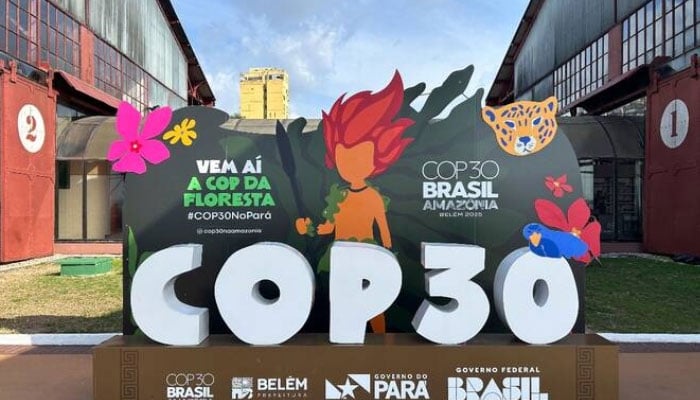
COP30 in Belem is being read in two ways: symbolic theatre to some, a gathering with substance to others. Torrential rains flooded the Amazonian host city in the opening days. A fire then tore through the conference venue, forcing delegates to evacuate on the second-to-last day.
Some sections of the media called the blaze “a disturbingly apt metaphor” for a process that many fear may no longer be fit for purpose. Even Pope Leo’s virtual address, warning that “creation is crying out”, seemed to mirror the week’s unsettling mood.
The summit opened under the heavy shadow of the UN Emissions Gap report. Released two weeks before COP30, it confirmed that the world is now almost certain to overshoot the 1.5 C limit within the next five years. That assessment reshaped the entire conversation. Climate diplomacy has shifted from avoiding overshoot to reducing how long and how far the world exceeds it.
This new reality demands not only rapid emission cuts but also credible pathways for large-scale carbon removal. And although solar geoengineering remained largely absent from official discussions, side-events on carbon-drawdown technologies drew strong interest. The political appetite remains cautious, but the scientific urgency is unmistakable.
The good news is that adaptation, often overshadowed by mitigation, received firmer attention at COP30. Negotiators agreed on a Global Goal on Adaptation with fewer indicators and more room for countries to apply it to their own circumstances. The call to triple adaptation finance by 2035, even though developing countries had pressed for a 2030 deadline, offers some reassurance to vulnerable states. The bad news is that without a defined baseline and clarity on exactly what is being ‘tripled’, monitoring becomes difficult and accountability becomes elusive. A pledge without metrics risks becoming another promise that struggles to materialise.
Where the summit faltered most was on the central question of fossil fuels. The UAE-led COP28 in Dubai produced the first-ever global pledge to “transition away from fossil fuels”. At the time, many saw it as a breakthrough. Two years later, the Belem agreement contains no reference to fossil fuels at all. An early draft suggested a ‘roadmap’ for phasing out their use. This could have encouraged countries to set milestones, publish timetables and build sectoral pathways. That language survived only briefly.
Saudi Arabia, Russia and India pushed back firmly. Their resistance, combined with the need for full consensus, ensured that all reference to fossil fuels was removed from the final document. A coalition of countries, including the EU and several Pacific island states, threatened to reject the agreement unless the wording was reinstated. The pressure did not work.
The outcome reflects a familiar tension in global climate diplomacy. Issues that require binding commitments encounter political resistance that the COP process cannot overcome. This year, even proposals to revisit national climate plans (NDCs) more frequently, given the failure to cut emissions at the required speed, were dropped. The suggestion of a global roadmap to end deforestation met a similar fate. What survived were voluntary mechanisms and aspirational platforms.
Still, the fortnight brought some positive developments. Brazil pledged to advance discussions on fossil-fuel roadmaps through the G20. Colombia and the Netherlands announced they would host a global conference on phase-out pathways next year. And one tangible outcome was the launch of the Tropical Forests Forever Facility, with an ambitious target to mobilise up to $125 billion by paying countries for every hectare of tropical forest they preserve.
The geopolitical context shaped much of this outcome. The US did not send a federal delegation. China, which was expected to take a leadership role in America’s absence, avoided taking such a role. China and Russia blocked references to critical minerals, a sector they dominate, while tensions persisted between the EU and the G77 plus China over the EU’s CBAM, widely viewed as a unilateral trade barrier. India, managing its coal-heavy energy mix, joined other emerging economies in resisting language that could lock countries into firm fossil-transition milestones.
Brazil’s presidency framed the summit around Mutirao, an indigenous word meaning ‘collective effort’. The spirit of ‘mutirao’ underpinned the Paris Agreement a decade ago. Yet the voluntary, non-binding nature of such collective action limits what these summits can deliver, a constraint that also loomed over COP30.
Outside the negotiation rooms, participation itself became a barrier. COP30 was among the most expensive summits in recent memory. Accommodation costs in Belem spiked to extraordinary levels, with rooms and cruise-ship cabins priced from several hundred to several thousand dollars a night. Airfares to the Amazonian city soared. Many delegations from developing countries struggled to find affordable lodging. Belem drew more than 56,000 registered participants, fewer than Dubai’s 85,000 at COP28 and Baku’s 65,000 at COP29. The size of delegations skewed heavily towards wealthier states and large institutions, reinforcing concerns about equitable access and inclusion.
The debate over inclusion at COP30 can be understood within Brazil’s broader social reality. The summit took place in a country that is only now beginning to confront a past built on the forced labour of nearly five million enslaved Africans. This was the largest number brought to any country. Incidentally, Brazil observed its first national ‘Black Consciousness Day’ while COP30 was underway. The national holiday honours Zumbi dos Palmares, who led the continent’s largest community of escaped slaves and was captured and killed by Portuguese forces on November 20, 1695.
Many in Brazil saw the decision to mark this day as a political gesture by President Lula because earlier generations had been encouraged to believe that Brazil was a land of racial harmony. Recent historical work has challenged that narrative. New genomic studies reveal uneven patterns of ancestry that point to a long history in which enslaved and Indigenous women bore the brunt of exploitation by Portuguese colonialists. The holiday, even if it is politically motivated, represents an attempt to acknowledge lives and truths that had been set aside for centuries.
A useful parallel can be drawn between Brazil’s delayed acknowledgement of racial injustice and the global community’s delayed response to climate change. Critics on the populist right may dismiss calls for climate action as political theatre. However, recent scientific assessments and extreme weather events make that stance harder to sustain. The evidence is no longer abstract. It is visible, immediate and often devastating. This growing clarity mirrors the way historical truths eventually break into public debate after years of avoidance.
Recognition alone, however, does not resolve a problem. Whether the issue is injustice or rising temperatures, progress depends on actions that match the scale of the harm. This is where COP30 fell short. The summit acknowledged the crisis. It did not deliver the level of action that the moment requires.
LinkedIn: @Abidsuleri The writer participated in COP30 as a civil society representative.