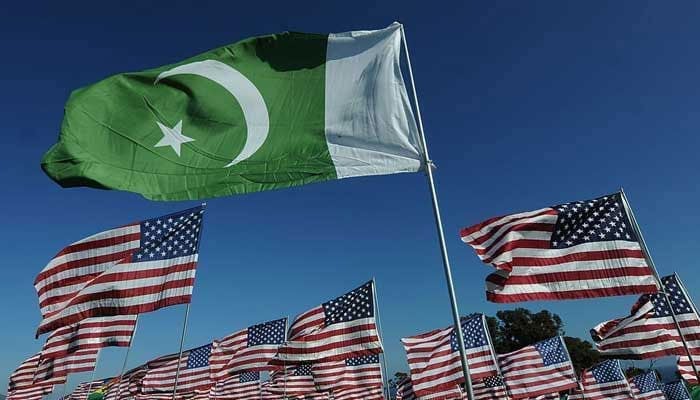
Pakistan stands at a crucial crossroads in its foreign policy trajectory. The country’s relationship with the US has historically oscillated between intense cooperation and abrupt abandonment, a cycle that generally affects Pakistan’s security, economy and internal political dynamics.
Today, as global geopolitics reorders itself around new technological, economic and strategic priorities, Pakistan needs to understand its ties with the US with clarity and foresight. For decades, Pakistan’s ruling institutions have viewed close ties with Washington as central to national strategy. Even today, Pakistan’s elite establishment largely aligns with American positions in South Asia and the Middle East. The admiration for US President Trump in some quarters, reflected in public praise and even symbolic nominations for the Nobel Prize, shows the extent to which these circles believe that aligning with Washington is the safest foreign-policy bet.
Pakistan, in the process, has extended unprecedented strategic offers to the US, ranging from support for the US resolution in the UNSC to potential access to naval facilities in Balochistan to a partnership in the exploration of rare minerals, resources that remain largely untapped in Pakistan’s western provinces and offshore zones. These overtures signal Islamabad’s desire to anchor itself firmly within the US security and economic orbit. Across the aisle, the Trump administration has responded with equal warmth. Washington imposed lower tariffs, praised Pakistan’s cooperation on Afghanistan and maintained open channels with Pakistan’s political and military leadership. For a moment, it appears to be a two-way love affair.
Yet beneath the cordial optics lie uncomfortable truths. The US has historically maintained a transactional approach towards Pakistan. When the Soviet army marched into Afghanistan, Pakistan became indispensable. After 9/11, Pakistan was essential again, albeit at a tremendous domestic cost. But once the US withdrew its forces from Afghanistan, the calculus changed. Some quarters within the US are also concerned about Pakistan’s nuclear programme, despite the fact that Pakistan clearly follows a deterrence policy against a conventionally superior adversary. Pakistan has always been a responsible nuclear state and its arsenal is safe from any external or internal threat.
Washington’s concerns today revolve less around counterterrorism and more around great-power rivalry, particularly China’s expanding influence. This shift has profound implications for Pakistan. The global race today is no longer about oil and gas; the world is entering an era dominated by artificial intelligence, robotics, and clean energy technologies. In this new order, rare earth elements and strategic minerals, critical for semiconductors, batteries, and defence technologies, are the new gold. Pakistan sits atop significant mineral wealth that remains largely unexplored and undeveloped, making it a potential epicentre of competition between the US and China.
China’s Belt and Road Initiative – and particularly the China-Pakistan Economic Corridor (CPEC) – anchors Pakistan tightly into Beijing’s strategic vision. Gwadar, a key node in this corridor, is seen by Washington as part of a broader Chinese attempt to reshape regional trade and security patterns within a strategic arc extending from the South China Sea to the Persian Gulf. Pakistan, on the other hand, sees CPEC as a commercial project with significant economic benefits for the country.
Pakistan’s public sentiment is heavily skewed towards China, particularly given its rapid economic and technological growth, shared border and transit trade through CPEC, which is projected to yield huge dividends for Pakistan. Beijing’s diplomatic and military backing during periods of heightened tension with India, particularly its deterrent role and the deployment of advanced weaponry, has reinforced the belief that China is Pakistan’s most reliable partner. A significant portion of Pakistan’s population views China not merely as a friend but as the guarantor of regional balance.
On the other hand, Washington has historically looked towards India, its largest South Asian trading partner, as the more profitable and politically aligned market. India’s middle class alone is twice the size of Pakistan's entire population, and for the US corporate sector, India promises far greater economic dividends.
President Trump’s tariff pressures on New Delhi, his administration’s involvement in facilitating ceasefire agreements between India and Pakistan, and other efforts to lure India back into the US strategic camp all reflect Washington’s broader Indo-Pacific strategy. If these efforts succeed, Pakistan risks once again being relegated to the margins, discarded to the sidelines as soon as it becomes inconvenient, as history has demonstrated more than once. The world has entered a new age. The Middle East is undergoing profound realignments. The US–China rivalry will define the decade. Artificial intelligence and critical minerals are reshaping international power structures. Pakistan sits at the geographic and resource-rich intersection of all these forces.
All these bring Pakistan to a crossroads: Should it continue to trust the US despite repeated cycles of abandonment? Or should it pivot into China’s technological and economic sphere? An ill-conceived alignment, whether skewing too far towards Washington or too deep into Beijing, could expose Pakistan to geopolitical coercion, economic vulnerabilities, or even internal destabilisation. The stakes are high. Miscalculations could aggravate Pakistan’s domestic challenges, undermine national cohesion or worsen law-and-order conditions. In the worst-case scenario, prolonged instability could threaten the country’s territorial integrity. Pakistan needs a foreign policy rooted in national interest, not institutional preferences or personal loyalties. Pakistan should carefully craft a path of strategic neutrality that protects its sovereignty while enabling partnerships with both powers. A foreign policy crafted by a weak or unrepresentative government will not earn public trust, nor will it be durable in the face of crisis.
Pakistan must ensure that its leadership – political, military, and bureaucratic – is guided by a democratically elected mandate and remains accountable to the people, not to foreign capitals.
Note: This article is based on a presentation given to the Forum for Dialogue and Diplomacy, Houston, TX.
The writer is a former senator and former chairperson of the HEC.