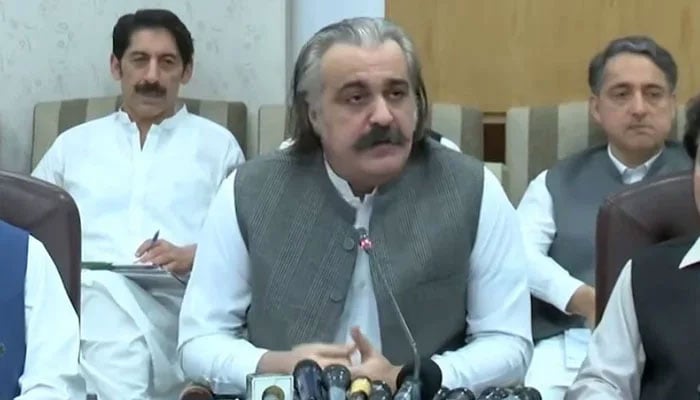
PESHAWAR: Chief Minister Ali Amin Gandapur on Friday unveiled a two-year reform roadmap, promising strict monitoring and accountability across all departments along with performance-based incentives.
Unveiled at a ceremony at the Chief Minister’s House, the “Khyber Pakhtunkhwa Good Governance Roadmap” aims to address long-standing inefficiencies in the public sector.
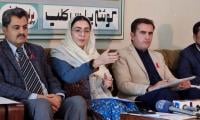
Chief Secretary Shahab Ali Shah, the lead architect of the reforms, briefed cabinet members, secretaries and the media on the plan and its implementation.
In his address, Chief Minister Gandapur emphasised that monitoring would be central to ensuring the success of the roadmap. “Monitoring is the core stage. Without it, no reform agenda can succeed,” he said, adding that the province had suffered due to chronic mismanagement and poor governance.
“We prepared this roadmap after extensive consultation. Now is the time to implement it so the public can benefit,” he said, noting that public funds were routinely wasted, with departments unaware of the resources available to them.
He lamented that the province had long been unable to resolve key issues due to chronic bad governance, noting that despite the presence of a large number of government employees, the same issues persisted without resolution.
Gandapur said the public money continued to be wasted year after year, with little or no action taken against responsible officials.
He pointed to systemic inefficiencies, observing that departments often had funds lying unused without the knowledge of their ministers or officers.
“Funds exist, but departments don’t even know they have them,” he remarked, adding, “This is exactly the kind of mismanagement that must end.”
“The departments have funds, but they don’t even know about it,” the chief minister remarked during his address.
“Our Education Department, for instance, has huge funds available but even our own Education Minister, Faisal Khan Tarakai, was unaware of it,” he said, prompting a moment of amusement across the hall and highlighting the serious communication gap within the government machinery.
The young and seemingly decent Tarakai felt embarrassed when his fellow colleague and Sports Minister Syed Fakhar Jehan laughed at him when Gandapur personally targeted the education minister.
Gandapur spoke for almost 14 minutes and criticised the Education Department under Faisal Khan Tarakai, younger brother of MNA Shahram Khan Tarakai.
Some of the bureaucrats were heard saying the chief minister should have talked about the pathetic situation of other government departments, including the Higher Education Department, health, Communication and Works, sports and culture.
Interestingly, neither the chief secretary nor the chief minister discussed the 10 Medical Teaching Institutions (MTIs) run by the board of governors, costing billions of rupees but not answerable to the government, and then the alleged corruption and misuse of Sehat card in the private sector hospitals.
Recalling his first directive after assuming office, the chief minister said he had announced the provision of furniture to all public schools. “But today, we find government school furniture being used in political gatherings, while children sit on bare floors,” he said. “Furniture is not in classrooms, but in the homes of government officers. This is criminal negligence, and those responsible will be held accountable.”
The chief minister asserted that the reform roadmap included a clear system of reward and punishment and said that he would personally review its progress every month. “I will not offer explanations for removing underperforming officials,” he said. “No political pressure or personal recommendation will be accepted. Action will be merit-based and performance-driven.”
He warned that deputy commissioners failing to act on the 99-point reform agenda would face immediate disciplinary proceedings. “From now on, those who do not work will be shown the door,” he said, while reaffirming his administration’s resolve to restore the spirit of justice and merit in governance. “The State of Madina was built on justice and merit. That is the model we aim to follow.”
Chief Secretary Shahab Ali Shah said that weaknesses in the security apparatus directly harmed the people.
“When the security system is compromised, it is the public that suffers,” he said. He emphasised the ongoing impact of terrorism on the province’s development and stressed that every institution must play its constitutional role in eliminating the threat. “Terrorism remains a direct obstacle to progress, and joint action from all departments is essential,” he added.
The chief minister said that the provincial government had officially launched its two-year roadmap and that all appointments and transfers would now be based solely on performance. He assured that the Provincial Action Plan would be implemented in full and that funds for development projects would be released on a priority basis.
He further stated that KP reform roadmap, hospitals across the province would be ensured 100 percent availability of medicines and that 250 Basic Health Units would be upgraded under the roadmap.
The government also plans to provide stipends to 10,000 persons with disabilities and to reduce the number of out-of-school children by 50 percent. Environmental and housing initiatives were also announced, including the distribution of 1,000 fruit-bearing plants and two million wild olive grafts, as well as the development of 14,000 residential plots in the New Peshawar Valley. Additionally, households earning less than Rs100,000 per month would be shifted to solar energy as part of the province’s clean energy goals.
The roadmap also includes the digitisation of over 100 public services, operationalisation of four new mineral zones, improvement of solid waste management systems in key districts, and upgradation of 70 public parks across the province. A major connectivity boost is planned with the start of work on the Dera Ismail Khan–Peshawar Motorway, along with the completion of the Northern Bypass and the New General Bus Stand in Peshawar. In agriculture, 571 acres of Harichand Dairy Farm will be developed under a public-private partnership, 90,000 livestock animals will be vaccinated, and 1,000 high-quality fruit orchards will be planted. Technical education will also be a focus area, with 32 vocational institutes set for upgradation. Moreover, more than 50 new tourist destinations and 25 new tourism sites will be developed under a home-stay programme in seven districts.
The chief secretary noted that departments and officers completing assigned tasks on time would be recognised and rewarded, while those responsible for delays or inefficiencies would be held to account.
However, the roadmap has also drawn criticism from several quarters. Some government officials have reportedly described the plan as a “waste of Rs9 billion,” arguing that it lacked a clear agenda or any major transformational development projects. They said that the allocated budget could have been better utilised through more targeted initiatives with measurable impact.
Concluding the ceremony, Chief Minister Gandapur reiterated his administration’s determination to see the roadmap through. “We have the plan, we have the resources, and we have the political will. Now we must deliver with discipline, transparency, and accountability,” he said.