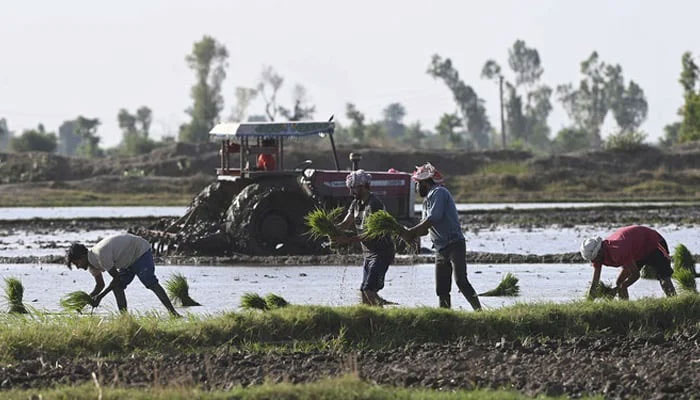
LAHORE: Reacting to Budget 2025-26, farmers' representatives have raised concerns regarding the government's fiscal management strategy in addressing the challenges posed by Indian water aggression and climate change on river flows.
The budget has sparked concerns among farmers regarding the government's approach to addressing Indian water aggression and climate change-related challenges to surface water availability. “The budget fails to specifically address the challenges related to climate change affecting river flows or the issue of Indian water aggression, which may further imbalance already constrained water availability", said Farooq Bajwa, a progressive farmer and water activist.
He emphasised that incorporating climate-resilient water management practices and addressing concerns about Indian water aggression are crucial for ensuring water security and sustainable agricultural growth in the country. As the agriculture sector is heavily reliant on water, and scarcity can severely impact crop yields and farmers’ livelihoods, the government must present a plan to ensure the smooth flow of water in the Jhelum and Chenab Rivers. “These two rivers are especially being targeted by India for obstructing river flows", he warned.
Bajwa was also worried about the high cost of water for the farmers. With each passing day, farmers are facing immense problems in getting water to irrigate their crops. He observed that the cost of pumping and the revised water rate for canal water grossly hurt farmers’ interests.
Chairman of Agri-Forum Pakistan Ibrahim Mughal strongly condemned the federal government for not devising a solid plan to ensure sustained water supplies through the eastern rivers. He said the government should focus on building the Chiniot Dam on the Chenab River to help balance river flows.
The agriculture sector is already confronted with significant obstacles such as inadequate access to water, financing and technical expertise, limited adaptation to climate change challenges, and low adoption of certified seeds and modern technology. The federal government seems to have ignored all these challenges plaguing the country’s agriculture sector.
The Kissan Board Pakistan stressed the need to boost investment in the agriculture sector, especially in areas such as mechanisation, irrigation reform and seed quality. “On top of that, climate-resilient water management is the need of the hour", said KBP Spokesperson Haji Ramzan.
He emphasised that adopting climate-resilient water management strategies and addressing concerns regarding Indian water aggression could be vital for ensuring water security and fostering sustainable agricultural growth. The budget does not specifically address climate change-related challenges affecting farmers at the grassroots level.
He added that one of the key reasons for weak growth in the current fiscal year is the poor state of agriculture, which has inflicted heavy losses on farmers. It seems the federal government has not addressed the critical issues the agricultural sector faces, leading to dissatisfaction among farmers.
He welcomed the move not to impose GST on agricultural inputs, including fertilizers and pesticides, saying the government must also introduce measures to reduce the cost of production for growers. The KBP spokesperson also highlighted that farmers suffer huge losses due to high input costs as they have failed to get fair returns on their produce. Farmers are struggling with rising costs and high tariffs, which seriously impact their livelihoods and the overall growth of the agriculture sector.