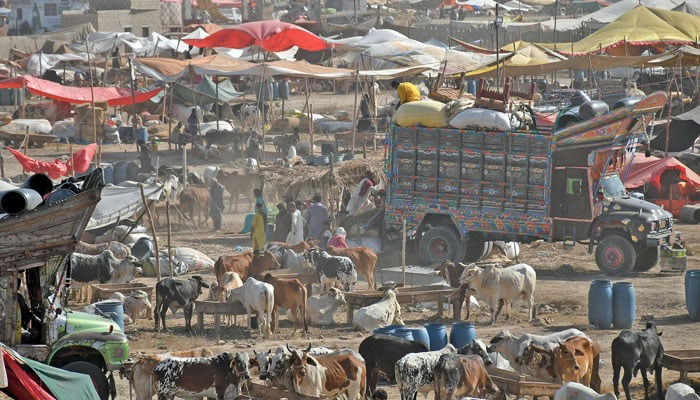
LAHORE: In contrast to the strong buying and selling trends of previous years, this year’s Eidul Azha cattle market experienced an unusual slump in both prices and the volume of animals traded, resulting in substantial losses for feedlot farmers and traders.
According to hide and skin processors, around 0.6 million fewer animals were sacrificed during Eid compared to last year. Feedlot farmers, however, believe the shortfall could be as high as one million. Estimates from the hides and skins industry suggest that a total of 6.977 million animals were sacrificed this year, including three million cows, 3.4 million goats, 0.4 million sheep, and 0.1 million camels.
A noticeable downward trend in sacrificial animal prices was observed during the just-concluded season. As a result, the total value of sacrificial animals is estimated at under Rs500 billion -- despite the reduced number of slaughters. The average price of a cow fell by Rs25,000 to around Rs150,000, while the price of goats rose by Rs10,000 to approximately Rs50,000. Camel prices also increased. The total estimated value of hides and skins this year stood at Rs6.35 billion.
Multiple factors appear to have contributed to the downturn in the traditional cattle market. Economic slowdown is being cited as one of the major reasons. “When the broader economy is under pressure and people face higher living costs, their disposable income for seasonal purchases such as sacrificial animals declines,” said Mohsin Raza, a progressive feedlot farmer who set up a temporary stall at Kahna Mandi on the outskirts of Lahore. He added that reduced purchasing power, compounded by inflation, made it difficult for many families to afford an animal -- particularly when prices remained relatively high.
Feedlot farmers also pointed to rising input costs -- such as animal feed, labour and transportation -- as a major concern. With lower selling prices and higher costs, profit margins shrank and, in many cases, turned into outright losses.
Some observers believe an oversupply of animals in certain markets may have contributed to the slump. This could be due to more farmers entering the feedlot business in anticipation of higher seasonal returns.
Changing consumer behaviour may also be playing a role. An increasing number of buyers are opting for smaller animals, participating in collective sacrifices, or donating to charities that carry out sacrifices on their behalf -- thereby reducing individual purchases. This situation has undeniably caused financial hardship for many farmers and traders who invest heavily in raising and maintaining livestock throughout the year. Failure to sell at expected prices or volumes means a direct loss of income, which is especially concerning given the religious and cultural significance of Eidul Azha.
Observers noted that this year’s market dynamics were shaped by a unique confluence of factors -- including cross-border disruptions, changing donor preferences and speculative uncertainty.
The temporary closure of borders with Afghanistan and Iran had a notable impact. High-quality livestock from these neighbouring countries were held up, and when borders reopened, high fees discouraged traders from completing transactions. Consequently, many animals were brought back into local markets, increasing supply and further depressing prices. Meanwhile, the conflict in the Middle East affected priorities for international donors and humanitarian organisations. A shift in focus and funding meant fewer donations for sacrificial animals in Pakistan, adding to the local surplus.
Market sentiment remained uncertain until just days before Eid, when traders realised that animal supply exceeded demand, triggering a sharp drop in prices. While this benefitted buyers, traders and farmers who had delayed sales suffered significant losses.
It was observed that buyers predominantly sought cattle priced between Rs175,000 and Rs250,000, with limited interest in animals priced above Rs350,000. This led to losses for those who had invested in premium livestock, unable to achieve the returns seen in previous years.