music
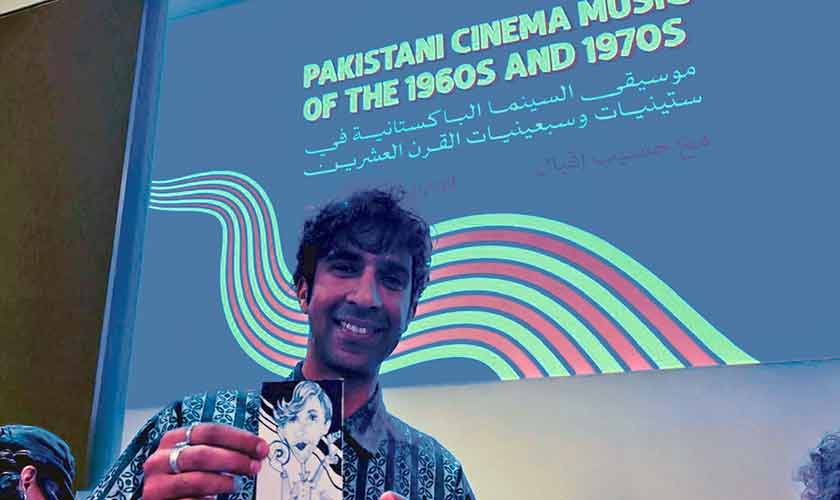
I came across a poster on Instagram and almost didn’t think twice about it. It looked like one of those cultural events you scroll past, maybe save, maybe forget. But the words ‘Pakistan’ and ‘songs’ were enough to make me sign up.
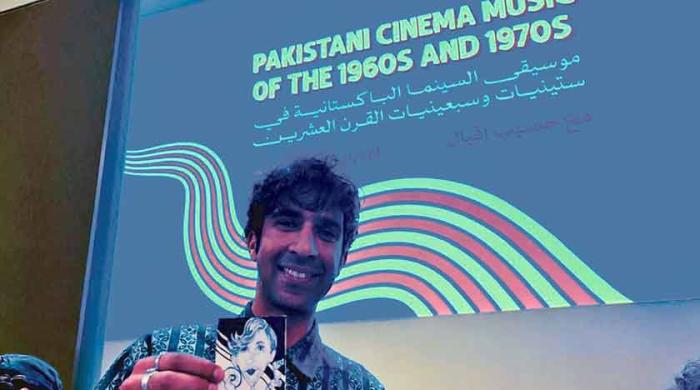
It was Haseeb Iqbal’s Pakistani cinema listening session at JAX District for the Diriyah Biennale 2026, held recently. I didn’t know much about him before that night. Honestly, I didn’t know much about the world he was about to open up either.
The setting was intimate, an auditorium that felt more like a shared memory space than a performance venue. I watched him walk onto the stage in matching separates, striped and bronzy, with just the right amount of jazz in the look. At that point, I started searching my own memory for Pakistani songs I knew. Apart from a few popular tracks, there wasn’t much I could pull up.
I remembered my mother playing Indian classics at home and me humming along without thinking. My father had Western playlists that filled our unusually tall windows with sound. But Pakistani music? Nothing came to mind.
My teenage years were scattered musically. Hindi and Urdu film songs dominated most of it, me trying to copy dance steps from ‘Kuk Kuk’ or getting lost in the heavy melodies of Devdas. Pakistani cinema, Pakistani songs, they weren’t part of that rotation. Not because they didn’t exist, but because they weren’t present in my everyday listening.
What unfolded that evening was not a simple listening session. It wasn’t just tracks playing while people swayed in their seats. It felt closer to a guided memory, a mix of music, storytelling and personal archive. Haseeb wove in anecdotes about himself, about Pakistani cinema and about how he came to this sound world in the first place.
He grew up in England and spoke openly about his questions of belonging. Not just to Pakistan, but to language, to identity, to what it means to claim something you don’t fully speak or fully know. And yet, through music, he seemed to have found a way in.
He shared that at around 15, he knew he wanted purpose more than just a profession. Later, through a chance connection, an acquaintance with no ties to Pakistan, who had discovered old records through vinyl purchases in India, he was introduced to Pakistani cinema music. It wasn’t a planned discovery. It was almost accidental. But it stayed.
Belonging became the thread running through the performance. Even as he admitted he couldn’t always pronounce Urdu words correctly and didn’t claim technical expertise, he carried his roots with ease. That stayed with me longer than I expected.
I found myself thinking about my own identity in fragments. I am Baloch on both sides, but not fluent in the language. Still fully Baloch. He is fully Pakistani. And yet, both of us sit in that in-between space of recognition and distance. There was even a lighter moment of comparison, he joked he could pass as Mexican and I’ve been told I look Arab. It sounds casual, but it sat inside a deeper question the night kept circling back to: where do we place ourselves when language doesn’t fully hold us?
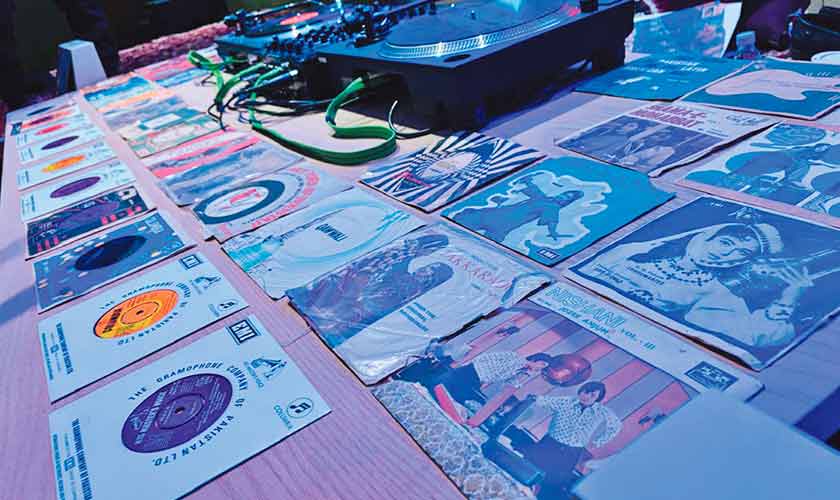
He also spoke about his visits to Pakistan, often through stories rooted in family, especially father-son relationships. One story stood out, about a father-son duo in Karachi who preserved tens of thousands of vinyl records from Pakistani cinema’s earlier decades. When the industry shifted in the late ’70s and music formats and film culture changed, these records were at risk of disappearing. The family, deeply rooted in the music profession, chose to keep them alive instead.
That detail reframed something for me. Pakistani cinema and music are often spoken about in terms of absence or decline. But Haseeb’s work pointed elsewhere, toward continuity, preservation and memory. He traced back to a time when cinema was more expansive, when women directed films, when stars sang their own songs and when the industry stood among the most productive in the world.
He mentioned that at its peak, Pakistan ranked fourth globally in film production. It was not nostalgia for the sake of nostalgia. It was context, a reminder that what feels missing now once existed in full volume.
After the session, I went home and messaged my mother. I needed to know why I had never heard these songs growing up. I sent her one of the tracks played that night. She recognised it instantly, Naheed Akhter.
She didn’t have a clear answer for me. Maybe it was the dominance of Indian cinema in her own viewing habits. Maybe it was simply what was available, what was circulating, what filled screens and homes at the time.
I asked my aunt too, half-curious, half-testing my own ignorance. She responded with immediate enthusiasm, naming artist after artist, pulling up references I couldn’t keep up with. It felt like I had walked into a room that had always been full, but I had only just entered.
I was there with my friend Reem, who is Palestinian. She didn’t understand the language of the songs, but she didn’t need to. She swayed through the session, repeating fragments of choruses, sometimes just mouthing ‘never mind’ when she caught onto rhythm instead of meaning. She was fully in it in a way that didn’t rely on translation.
That stayed with me too, how music held meaning even when language didn’t.
It was a beautiful night and a beautiful era to look back on, or perhaps even look forward to.