Emissions from petrol-powered vehicles pollute the environment. The need of the hour is a green transition,including electric vehicles, which are an environmentally friendly mode of transportation. You! takes a look…
My salary hasn’t increased in the last five years but the prices of fuel have gone up multiple times during this period. With rising inflation, I don’t know how to manage household expenses and pay for petrol for commuting to the office and running errands,” says Shafaq to her colleague Tayyaba. “You are right, I am also facing the same problem. Everything is so expensive and it is becoming difficult to make ends meet,” agrees Tayyaba.
Soaring petrol prices have affected everyone but they have hit the working middle class the hardest. For them, the only purpose in life seems to be paying their bills and other necessities. Once, long drives were a pleasure but not anymore. Now, people think twice before taking their cars out for outings or social visits.
So, is there a way to curb petrol prices and inflation? Well, that would require effective policies and measures on the part of the government, which may take years to implement. As of today, a simple solution to the common man’s woes lies in electric vehicles, which are an environmentally friendly mode of transportation and are cheaper to operate than petrol-powered vehicles. Emissions from petrol-run vehicles pollute the environment and also contribute to climate change.
What is green transition?
Green transition is the shift from an economy that depends on fossil fuels to one that is environmentally friendly, low in carbon emissions and better able to handle climate change. A key part of this shift is the energy transition, which focuses on replacing fossil fuels with renewable sources like solar, wind and geothermal energy.
In simple terms, the sustainable energy transition aims to reshape the global energy system to fight climate change while supporting long-term development. This means not only using cleaner energy but also improving energy efficiency, adopting new technologies such as energy storage and reducing emissions in major sectors like electricity, transport and industry.
Green transition in Pakistan’s automotive sector
Pakistan is steering its automotive industry towards cleaner mobility, aiming for electric vehicles (EVs) to make up 30 per cent of all new car sales by 2030. Backed by the New Electric Vehicle Policy (NEVP) 2025-2030, this transition is designed to lower fuel import costs and reduce urban air pollution. Automakers such as BYD have already begun introducing EV models, while the government is focusing on expanding local production, building charging infrastructure and providing incentives to encourage adoption.
For a country highly vulnerable to climate change, this shift could have far-reaching benefits. Major cities continue to struggle with severe smog and poor air quality, while dependence on imported oil places significant strain on the economy. Moving toward EVs offers a pathway to ease these challenges by cutting fuel imports, improving air quality and strengthening the country’s external financial position.
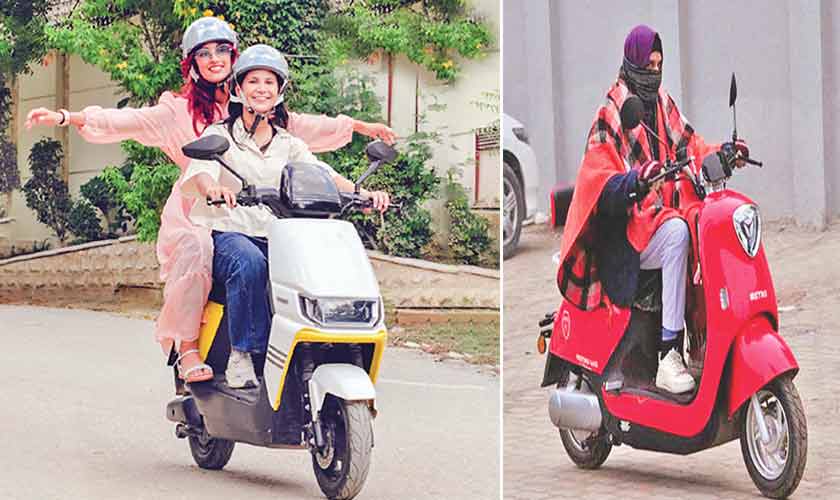
Electric Bikes: Redefining women’s travel
Navigating public spaces has long been a challenge for women worldwide. In Pakistan, many women rely on public transport, ride-hailing services or family members for their daily travel. Yet, overcrowded buses often make commuting particularly difficult. Safety remains a serious concern, as harassment and catcalling are common, leaving women feeling vulnerable during routine journeys. On top of this, long wait times, lack of privacy and unreliable schedules make daily travel stressful and draining. Constantly having to avoid unwanted attention and harassment takes a significant toll on women’s mental, emotional and physical well-being.
Women often have to put up with unnecessary tantrums from male family members just to be dropped off or picked up, sometimes even pleading at the cost of their self-esteem. While ride-hailing services provide convenience, their high cost makes them unsuitable for everyday use. On the other hand, petrol-powered motorcycles and cars come with rising fuel expenses, ongoing maintenance and complex riding mechanics -factors that discourage many women from relying on them as a primary mode of transport.
These barriers greatly limit women’s ability to access education, employment, healthcare and wider economic opportunities. Electric mobility offers a practical way forward, giving women in Pakistan a safer, more affordable and more dignified means of transportation.
Electric bikes and scooters provide a straightforward and secure mobility option, particularly for female riders. Most e-bikes are automatic, removing the need for gear shifting or clutch handling. This makes them especially accessible for beginners and for women with little or no prior riding experience.
The Government of Pakistan’s ‘Women on Wheels’ initiative has played a key role in promoting women’s mobility and independence. By helping women overcome social and practical barriers, it builds their confidence to travel on their own. E-bikes can further accelerate this progress - encouraging more women to take to the roads, normalising their presence in public spaces and contributing to a more inclusive and equitable society.
Barriers to EV adoption
Despite various incentives, numerous challenges for automotive manufacturers and consumers persist in the market, ranging from cost efficiency, consumer expectations, end-of-life treatment of EVs, high up-front cost, national grid’s reliance on fossil fuels, lack of charging infrastructure and policy inconsistencies.
While Pakistan has announced ambitious EV policies and manufacturing plans, progress is constrained by high vehicle costs, infrastructure gaps and limited consumer awareness. The auto parts industry is also under increasing strain as companies grapple with shifting to electric vehicle technologies, hindered by gaps in technical expertise and unclear market demand.
Addressing the issues
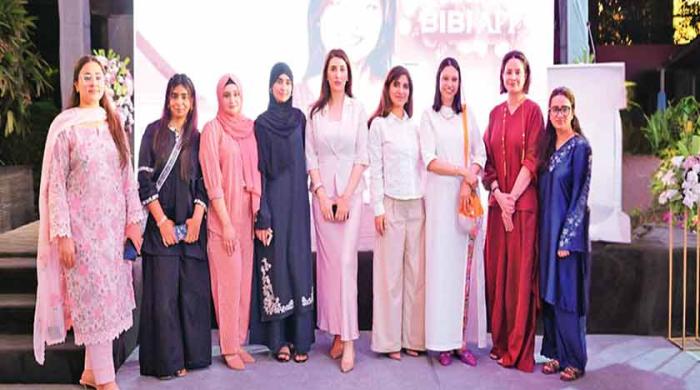
Recently, policymakers, industry leaders, academics, researchers and climate advocates gathered at an event in Karachi organised by Indus Consortium and Grow Green Network, with support from Sustain X Partners. Experts examined Pakistan’s green transition, with a strong focus on sustainable mobility and climate action, addressing policy direction, industry preparedness and implementation challenges across a series of sessions.
The first session focused on the green transition in Pakistan’s automotive sector, highlighting both structural barriers and emerging opportunities. The discussion featured Prof Dr Naveed Arshad, Director of the LUMS Energy Institute; Yasir Hussain, Director of the Climate Action Center; Muhammad Usman, Head of Sustainability at Thyssenkrupp Materials North America and a consultant at the LUMS Energy Institute; Shuja ul Haq Siddiqui, Vice Chairman of the Pakistan Association of Automotive Parts and Accessories Manufacturers (PAAPAM); and Bilawal Suhag, Head of Research at FPCCI.
Prof Naveed Arshad explained the vision behind Pakistan’s New Energy Vehicle Policy, underscoring the need for well-defined targets and sustained long-term commitment. He observed that increasing fuel prices, driven by geopolitical tensions, could make the goal of reaching 30 per cent electric vehicles by 2030 more achievable. Yasir Hussain pointed out shortcomings in implementation and coordination, while Bilawal Suhag stressed the importance of aligning the industry with global trends, identifying innovation as a crucial engine for growth. He also highlighted that consistent policy direction would be essential for the successful realisation of NEVP objectives.
Muhammad Usman emphasised that Scope 3 emissions continue to be the dominant source of emissions in the transport sector. He stressed the importance of addressing lifecycle emissions in a cost-effective manner, proposing alternative fuels - especially biofuels - as viable options for reducing emissions from existing heavy transport systems.
Shuja ul Haq Siddiqui highlighted that the auto parts industry is facing significant pressure, as companies struggle to transition toward electric vehicle technologies due to limited technical expertise and uncertain market demand. He also identified shortcomings in policy support, particularly in terms of incentives for localisation and effective implementation. He noted that electric vehicles remain largely unaffordable for the general population, underscoring the need for greater localisation and stronger incentives.
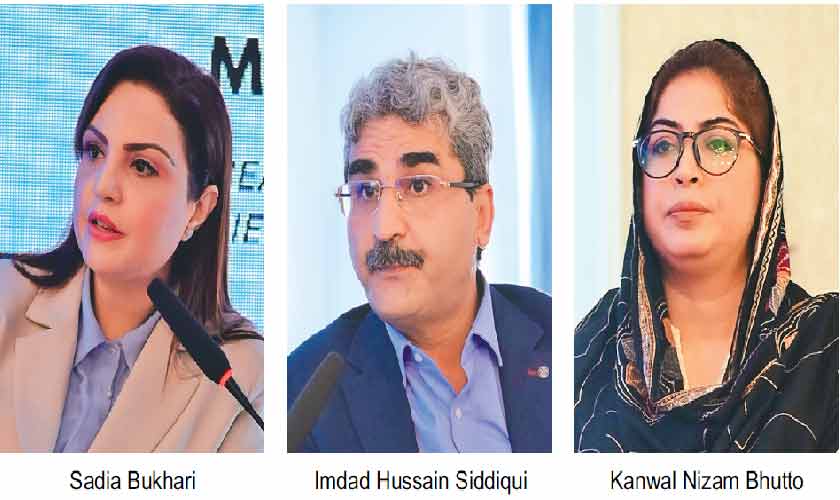
Kanwal Nizam Bhutto, Managing Director of the Sindh Mass Transit Authority, outlined the Sindh government’s ongoing and planned initiatives related to electric vehicles and the Karachi Circular Railway. “Our government is committed to providing clean, sustainable transport. Electric buses are operating across Sindh, and 100 more will be added soon,” she announced. She also said that the provincial government would move forward with the circular railway project once land issues are resolved, adding that a memorandum of understanding would be signed with the railway ministry to revive the system.
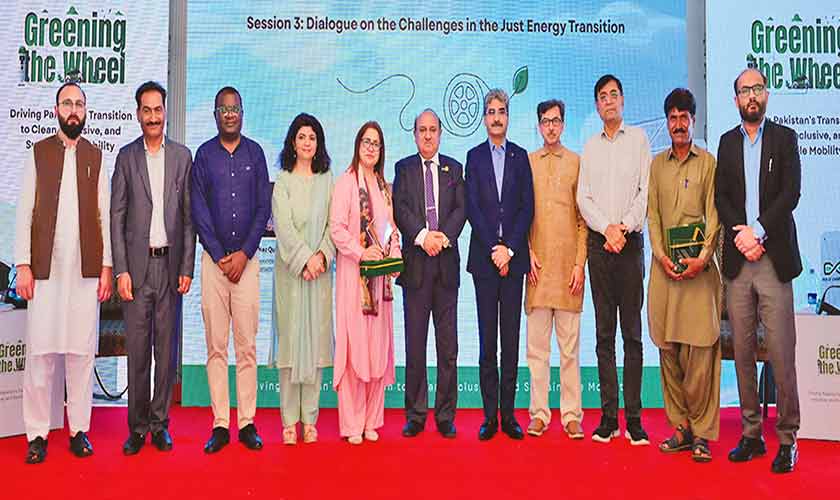
Financing was a key focus of the second session, with participants emphasising the need for greater access to climate finance, increased investment in renewable energy, and stronger incentives for adopting sustainable practices. The discussion also highlighted the role of local initiatives and grassroots networks in supporting national strategies, helping to drive climate action that is both inclusive and scalable.
The session, titled ‘Banking the Automobile,’ featured Rashid Azeem, Divisional Head of ESG at UBL Bank, who discussed both the challenges and opportunities in innovative automotive financing. Wajih Zaman, Head of Operational Risk and Green Banking at Soneri Bank, examined the financial sector’s role in advancing green automotive products. Ms Sadia Bukhari of Sindh Bank provided insights into the current financing landscape and shared updates on ongoing initiatives.
Mashood Ali Khan, Director of the Small and Medium Enterprises Development Authority (SMEDA), emphasised the need for green financing and pointed out that electric vehicles have gained traction in developed countries due to strong government support, with infrastructure being a key factor in their adoption.
Mushtaq Ahmed Shaikh, Director of Industries and Commerce, Sindh, presented an overview of provincial initiatives, while Asim Jaffry from Pakistan Fair Finance drew attention to air quality issues associated with the automotive industry.
The third session, ‘Challenges in the Just Energy Transition’, highlighted community experiences and concerns around energy transition and climate justice. Imdad Hussain Siddiqui, Director of the Climate and Disaster Justice Unit at the Provincial Ombudsman’s Office, reflected on key lessons from the 2022 climate-induced floods. Dr Khalid Waleed of SDPI provided a critical analysis of carbon markets, while Advocate Shazia Nizamani from the Sindh Women Lawyers Alliance spoke about the barriers limiting women’s participation in energy-related decision-making.
Iqbal Hayder of the Laar Humanitarian Development Programme (LHDP) discussed the displacement of communities in the Indus Delta due to projects financed by multilateral development banks. Tayyab Ur Rehman represented upstream communities impacted by large hydropower schemes, and Kamal Palari of the Keenjhar Maroo Arra Welfare and Development Organisation highlighted the challenges faced by communities living in the wind corridor of Thatta district.
No longer a distant green dream
Notwithstanding persistent challenges and structural barriers, the road to green mobility in Pakistan - where electric vehicles are becoming an integral component - is steadily transitioning from aspiration to reality. This progress is driven not only by technological advancement and policy support, but also by the growing inclusion of women, who are increasingly participating in sustainable transport initiatives such as electric bikes. Efforts to ensure gender inclusion are helping to reshape mobility by enabling women to ride e-bikes independently. Organisations like the Indus Consortium are playing a significant role in this transformation by promoting community-based climate resilience, supporting women-led initiatives, and fostering awareness around sustainable practices, thereby reinforcing the collective momentum towards a greener and more inclusive mobility future in Pakistan.
Erum Noor Muzaffar is the Editor of You! Magazine. She can be reached at [email protected]