Taha Kehar is a Pakistani author. That is perhaps the shortest introduction to him, and I would like to leave it at that....
COVER STORY
Taha Kehar is a Pakistani author. That is perhaps the shortest introduction to him, and I would like to leave it at that. I could, perhaps, challenge myself to write a few more lines about him, but I know I would fail that challenge. This is because the unique tone that Taha’s writing carries is almost indescribable. It is something that must be experienced.
If anyone were to meet Taha, they would find a down-to-earth writer who would make you believe that he is nothing but a humble student of creative writing, not a conduit through which the voices, tensions and longings of the individuals who shaped his world are distilled into words.
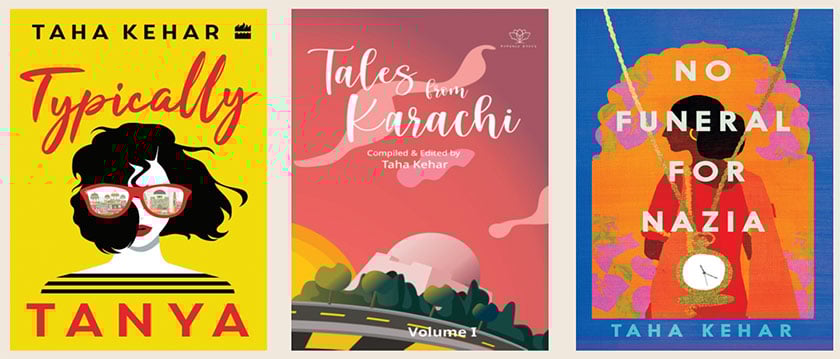
I had my ‘Aha! That’s so me!’ moments when I read his second novel, Typically Tanya (published in 2018). It was fascinating how he captured the frustrations and fears women travellers experienced when they began using ride-hailing apps for their daily commute. In his 2023 novel, No Funeral for Nazia, Taha crafts a compelling narrative voice for an independent, unconventional woman to tell her life story.
Last year, however, he did something of a role reversal. If Taha was once a conduit for the voices of others, this time he turned that conduit inward. No longer merely a ventriloquist animating imagined figures, he collaborated with fellow writer Fatima Ijaz to create something closer to a self-portrait - a work that allows readers to witness the life and thoughts of a creator.
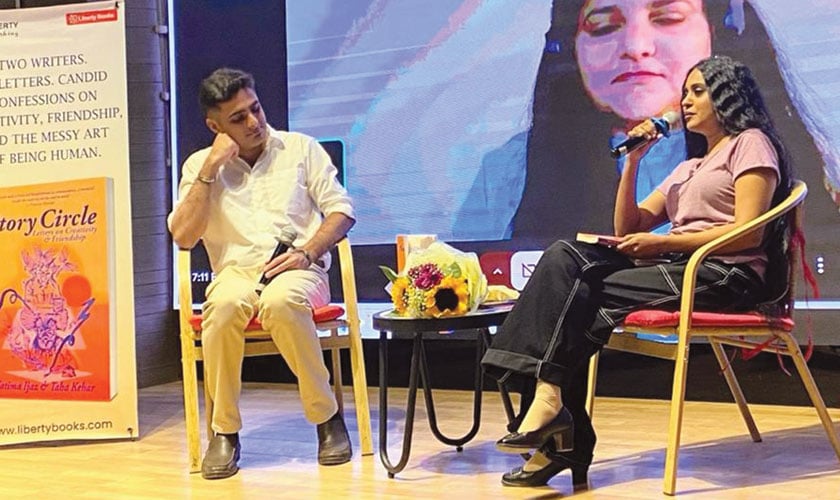
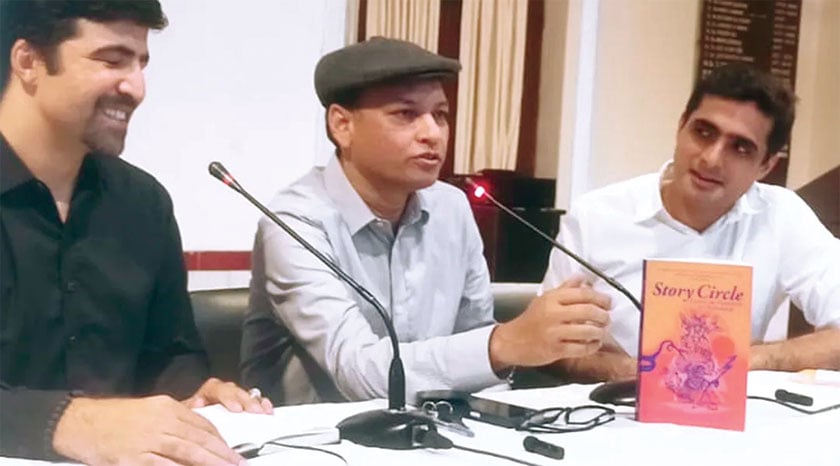
That experiment has led to my earnest attempt at writing about him as a creator. Launched in November 2025, Taha’s latest book, Story Circle: Letters on Creativity and Friendship on Saturday, is a collection of letters exchanged between Taha and Fatima Ijaz over five weeks via email. It is his humility that allows him to collaborate with fellow writers and, in his words, “sidesteps the unpleasantness associated with petty professional rivalries”.
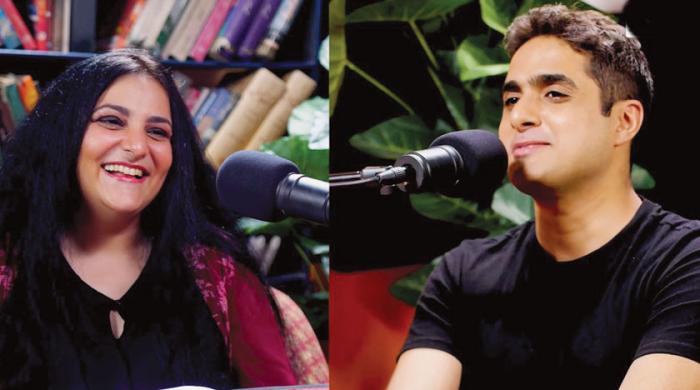
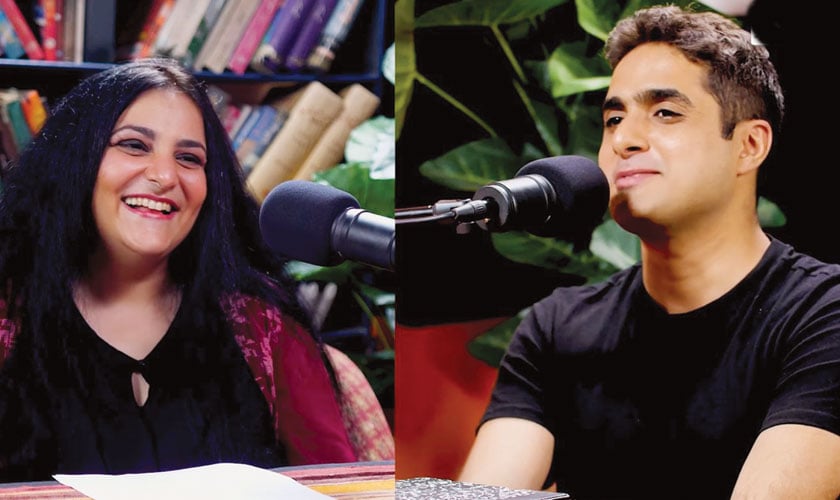
For this piece, I am more interested in providing the ‘behind-the-scenes’ of a novel, instead of talking about the creative work itself. With that aim, I arranged an online interview with Taha to better understand how his creative process works.
The interview is scheduled late, but Taha is accommodating. His weary eyes scream for rest, but his commitment suggests otherwise. He tells me that he has been up since 7am, but he does not mind talking about the art he deeply respects.
I ask him the question that almost every writer has been asked at some point: can we separate the writer from their characters?
For him, characters are not aspirational figures, nor idealised versions of who he wishes to become. Instead, these characters represent heightened, stronger versions of the writer’s own personality, embodying bold and dramatic lives. By leaning into what he calls an ‘intimacy of honesty’, Taha explores traits he sees in himself and those around him, shaping these observations into fictional figures that feel strikingly authentic.
The fictional world of Taha’s novels is populated by flawed individuals. Characters like Tanya, Nazia and Perveen navigate complex situations involving blackmail, unrequited love, sibling rivalries and the role of the ‘other woman’. Taha says he approaches these characters with deep empathy rather than judgement. “To portray a flaw is not to endorse it.” As a writer, he refuses moral policing. His task is not to advocate but to observe.
One characteristic of Taha’s work is its impeccable structure. His words flow like a mountain stream, gentle and disciplined. And yet the writing never appears pretentious. I ask him how he managed to crack this code.
Taha believes that if the first line, or even the first paragraph, is right, the rest of the work flows naturally. Language matters. The process involves distilling ideas and digging deep into the page before editing. He avoids flowery or obscure language, preferring straightforward and accessible English. This simplicity ensures that the work is ready for a wider market while remaining true to the writer’s voice. The simplest words, he insists, often carry the greatest force. At the same time, he is wary of excessive ‘wokeness’; a tone that feels overly sanitised does not help the story either.
“Human nature is wildly unpredictable and steers people to make some problematic choices. Many of us have a tendency to weaponise the differences between us, viewing them less as markers of diversity and more as threats to our existence. A writer’s job is to faithfully represent the many shades of this reality, even if the narrative ventures into dark terrain,” he says.
He is also acutely aware of the industry that surrounds his writing. Beyond the page, he thinks in terms of ownership - of stories that might extend into documentary or audiobook formats. For him, writing is not only an art but also part of an evolving ecosystem of form, language and reach.
So I ask how he manages that along with writing. “I enjoy building an architecture of ideas around a book,” he says. “My criticism is not destructive; it seeks to start a conversation around a literary text.”
Taha’s creative gears are not taking a break anytime soon (thankfully so!). He is all prepared to launch his new book Matchmaker. “My upcoming book is not a novel, but a collection of stories titled Matchmaker and Other Stories,” he explains.
“For many years, I’ve found solace in producing longer works of fiction that allow me the time and space to capture the full extent of my characters’ experiences. Over the years, I have written short stories only on request for friends and editors. Curiously, I have never considered myself to be a ‘short story writer’. Short fiction is sacred territory for me, a space that can’t be abused through excess. Before I put these stories out into the world, I want them to be perfect. Even so, I’ve seen short stories as warehouses where I experiment with ideas to determine whether they can hold my attention for a longer work of fiction.”
Taha adds: “Matchmaker and Other Stories comprises 15 short stories that I wouldn’t have dared to publish a few years ago. In many ways, releasing them into the world is both a courageous and frightening decision. The stories, though less transgressive than my novels, mean a great deal to me. One of the tales included in this book, which will be out in September 2026, is a prequel to No Funeral for Nazia.”
I have often wondered whether writers carry a small brigade of the famous Oompa Loompas, tiny hands at work busily arranging words before they reach the page.
This childlike image feels threatened now. With the growing dominance of AI and large language models (LLMs), I fear that a writer’s creativity may become the first casualty. Before this interview, I had already posed this question to Taha, nudging him to acknowledge his silicon-based rival and comment on its abilities.
According to Taha, while “AI has given writers a run for their money, it hasn’t extinguished their desire to express themselves. Even in an age where large language models are gaining prominence, many writers find solace in the language of their own souls instead of relying on the dull, repetitive texts churned out by chatbots. The art of writing will endure as long as we continue to prioritise the soul of a written piece over its mechanical elements.”