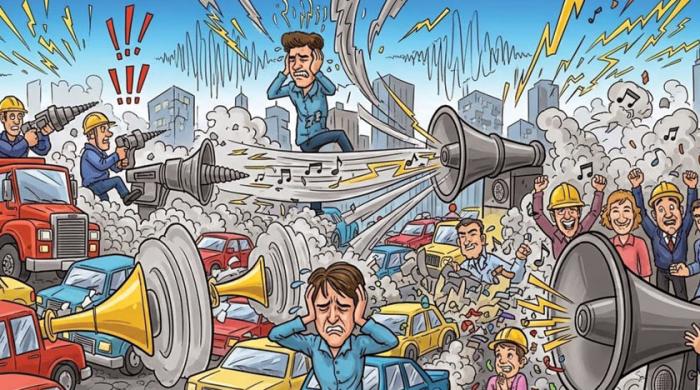
Noise pollution refers to excessive, unpleasant or harmful sound in the environment that disrupts normal activities and affects people’s health and well-being....

EDUCATION
Noise pollution refers to excessive, unpleasant or harmful sound in the environment that disrupts normal activities and affects people’s health and well-being. Common sources include traffic, construction work, loudspeakers and industrial activity. In busy city areas, constant noise has become part of daily life, but its impact can be especially harmful in places meant for learning, such as schools.
Schools should ideally be located in peaceful environments where students can concentrate and teachers can communicate effectively. Unfortunately, this is not always the case. In many cities, schools are situated along busy roads or in crowded commercial areas where traffic noise is constant throughout the day.
Noise pollution during classes distracts both students and teachers and negatively affects the learning process. When vehicles honk repeatedly or engines roar outside classrooms, students find it difficult to focus on their lessons. Teachers may also struggle to explain concepts clearly if their voices have to compete with loud background sounds.
Many schools in Pakistan are located near busy roads and commercial centres. Studies conducted in different Pakistani cities have shown that noise levels around educational institutions often range between 60 and 94 decibels, which is far higher than recommended limits. According to international guidelines by the World Health Organization, noise levels inside classrooms should ideally remain below 35 decibels to ensure effective teaching and learning. When sound levels exceed this limit, concentration becomes difficult and communication in the classroom suffers.
Infrastructure problems can make the situation even worse. Some schools lack proper boundary walls or protective barriers, allowing outside noise from traffic, construction sites and crowded streets to enter classrooms easily. In densely populated areas, classrooms are often built very close to one another, which can also create disturbances during lessons.
Noise pollution does not only disrupt learning; it may also lead to stress, fatigue and reduced academic performance among students. Researchers have found that students studying in schools located near busy roads often perform worse academically than those studying in quieter environments.
To address this issue, practical steps are needed. Schools should be provided with proper boundary walls, green belts or sound barriers to reduce outside noise. At the same time, traffic regulations near schools must be enforced more strictly.
However, this is not only the government’s responsibility. The public must also play its part. Drivers should avoid unnecessary honking near schools, loud music should be discouraged in school zones and noisy vehicles such as motorcycles and rickshaws should be regulated. Fines for excessive noise near schools could help create a more suitable environment for learning.
A quiet classroom is not a luxury - it is a basic requirement for quality education.