Power generation from renewable resources such as hydel, solar, biomass and wind has become central to Pakistan’s energy discourse, given persistent power shortages and a rising import bill. While these conventional renewables offer significant promise, another largely overlooked frontier exists: ocean energy. Harnessing energy from the sea -- through tidal currents, waves, salinity gradients and thermal differences -- could meaningfully diversify Pakistan’s energy mix and strengthen long-term energy security.
TIDAL ENERGY
Power generation from renewable resources such as hydel, solar, biomass and wind has become central to Pakistan’s energy discourse, given persistent power shortages and a rising import bill. While these conventional renewables offer significant promise, another largely overlooked frontier exists: ocean energy. Harnessing energy from the sea -- through tidal currents, waves, salinity gradients and thermal differences -- could meaningfully diversify Pakistan’s energy mix and strengthen long-term energy security.
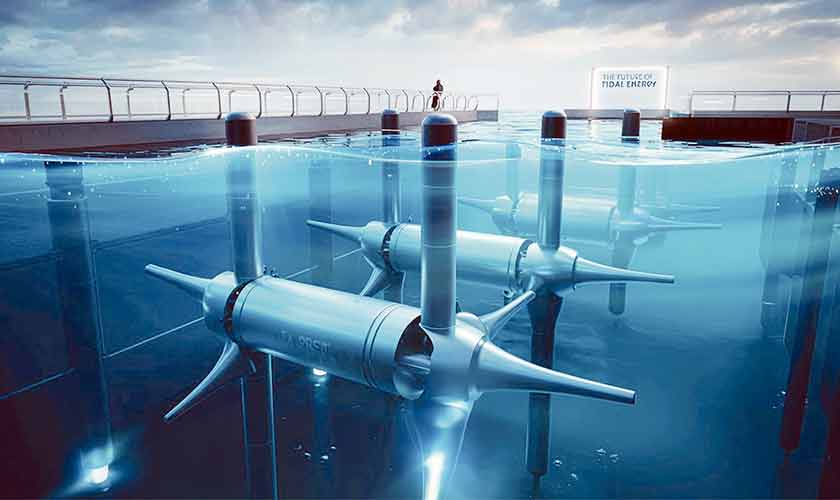
Ocean energy systems extract renewable power from marine sources through several technologies, including tidal stream generators, tidal barrages, wave energy converters, ocean thermal energy conversion and salinity gradient systems. Among these, tidal energy -- captured either through the kinetic energy of moving water (tidal streams) or the potential energy created by tidal height differences (barrages) -- is the most mature and feasible. Unlike solar and wind, tidal energy is not weather-dependent as it is governed by lunar cycles, making it a reliable and consistent source of power.
Pakistan possesses considerable tidal energy potential along its 1,045-kilometre coastline, particularly in the Indus Delta and along the Balochistan coast. Various national studies estimate a potential exceeding 1,000MW with the 170-kilometre network of creeks in the Indus Delta, comprising around 17 creeks, offering especially favourable conditions. Tidal ranges of two to five metres in these areas provide sufficient head for power generation. Korangi Creek near Karachi, as well as sites such as Khor Kalmat and Sonmiani along the Makran coast, have been identified as promising locations due to their natural lagoon-like characteristics, which are suitable for tidal barrages or stream technologies. Despite this potential, Pakistan has yet to develop a single large-scale tidal power project. The absence of a clear policy framework, inadequate investment and limited site-specific data have constrained progress, while ocean energy remains largely unaddressed in mainstream energy planning.
Institutional efforts, however, have laid some groundwork. The National Institute of Oceanography has played an important role in assessing tidal resources through coastal surveys, current measurements and environmental studies. The establishment of a tidal and weather observatory in Gwadar and ongoing research on tidal dynamics, coastal erosion and marine chemistry provide valuable data for future project planning. Similarly, the Pakistan Navy’s National Hydrographic Office has contributed significantly by conducting bathymetric surveys, mapping seabed conditions and collecting long-term tidal data across multiple coastal sites. These efforts have identified high-potential locations such as Gharo Creek, Waddi Khuddi Creek, Paitiani Creek and Dabbo Creek, along with sites along the Makran coast, including Ormara and Gwadar.
Globally, tidal energy is transitioning from pilot projects to early-stage commercialisation. Installed ocean energy capacity currently stands at about 500–513MW worldwide, with tidal energy forming the dominant share, underscoring that despite vast theoretical potential, the sector remains at an early stage of development. The global theoretical potential of tidal energy alone exceeds 3,000 GW, though only a fraction, up to 400 GW, is presently exploitable. Europe -- particularly the UK and Scotland -- remains the hub of innovation and deployment, while Canada is advancing large-scale testing in the Bay of Fundy. In Asia, China and South Korea are making notable progress; the 26MW Sihwa Lake Tidal Power Station in South Korea remains the world’s largest while China continues to expand its portfolio with ambitious projects under development.,
Technological trends favour tidal stream turbines over large barrages due to their lower environmental impact, modular deployment and scalability. Floating platforms and hybrid systems combining tidal with wind or solar energy are also gaining traction enabling more consistent, round-the-clock renewable generation and enhancing grid stability. Nevertheless, challenges remain. High upfront costs, complex installation in harsh marine environments and environmental concerns, particularly impacts on marine ecosystems and sediment dynamics, require careful planning and robust regulatory frameworks. However, as deployment expands and technologies mature costs are expected to decline following a trajectory similar to that of wind and solar over the past decade.
In this context, Pakistan stands at a critical juncture. The country has already identified potential sites, conducted preliminary studies and built institutional capacity. What is now required is a decisive policy shift that explicitly recognizes tidal energy within the national energy planning framework for IGCEP 2025–2035. While current strategies rightly prioritise hydropower, solar and wind, integrating ocean energy would align with broader objectives of energy diversification, import substitution and system resilience -- particularly as the grid incorporates higher shares of intermittent renewables.
Encouragingly, the prime minister’s directive issued just last week to formulate a comprehensive strategy to meet Pakistan’s future energy needs through renewable resources provides a timely policy opening. This direction should be interpreted broadly to include not only established technologies but also emerging resources such as tidal energy. Pilot projects in high-potential creeks should be initiated without delay to establish technical and economic viability. Off-grid tidal systems could offer a practical solution for electrifying remote coastal communities, reducing reliance on expensive diesel generation while supporting local development.
A comprehensive national policy on ocean energy -- integrated into the broader renewable energy roadmap -- should include appropriate tariff mechanisms, targeted fiscal incentives, environmental safeguards and facilitation of public-private partnerships. With rising energy demand and increasing pressure on conventional resources, overlooking tidal energy is no longer tenable. If pursued with strategic foresight and sustained commitment, Pakistan’s tides could evolve from an untapped natural asset into a dependable source of clean, indigenous power -- helping to ease the energy crisis while advancing the country’s transition towards a more resilient and diversified energy future.
The writer is a retired chairman of the State Engineering Corporation.