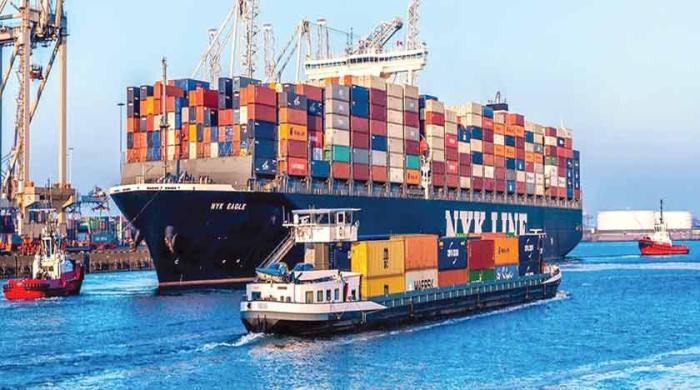
Pakistan’s international merchandise trade is once again under strain, with the deficit widening sharply during the first half (July-December 2025) of the current fiscal year. The trade gap has climbed to $19.2 billion -- an increase of nearly 35 per cent -- as imports surged to $34.39 billion while exports fell to $15.18 billion, compared to $16.63 billion during the same period last year. This represents a decline of about nine per cent in exports and signals a worrying downward trajectory that may persist through the remainder of FY2025-26 if prevailing conditions continue.
DECLINING EXPORTS
Pakistan’s international merchandise trade is once again under strain, with the deficit widening sharply during the first half (July-December 2025) of the current fiscal year. The trade gap has climbed to $19.2 billion -- an increase of nearly 35 per cent -- as imports surged to $34.39 billion while exports fell to $15.18 billion, compared to $16.63 billion during the same period last year. This represents a decline of about nine per cent in exports and signals a worrying downward trajectory that may persist through the remainder of FY2025-26 if prevailing conditions continue.
Over the past several years, Pakistan’s goods exports have fluctuated around the $30 billion mark, remaining largely stagnant in real terms despite repeated official claims of export-led growth. Exports stood at $31.78 billion in FY2021-22 but declined to $27.72 billion in FY2022–23 before modestly recovering to $30.67 billion in FY2023-24. In FY2024-25, exports rose nominally by about four per cent to $32.30 billion -- an increase insufficient to alter the broader structural imbalance. Against this backdrop, Prime Minister Shehbaz Sharif’s directive in January 2026 to double exports to $60 billion within four to five years appears overly ambitious, given existing constraints in competitiveness, productivity and market diversification.
Pakistan’s global trade profile remains characterised by a persistent structural deficit, with imports consistently outpacing exports for decades. The imbalance became particularly pronounced in the early 2000s and has since remained a defining feature of the economy. Despite its strategic geographic location linking South Asia, Central Asia and the Middle East, Pakistan ranks 67th among global exporters and 47th among importers, placing it among countries with some of the largest trade deficits worldwide.
A closer look at export destinations reveals continued reliance on traditional markets -- the US, China, the UK, Germany, and the UAE -- without substantial expansion in either volume or diversification. Exports to the US, which account for roughly 20 per cent of Pakistan’s total exports, amounted to $3.69 billion during the first seven months of FY2025-26, only marginally higher than $3.56 billion in the corresponding period last year. Similarly, exports to China stood at $1.47 billion, down from $1.48 billion previously, reflecting stagnation rather than growth. The export basket itself remains heavily concentrated, with textiles contributing around 60 per cent of total exports, followed by food products, leather goods, sports goods and surgical instruments. Limited value addition and inadequate diversification continue to constrain competitiveness.
Pakistan’s widening trade deficit is not merely a cyclical concern but a structural challenge rooted in low industrial productivity, limited technological upgrading, high input costs, policy inconsistency and insufficient market intelligence
Efforts to tap non-traditional markets have produced mixed results. Pakistan’s 'Look Africa Policy' sought to capitalise on trade complementarities with African economies, where engagement had historically been minimal. Until 2000, trade with African nations constituted an insignificant share of Pakistan’s global commerce. Bilateral trade rose to $4.44 billion in FY2022–23, but exports were only $1.55 billion, resulting in a deficit. Major partners include Kenya, South Africa and Tanzania, with exports comprising rice, textiles, pharmaceuticals, cement, paper and agricultural machinery. In calendar year 2024, bilateral trade reached $5.6 billion, with Pakistan’s exports at $2.3 billion -- again reflecting an imbalance. Preliminary indications suggest that the structural deficit persists.
A similar pattern characterises trade with the Central Asian Republics -- Kazakhstan, Kyrgyzstan, Tajikistan, Turkmenistan and Uzbekistan. Despite high expectations following the Soviet Union’s collapse, trade volumes remained negligible for decades, rarely exceeding $50 million annually before 2000. In FY2024-25, total trade with these five countries increased to over $442 million, including exports of $197 million, yet the overall balance remained unfavourable.
More recently, however, bilateral trade with these states has shown signs of contraction. During July-October 2025, total trade amounted to $78.34 million. Exports stood at $62.55 million compared to $69.18 million in the same period last year, while imports declined significantly to $15.79 million from $43.39 million -- a reduction that slightly eased the deficit but also reflected subdued commercial activity. Direct trade remains limited to textiles, food items and selected industrial products, underscoring the underutilised potential of regional connectivity initiatives.
Pakistan’s widening trade deficit is not merely a cyclical concern but a structural challenge rooted in low industrial productivity, limited technological upgrading, high input costs, policy inconsistency and insufficient market intelligence. Export targets, however ambitious, cannot substitute for comprehensive reform. Sustainable export growth requires diversification into engineering goods, information technology-enabled services, pharmaceuticals, agro-processing and value-added manufacturing, alongside institutional support for exporters and effective implementation of existing trade agreements.
Unless Pakistan undertakes serious structural reforms to broaden its export base, enhance competitiveness and strategically integrate into regional and global value chains, the trade imbalance will continue to strain foreign exchange reserves and macroeconomic stability. The country’s strategic location offers immense potential, but geography alone does not generate trade.
Only a coherent long-term export strategy -- grounded in productivity, innovation and diversification -- can transform Pakistan from a deficit-ridden trading nation into a resilient participant in global commerce.
The writer is a retired chairman of the StateEngineering Corporation.