War has long shaped the emotional vocabulary of music. In moments of conflict, words can fail and that’s when music speaks and heals.

During times of war, artists often become chroniclers of collective emotion, trans-lating fear, anger, grief and resistance into melody and verse. Some songs function as rallying cries, while others act as metaphors for the loss of human lives due to decisions made in the highest echelons of power.
In Pakistan, the musical response to war has been particularly complex. While official narratives tend to frame conflict through heroism and sacrifice, many artists from a variety of genres have approached the subject with great nuance and, in many cases, ambiguity. Therefore not all songs are straightforward. Some are universal as they apply to many scenarios including war. What these songs do have in common is how they present the emotional wreckage of violence and challenge the idea of war and the need to fight. Rather than offering certainty, these tracks linger in doubt, revealing how war fractures societies, reshapes identities and leaves wounds that endure long after the battlefield falls silent. Here’s a look at some of the songs that feel most apt about the ongoing situation around the world.
‘Beirut’ by Strings
Few Pakistani songs capture the existential confusion of war as effectively as Strings do in ‘Beirut’. Instead of framing conflict through national pride, the song opens with a disarmingly simple question: why are we marching, and toward what end? The repeated admission that no one really knows the objective turns the track into a quiet indictment of the war machine itself. The lyrics build this critique through stark imagery. A once-thriving city is reduced to ash, its name erased from memory. Mothers’ silent grief and burning homes replace the rhetoric of victory typically associated with wartime narratives. By invoking Beirut, a city synonymous with prolonged strife, the song situates Pakistani listeners within a wider global history of destruction. Strings ultimately present war not as glory but as tragedy, seen through the eyes of those who must live with its consequences.
‘Baat Barti Gayi’ by Mauj
Mauj’s ‘Baat Barti Gayi’ is not written as an anti-war anthem but its beauty lies in how it fits the present crisis on our doorstep (with Pakistan’s ongoing tensions with Afghanistan) and the one taking place in and around the Middle East due to an unprovoked attack on Iran by the United States and Israel.
The title phrase, roughly translating to ‘things kept spiralling’, suggests how tensions build quietly until they become impossible to contain. Rather than depicting violence directly, the song captures the emotional atmos-phere that always follows war and the loss of life. Although the song shows a certain restraint, it is precisely this that gives it its recall value.
By focusing on sorrow rather than spectacle, the song is a reflection not only on the slow horror and shadow of grief that follows loss of life but also the battle within.
‘Bum Phatta’ by Ali Azmat
‘Bum Phatta’ captures the chaotic frustration of a society perpetually on the edge of crisis. Built around the explosive phrase ‘Bum Phatta’, which means a bomb exploded, the song mimics the volatility of a world where political tensions and everyday frustrations collide. The lyrics, though, quickly reveal that the anger extends well beyond violence itself. While the music video is satirical, with Ali Azmat playing the characters of many real-life figures, the song is unique because it notes how a war can lead to suffering in every person’s life because of basic needs like shortages of electricity, water, flour and fuel. War and instability are not abstract concerns; they shape daily life in tangible, grinding ways.
By placing explosions alongside mundane grievances, Azmat exposes the deeper social frustrations sim-mering beneath political rhetoric.
The song’s restless energy mirrors the frustration of a generation that feels trapped between systemic fail-ures and the spectacle of conflict.
In this context, the explosion becomes both literal and symbolic: an eruption of anger from people whose grievances have long been ignored.
‘Sawal’ by Ali Azmat
If ‘Bum Phatta’ expresses rage at that chaos that erupts as a result of war, ‘Sawal’ from Azmat’s second album Klashinfolk, approaches the same landscape with a tonal shift, one that isn’t about fury but introspection. As its title suggests, it is about questions that revolve around the fragile nature of existence itself. The real beauty of ‘Sawal’ is not just how Azmat has sung it but also how he doesn’t make the mistake of giving listeners any answers.
He lets uncertainty dominate the narrative. He repeatedly returns to the idea that every moment contains contradictions: joy and sorrow, rise and decline, hope and despair. Within the context of violence, this endless questioning becomes a subtle form of resistance.
War often depends on certainty: clear enemies, ideologues bound by dogma and the simplification of complex issues into right or wrong. ‘Sawal’ disrupts that logic by insisting on ambiguity.
Dreams and ambitions appear fleeting, joy and grief blur together and every apparent truth gives way to another question. The song suggests that doubt, the refusal to accept easy explanations, may be one of the most powerful responses to a world shaped by violence.
‘Sarhad Paar Se’ by Sunny Khan Durrani
How many times must a man look up before he can see the sky?
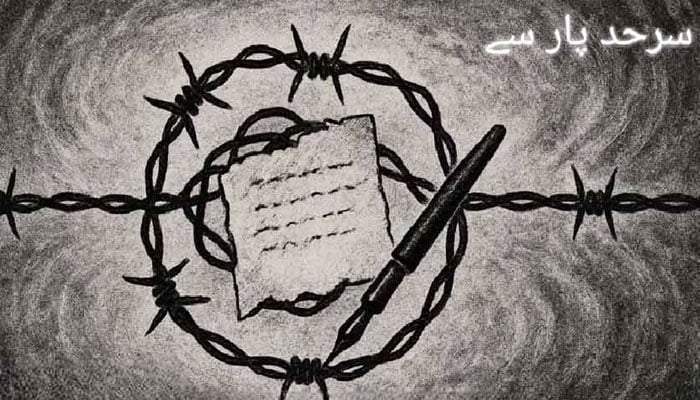
‘Sarhad Paar Se’ is not an interrogation of why conflict exists; it approaches war from the perspective of borders and fractured identities. The song was released during Pakistan and India’s most recent (and mercifully short-lived) standoff but has a universal value in relation to struggles and how neighbours become enemies. The song imagines a message arriving from across the border, a voice that was once familiar but is now overshadowed by hostility. What Durrani does beautifully is make the idea of division not only territorial but psychological.
Durrani returns repeatedly to the tragedy of how easily political narr-atives transform neighbours into enemies. His prayer for people to laugh together, share food and live without suspicion sits in sharp contrast to the nationalism that so often fuels hatred.
The track also takes direct aim at those who manipulate religion and patriotism for political gain. By shifting the focus from governments to individuals, ‘Sarhad Paar Se’ reframes war as a human tragedy rather than a geopolitical strategy. The enemy, the song suggests, is not the person across the border but the systems that profit from division. This is a reflective hip-hop elegy and a beautiful one at that.
‘Waasta’ / ‘Jawab De’ by Faris Shafi
Faris Shafi’s music thrives on provocation and confrontation. Tracks like ‘Waasta’ (ft. Ali Sethi) and ‘Jawab De’ (with Talal Qureshi as music producer) transform political anger into blistering social commentary, blending satire, absurdist humour and relentless critique to expose the contradictions of societies that sim-ultaneously condemn violence and perpetuate it.
‘Jawab De’ repeatedly demands answers for a world where bombings, corruption and extremism have become disturbingly normalised.
Shafi’s barrage of questions forces listeners to confront uncomfortable truths about hypocrisy within political, religious and social institutions.
‘Waasta’, meanwhile, combines personal vulnerability with sharp social observation, the result deli-berately chaotic, reflecting a society where emotional instability and political turmoil feed into one another.
Together, the tracks demonstrate how hip-hop has become a powerful space for confronting the contra-dictions of contemporary life.
‘Yeh Hum Naheen’
by Various Artists
‘Yeh Hum Naheen’ occupies a unique place among Pakistani songs about war because it emerged as a collective response from multiple artists. The song rejects the idea that violence carried out in Pakistan’s name reflects the country’s identity. The refrain, ‘Yeh Hum Naheen - This Is Not Us’, functions as both protest and a declaration of values. The lyrics suggest that false narratives have attached themselves to the nation, obscuring its humanity and diversity. The lyrics also acknowledge how fear and mistrust can spread inward, leaving communities suspicious of one another. The collaborative structure reinforces the message. By bringing together artists from different musical backgrounds, ‘Yeh Hum Naheen’ suggests that unity, however fragile, remains possible even in moments of national crisis.
‘Yeh Dunya’ by
Karakoram, Faris Shafi and Talha Anjum
‘Yeh Dunya’ moves beyond the boundaries of any single war to reflect on a global landscape defined by constant, indifferent change. Cities burn, people disappear and memories fade, yet life continues with unsettling momentum. The song’s central idea is that the world never pauses for individual suffering. Faces change, generations pass and the machinery of history keeps turning. Within this bleak observation, though, lies a fragile sense of resilience: wounds eventually heal, even if time itself remains unmoved. The track ultimately presents a bittersweet perspective on conflict, acknowledging pain while recognising that survival itself can be a form of quiet resistance.