“Directing a machine requires a different kind of skill, one that challenges the way our minds are wired to work with real people”, says Sarmad Khoosat, reflecting on how AI is reshaping art of filmmaking
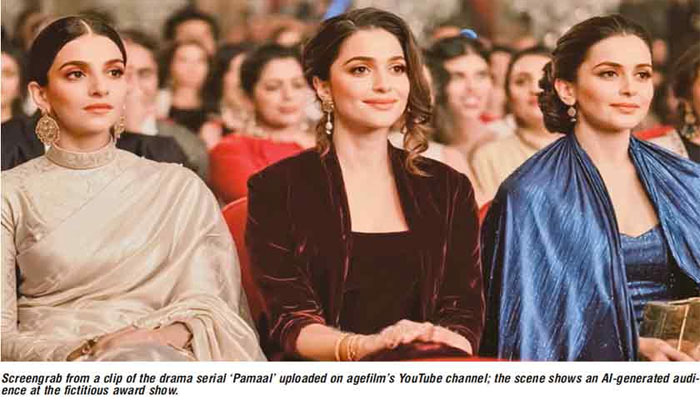
Several weeks back, viewers of Pakistan television dramas looked on in awe as the now-omnipresent artificial intelligence (AI) charged its way onto their TV screens in the most unpredictable manner.
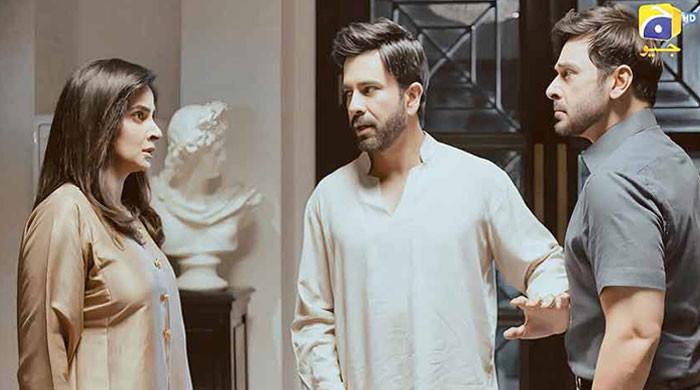
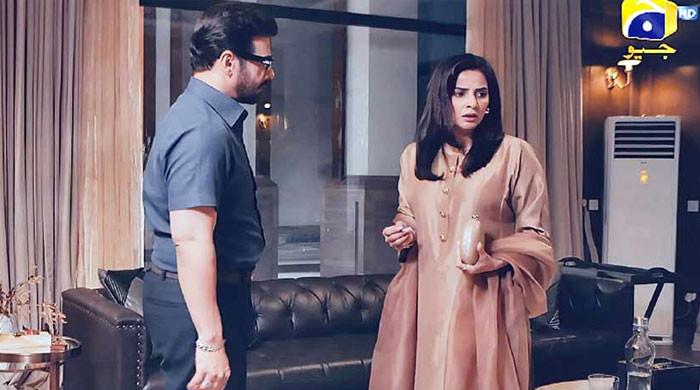
In one of the episodes of Green Entertainment’s Pamaal, broadcast in October, audiences saw a peculiar scene: an award show with an AI-generated audience. Dressed in formals, the AI characters laughed and clapped as the award show’s human hosts announced the winner.
This cinematic engineering is possible in part through deep learning, where models are trained on the provided images and videos. But does this ring alarm bells for the entertainment industry in Pakistan?
‘Dystopian future’ and ‘ominous inevitability’: how entertainment industry sees (and welcomes) AI
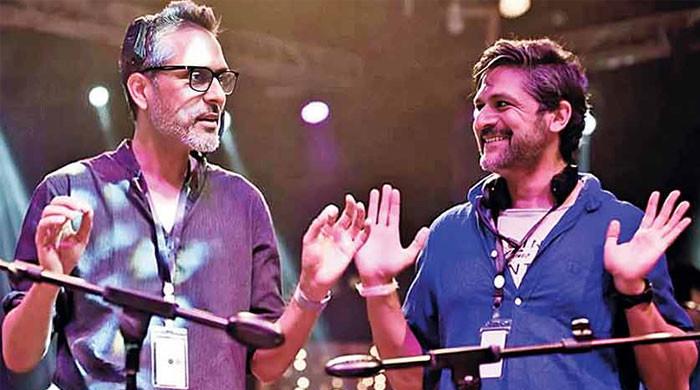
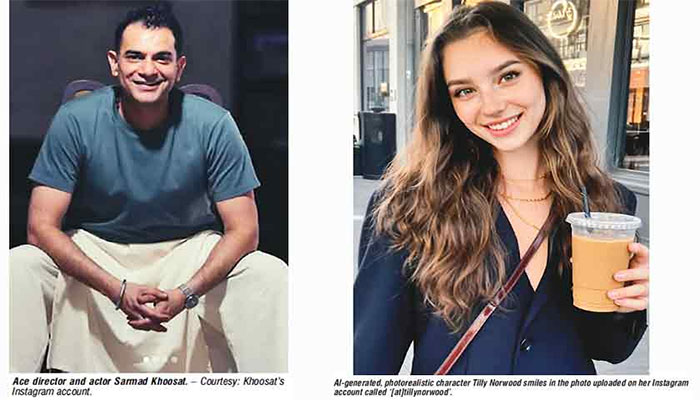
Instep reached out to ace director and actor Sarmad Khoosat and asked whether digitally created sets and crowds risk replacing the spontaneity of real-world shoots, and where the line should be drawn between creative technology and the human element. He said: “There is no replacement for the real, the visceral and the human element. As much as we would like to believe that everything is make-believe and fake on the screen, what’s fed into it is real energy, and it has its own strange ways of getting registered.”
Years ago, before the green screen became a fixture of modern filmmaking, directors would rise before dawn to capture scenes at iconic locations before the crowds arrived. Those shoots carried a kind of raw authenticity.
On this, Khoosat added: “VFX and green screen have been around for quite a while now. Some intelligent use of those has definitely been in vogue, and, as a creative style, people have used a lot of it - and I’m not against that.”
“I have not done any action-packed stuff, but for action and other things, this whole sort of integration of VFX and other tools did become a big advantage. I would say that the sweet spot has existed. For example, if you need a crowd of a thousand people, of course, you can’t afford it. So, you get a hundred or two hundred, and the rest in the background could be VFX-generated. Those kinds of things I do not feel bad about, as long as it is subtle and not an absolute replacement for the real.”
“In terms of locations too, I have been using VFX for cleaning; for example, for outdoor scenes, if we are doing a period piece, then the background and environment are cleaned up. Those kinds of augmentations and clean-ups are definitely very good functions of VFX and all the green screen, computer-generated, CGI, etc.”
Critic, entertainment journalist and former editor of Instep Aamna Haider Isani said that while she is “not in favour of artificial replacement as a replacement for a human resource, the shift is inevitable, albeit ominous.”
Beyond questions of authenticity and aesthetics, AI’s growing role in production also raises concerns about employment. In 2023, Hollywood’s first double strike in over 60 years brought actors and writers together to resist the threat of technology replacing workers across the industry. The joint action by the Screen Actors Guild-American Federation of Television and Radio Artists (Sag-Aftra) and the Writers Guild of America (WGA) halted major studio productions.
Among the protesters was Chivonne Michelle, who got a big break in the industry by working as a background actor. With technology now capable of generating realistic crowds and background scenes, Instep asked Isani whether this could sideline background actors - those who often rely on such roles to gain experience or build connections in the industry.
Isani’s take suggests that Pakistan’s case is different. She said: “Since background actors are already sidelined, this will perhaps provide them a clean break and encourage them to scout better possibilities. Those who actually make it big from the sidelines are ‘very very few and very very far between’.”
AI-generated images or videos are not confined to TV screens. Scroll through TikTok or Instagram, and users will see everyday people using filters that change faces, moods and even voices. So how different is an AI-generated actor from a person editing themselves into an ideal version online?
Khoosat added: “At the moment, whatever AI is capable of creating in terms of actors looks ridiculous. It is interesting; it’s very gimmicky. Of course, it doesn’t look real to me; it doesn’t look believable. And perception-wise also, it does create a disconnect.”
“Unless you are doing a full-on animated thing, or you are doing an experimental piece where the genre itself uses that kind of unreal element, then it works. But just producing it as real does not work. I think right now it is not as sophisticated. One can always tell (I can tell, at least), and for me, it really creates a disconnect. It makes the whole belief in the make-believe of it just fall apart. I don’t think it is good enough at the moment.”
The director elaborated on the social media effect. “There are things that are very social-media-specific,” he said, “but I do not think that ever qualifies to become a film without having some kind of hierarchy in differentiation. It’s a very different kind of thing. That sort of gimmicky stuff works fine for short-form, fun content, for people to just use it and have fun with it. But in serious filmmaking, I don’t know. It [AI] will take time to refine itself, and maybe it does.”
“But again, for me, that would require another kind of specific skill to direct a machine as opposed to directing real people, which is how our brains are usually wired and how our minds work. It kind of reminds me of Terminator 2, which is one of my most-favourite films, and the theories or ideas conceived in that film, which were about the rise of the machines, or the machines taking over. But for me, [adoption of AI] does feel a little dystopian - and not like a happy place.”
AI music tools are also changing how songs are created and edited. Platforms like Suno now allow users to generate entire tracks and even separate the different elements of a song - known as stems - such as vocals, drums, bass or guitar.
Each stem can then be adjusted, muted or remixed independently, giving musicians the kind of control that once required a professional studio, explained musician, anchor host and cultural critic Ali Aftab.
According to US-based software company Appfigures, the app’s popularity has soared, reportedly generating around $27 million in revenue, and even prompting OpenAI to develop a competing tool. Per Aftab, Suno is now capable of producing songs that sound nearly indistinguishable from professional studio tracks.
Creating, producing and distributing content for TV, film, music, books or other forms of media usually involves substantial time and money. Morgan Stanley Research estimates that major media companies could reduce their overall programming expenses by around 10 per cent as they begin to test Generative AI (GenAI) tools.
Aftab explained to Instep that the reason Pakistan does not have many singers is the high production costs. “I am surprised to read the feedback that the ongoing programme ‘Pakistan Idol’ has garnered where people are amazed at the talent of Pakistani singers. For a country with 241.5 million, it is highly unlikely that there are only 15-16 singers. The reason we don’t see many singers here is the high costs.”
For the musician, platforms like Sonu are an equaliser. He added that users can download one stem from the app for about 50 credits. “There are different subscription models; for a $10 [roughly Rs2,800 exclusive of taxes] subscription, users can get 2,500 credits monthly.” With stem extraction, anyone with basic editing skills can manipulate complex compositions. Contrary to this, “A session player in the studio could cost anywhere between Rs25,000 and Rs50,000; on top of it there are studio charges. Naturally, this lets singers with less resources to produce their soundtracks.”
When asked if this could raise concerns over creativity, ownership and the role of human artistry in music production, Aftab said that the final edits and the singing still lie with the human composer. “If the model is being told repeatedly to fix certain things, it means there is some human involvement. If someone is asking [any large language model] to write lyrics and not using the draft as-is, there is human involvement. You still need to tell [the model] to revise its first draft. It is not entirely AI-generated. And at some point, the entire process is so frustrating that you do it on your own. So, if you have to edit the lyrics suggested by [the LLM], there is human input.”
Long before AI entered the conversation, filmmakers and critics were already debating what authenticity on screen should look like. A widely discussed comparison on X (formerly Twitter) some time ago suggested that while Hollywood often favoured airbrushed perfection (pearl white teeth, wrinkle-free face), European cinema leaned towards raw, unfiltered realism.
Whether audiences seek relatability or idealisation continues to shape how performance is perceived today.
Khoosat shared his perspective: “It depends on the audience, to be honest, and on the genre. I mean, for big blockbusters and so on, I am sure that kind of airbrushing works (for romcoms, comedies, and whatnot).”
“Having said that, if you look at the stuff that Marvel is doing, and other franchises of that sort, they are going for grit and not keeping it overly airbrushed. The whole ‘X-Men’ thing, for example, you can see a gradual shift from it looking completely sci-fi in its treatment to becoming more raw, rough and edgy.”
He added, “[Filmmaker Christopher] Nolan is as mainstream as cinema can get, and yet he creates worlds that are kind of hyper-natural; as in, he’s always creating these alternative universes, but he keeps them un-airbrushed and rough, only to somehow make them still believable. So yes, it depends on the audience. But that divide is clearly there.
“And it is not just European cinema; I would say there is a lot of global cinema that has its own aesthetic about it. Even among, say, the Koreans, they can be quite airbrushed, but within that you still find things where the human element isn’t compromised.
“Style is there, and all those elements are being exploited, but I do feel that an absolute invasion of the machine is not a great idea, even if it is for perfect airbrushing and so on.”
As the Pakistan entertainment industry experiments with AI, questions of equity and audience perception also emerge. Could this trend deepen inequality within the industry, where only a handful of major stars remain in demand while digital tools replace everyone else? And do audiences even care, as long as what they’re watching feels real enough?
Isani added that “more than inequality in the industry (which already strongly exists), this shift will compromise (and not enhance) the art and craft of storytelling.
Pakistani dramas and films are mostly family dramas or human stories, which need human actors. If we want AI to replace them, we will need to broaden the range of stories we are telling.”
For the music business, AI is likely to be a disruptor for studios, leading to less revenue. Aftab shared that it is time for studios to evolve. Studios could roll out packages where creators can assemble songs, mixing and matching AI-generated vocals, instrumentals or rhythms to produce complete tracks.
*The writer heads the Business Desk at The News International. She can be reached at [email protected]