Print Story
X




From lapses in planning, protracted neglect and lack of funds to corruption and complete infrastructure collapse Karachi faces many stubborn problems
| M |
any people believe that Karachi, home to nearly 30 million people, is an ‘unplanned’ city. The ground reality is that it has been actively mis-planned. For those familiar with Karachi’s history, a frightening picture of “governance failure” is emerging. The chaos is neither a sudden development nor an accident. It is a systematic outcome of negligence and political tussles that have gone on for decades.
The population boom has directly contributed to governance failures. The city has consistently had the highest rate of urbanisation in the country with undocumented and politically managed population growth.
According to the latest census, held in 2023, the city’s population is 20.3 million. It has been alleged however, that 9.7 million people living in the city have not been counted.
Once the actual numbers were ignored, the planning and governance were bound to fail. The city was receiving inadequate funds from the federal and provincial governments. Meanwhile the population continues to grow. People head to the city not only in search of livelihoods but also due to climate catastrophes.
Even going by the contested census data, the city’s population doubled from 9.8 million to 20.3 million in nearly 25 years. However, the numbers collated from the city’s service providers (including electricity, water and gas utilties) suggest that the population has crossed 30 million.
The conventional definition of slum now applies to entire Karachi, considering access to basic services - reliable piped water supply, sewerage, electricity, gas, waste collection and fire safety, access and mobility remains inconsistent or absent even in the so called planned areas.
While a large number of people are forced to live in informal settlements, municipal institutions are focusing on dispossession, displacement and elite planning. Dispossession of marginalised communities in the name of development projects is routine. From revival of Karachi Circular Railway, Gujjar and Orangi Drains to Bahria Town, top-down planning, anti-encroachment drives and expressway/ drains projects have displaced entire communities without resettlement. This has added another layer of urban risk and inequality in the city.
Dispossession of marginalised communities in the name of development projects is routine. Remember the revival of Karachi Circular Railway), Gujjar and Orangi drains, Bahria Town. Top-down plans, anti-encroachment drives and expressway/ drains projects have displaced entire communities without resettlement.
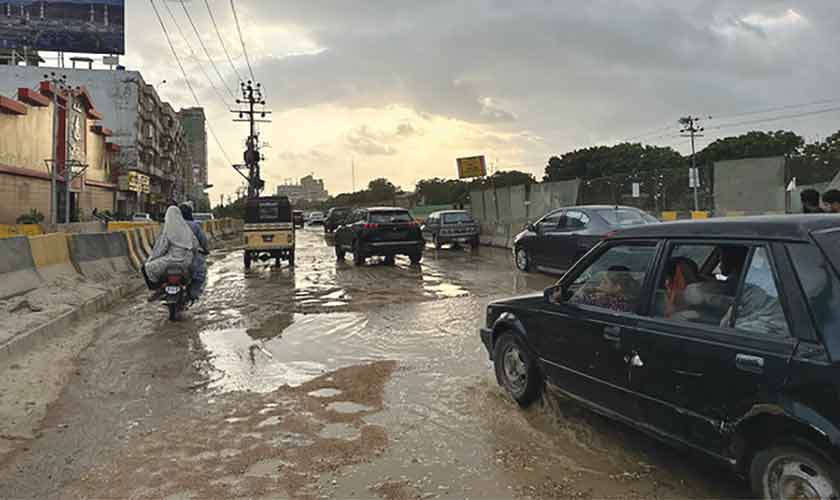
Besides the housing crisis, Karachi’s core infrastructure shows signs of governance failure. The condition of water supply and sewerage systems, roads and storm-water drains should suffice as evidence of institutional incompetence. The result is a mixing of sewage in drinking water and illegal hydrants.
Potholes on the roads, resulting from poorly planned digging and road cuts, failed projects like Red Line BRT and Karimabad underpass are making people’s lives difficult.
Many of the development projects are led by construction contractors rather than the nominal beneficiaries.
Recurring fires are also a symptom of governance failure as they expose structural weakness in regulation, planning and infrastructure management. These are not accidents; these are ticking time bombs. The city has building codes and bylaws under the Sindh Building Control Authority (SBCA), Karachi Building and Town Planning Regulations 2002 (as updated in 2024/2026), specifically referencing chapter 13, Fire Resistance and Fire Precautions and chapter 14; Fire Resisting Structural Requirements. However, these are not enforced.
As for waste management, Sindh Solid Waste Management Board was meant to reform waste collection but it has failed and is now relying on a contractor-based model. In many areas of the city the municipal waste remains uncollected. In some areas the residents are accustomed to throwing solid waste in storm-water drains.
The mobility crisis is another layer of failed governance. Comfortable, safe and affordable public transport is a distant dream. There is apparently no concept of last mile connectivity, footpaths, pedestrian safety and gender inculsive integration. Widening of roads, underpasses, bridges and signal free corridors is preferred over traffic management. State priorities are not informed by people’s needs.
The contributor is a Karachi-based urban planner and geographer