Print Story
X




Quality of water in our cities is a major cause for concern
| A |
s per predictions by various experts on climate change, warmer summers are approaching Pakistan. An ongoing war in our immediate neighbourhood will also impact our climate. One of the natural outcomes of this situation will be higher consumption of water. Many Pakistani cities will face exceptional challenges in terms of water volume and quality.
Drinking water quality in our cities is far from satisfactory. According to the Ministry of Water Resources, 61 percent of water samples in 29 cities were found contaminated and unfit for drinking. Studies have revealed that 93 percent of Karachi’s drinking water is contaminated.
The Pakistan Council of Research in Water Resources investigates water quality in different locations. The PCRWR found through one of its recent studies that 11 percent of bottled water brands, marketed in 21 larger cities in the country, were unsafe.
Due to increased awareness about public health and better purchasing power, urban middle- and upper-income groups either obtain bottled water or resort to filtration, ultra-violet treatment devices or simply boiling water.
The poor, however, lack both awareness and the means to access safe drinking water. Piped water supply is the usual mode through which households access supply in our cities. Water quality is affected by the mixing of lethal impurities. Networks of water supply pipes have been found in many locations to be in a dilapidated state. Poor quality of work, dubious choices, lack of prevention from adjoining sewers/ drains and inappropriate connections are common ailments.
In many cities, ground water is locally extracted for domestic consumption. High arsenic content in water is a challenge faced in many cities. Boiling water to make it drinkable is becoming very expensive due to increasing tariffs on gas and alternative fuels.
Many urban locations are experiencing groundwater depletion. A water conservation regime is needed to protect the aquifers.
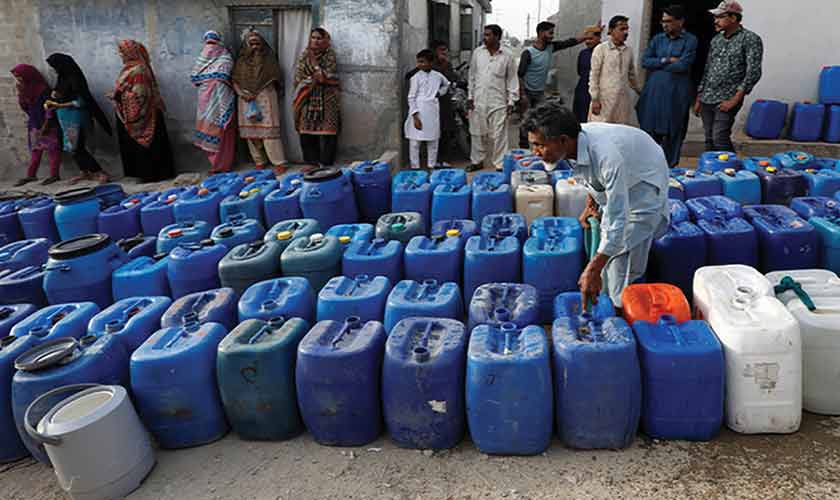
Water vending had emerged initially as an emergency service. It has now become an enterprise. Karachi relies heavily on water supply through tankers. More than 18 million gallons per day of water is distributed through over 60,000 tanker trips each day. Water from vending is at least 23 times more expensive than piped water. Owing to water scarcity, some dwellers are forced to use saline or brackish water for drinking.
The exponential rise in fuel prices has been quietly passed on to the consumers. Demand for water processed through reverse osmosis plants is also increasing. This is a non-regulated process with mixed results. In some cases, errors and omissions in this process do not lead to the desired level of purification.
Water quality testing and assurance of safe water supply to all consumers is the core function of water utilities in cities. They must develop expanded mechanisms to ensure that consumers receive safe water for domestic consumption. Supply chain of water through bottles and other means must be regulated. An integrated urban water management programme must be prepared and enforced in every large and medium city in the country as a starting point. Safe water will reduce our healthcare expenditure which will be a boon, both for the government and consumers.
Many affordable options for water quality management are available. Solar water disinfection utilises solar energy to produce small quantities of drinking water at household level. The SODIS technology is used in more than 50 countries across the world. Solar energy is abundantly and universally available, free of cost, and can be conveniently utilised to provide a simple, efficient and sustainable water treatment option.
The basic concept of the treatment process involves the use of transparent containers that are filled with water and exposed to sunlight for several hours. The process is found to be efficient in killing and inactivating microorganisms by radiation. SODIS has been used as a batch process at household level to treat small quantities of drinking water in bottles and plastic bags. By transforming ordinary soft drink bottles, single use drinking water bottles and other bottles of similar nature, applying permissible paints externally under the supervision of trained staff, filling with ordinary tap water and putting out the bottles on rooftops or any other surface exposed to sunlight for 5-8 hours, significant improvement in water quality can be obtained. SODIS is a very simple and cost-effective technology, applied in many parts of the world. Pakistani cities and rural locations can benefit if introduced with the right combination of social mobilisation and training, especially in informal settlements.
The writer is an academic and researcher based in Karachi.