Print Story
X




As work progresses on the parking facility being developed at the park site,environmental and social concerns against it grow stronger
| T |
he historic Nasser Bagh is at the centre of a heated debate as Lahore’s first underground parking project takes shape. The park is famous for hosting political and social activists. Work on the parking project began recently. As soon as the work began, some civil society activists and environmental groups rallied against it, raising concerns over its impact—environmental and historical.
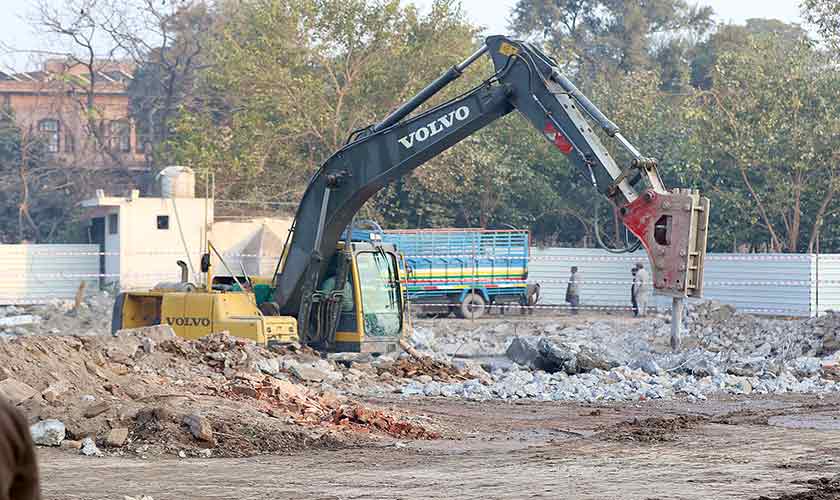
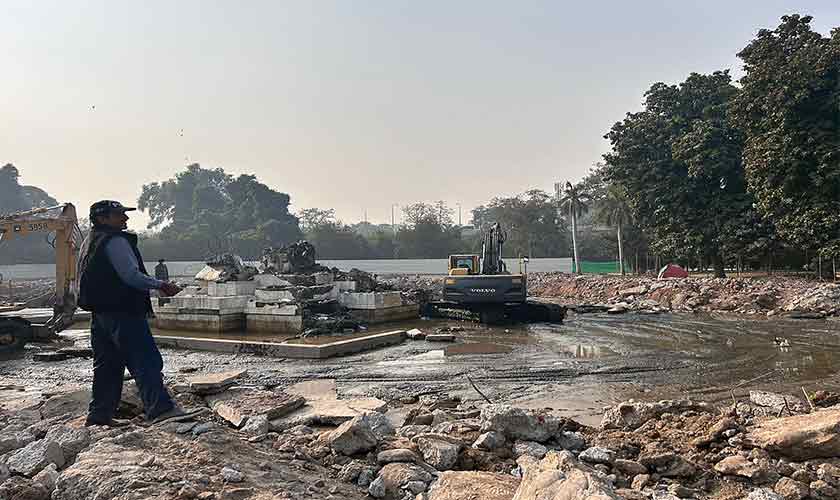
The Traffic and Engineering Agency is executing the project. The agency has barricaded the construction site with metal sheets, making the work invisible to passers-by on the Lower Mall. On Wednesday, heavy machinery was seen on the site. Water had been drained from a small lake, leaving two ducks stranded in the void. Some officials were seen driving them away, but they had nowhere to go. The Parks and Horticulture Authority—whose job it is to develop and maintain parks—is overseeing the removal of the water body under the supervision of NESPAK.
Despite symbolic protest, the project is in full swing.
Environmental and rights activist Altamush Saeed has filed a petition in the Lahore High Court, arguing that the project threatens biodiversity and violates both environmental and animal protection laws.
Saeed says that the project has both social and legal repercussions.
“Nasser Bagh is home to many trees that provide habitat for native species. Removing or altering those will be disastrous for animals,” he says. “Over the years, we have already lost bird populations in Lahore. Destroying their homes is a violation of the Prevention of Cruelty to Animals Act (1980, 1990), the Punjab Wildlife Act and the Punjab Protected Areas Act (2020).”
“No environmental impact assessment has been made public for this project,” says Saeed.
“This is a serious legal and ecological issue.”
Saeed says that preserving biodiversity is essential for a healthy ecosystem, which ultimately safeguards human life and ensures a clean environment. “Civilised nations maintain their parks, recognising them as habitats for living beings, not just green spaces.”
“We hope the court sees this as a serious issue,” he says.
Authorities involved in the project insist that it balances development with environmental conservation. According to Osama Mahmood, the Lahore Development Authority spokesperson, it is the first-of-its-kind green project in Lahore. Mahmood says that the LDA has transplanted 123 trees under a ‘zero tree cutting’ policy.
“No environmental impact assessment has been made public for this project,” says Altamush Saeed, an environmental activist.
The tree relocation, he says, was conducted with support from the PHA and a social organisation, Save the Tree, ensuring minimal disruption to the park’s ecosystem.
Mahmood says that an additional 1,000 saplings and trees will be planted to enhance the greenery on the site.
The state-of-the-art underground parking plaza is modelled after the successful Neela Gumbad project, says Iqrar Hussain Qureshi, the TEPA chief engineer. He says the park will be restored to its original condition once construction has been completed.
The facility will cover an 11-kanal plot with two basement levels, accommodating 256 cars and 445 motorcycles (maximum capacity has been estimated to be 310 cars and 510 motorcycles). This, he says, will address the needs of nearby locations, including the District Courts, Lahore Civil Courts, Government College University, Punjab University’s Old Campus, Post Master General’s office and commercial markets.
The plaza will feature modern technology, including parking management systems, CCTV surveillance, fire-fighting systems and lifts. The area above will include seating areas and landscaped green spaces.
Qureshi says the project did not begin overnight. He says several surveys were carried out to examine vehicular flow and the demand for parking. He says the parking plaza has been designed to meet the high demand in the surrounding areas.
However, the parking demand in the area stands at 957 cars and 1,842 motorcycles. This means that the Nasser Bagh facility will cover a portion of the estimated total needs, particularly focusing on easing congestion in the vicinity.
The project will cost Rs 1.63 billion and be completed in 10 months.
Qureshi says that the project will meet its own operational cost, adding that it is projected to be sustainable. According to their analysis, the facility will generate Rs 83.5 million annually, with daily revenues of Rs 97,908 from motorcycles and Rs 140,800 from cars. Operating and maintenance costs are estimated at around Rs 19.1 million per year. The amount includes staff salaries, utilities, security, mechanical maintenance and landscape upkeep.
The state-of-the-art underground parking plaza is modelled after the successful Neela Gumbad project, says Iqrar Hussain Qureshi, the TEPA chief engineer. He says the park will be restored to its original condition once the construction has been completed.
He says the key staff will include a plaza manager, administrative and billing officers, shift in-charges, ticketing operators, CCTV and security personnel, lift operators and janitorial staff, with monthly salaries ranging from Rs 35,000 to Rs 100,000.
Utility and maintenance costs for electricity, water, generator fuel, IT systems, plumbing, fire safety and general upkeep have also been factored in.
Some civil society activists, however, contend that parking lots should instead be constructed in commercial buildings instead of being housed in the park. They are describing the initiative as “destruction of history and culture.”
Iqrar Hussain insists that the project is being executed with care.
A delegation from the Judicial Water and Environment Commission recently visited the site and praised the tree relocation efforts and measures taken to preserve the historical significance of the park while implementing modern urban development plans.
Be that as it may, many civil society activists remain unconvinced.
For Altamush Saeed and his fellow activists, the park’s heritage and natural ecosystem should have taken precedence over all other considerations. They warn that the loss of habitat for native species could have long-term environmental consequences. They maintain that publicly accessible environmental impact assessments and mitigation plans are necessary before any irreversible changes are authorised.
The writer is the editor of Minute Mirror. He may be reached at [email protected]