Print Story
X

| I |
never imagined that breathing could feel like an act of betrayal. Yet every morning, when I step out of my flat in London and the sharp, cold air fills my lungs, I hesitate. Something inside me protests: How can you breathe so easily?
It sounds absurd. Who feels guilty for breathing? But guilt is a quiet hunter; it chooses its moment, often without warning, especially when the air entering your chest feels like an undeserved luxury. The breeze here is crisp, saaf, transparent; like a glass held up to the light. It carries no weight, no acrid stench of burning straw, no invisible dust that settles on the tongue.
With every inhale, I am reminded that back home in Lahore, people are measuring their days in AQI numbers and aching chests.
I was born in Lahore in what now feels like an entirely different lifetime.
The Lahore I knew smelled of mitti after rain. The morning fog was truly fog and not venom disguised as mist. I remember cycling through the quiet streets of Model Town, the air brushing against my face like a gentle reprimand; my siblings and I insisting on sleeping on the chatt, tracing our own childish myths across the constellations. Nani Ammi would say, “Lahore ki hawa mein aik mithaas hai,” and she was not exaggerating. There was sweetness, softness, an effortless abundance you never felt the need to earn.
“The natural world is not just the outer manifestation of the ‘environment’ of human beings; it also exists in their souls and minds,” writes Sonia Irum.
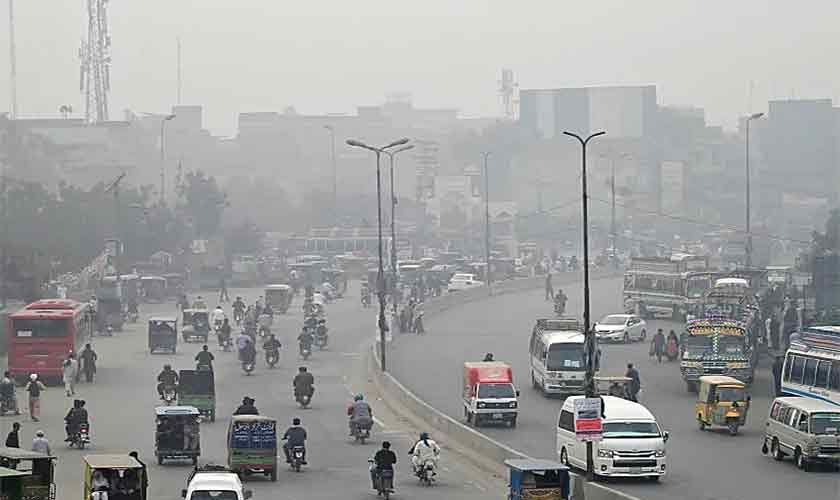
In the last few years, that sweetness has been smothered, drowned beneath a sullen grey stillness. Dhuaan and dhool hang in the air like a curse that refuses to lift. Schools close; roads vanish into a blurred monotony; children cough in ways children should never cough. People wake up with headaches that feel carved out of stone, lungs thick with heaviness, nausea twisting itself into their gut.
I have been its victim too. My body has known the slow suffocation of Lahore’s smog, the fatigue that creeps in without warning, the breath that refuses to deepen, the panic that rises when the air itself becomes an adversary.
Lahore was not always like this.
I remember the crisp winters, the clean silhouettes of distant buildings, the lazy drift of smoke from desi food stalls that never grew heavy enough to obscure the sky. There were stars - actual stars - scattered and luminous, twinkling above rooftops where we would sit and spill the stories of our day over a steaming cup of chai. Somewhere between then and now, Lahore has lost its breath, like a weary traveller who has forgotten the way home.
This is not a note of guilt or nostalgia; it is a call to action.
We need trees, thousands upon thousands of them. Not ceremonial saplings planted for photographs, but deep-rooted, living forests. Trees that stand like guardians. Trees that do the quiet, unseen labour of keeping us alive.
We need responsible industries with mandatory filtration systems, rigorous inspections and zero tolerance for non-compliance. Factories that pollute the air must either modernise or relocate; there is no moral or environmental justification for allowing them to operate as they currently do.
The National Clean Air Policy requires each province to develop a Provincial Clean Air Action Plan. These plans mandate real-time air quality monitoring, source-specific emission inventories and short-term “smog action” responses, such as school closures, restrictions on stubble-burning and targeted controls on high-emission industries during severe pollution episodes.
These commitments must be redeemed fully and without delay.
Beyond industrial reform, Lahore’s transport system demands a full reckoning. The city needs cleaner public buses, the widespread adoption of electric rickshaws, incentives for hybrid vehicles and a decisive crackdown on the black-smoke beasts that dominate the roads. Without transforming the transport and enforcing industrial accountability, meaningful improvement in Lahore’s air quality will remain out of reach.
More than anything, we need a shift in the collective consciousness. Air is no longer invisible; it is urgent, political and deeply intimate. If every household understood that protecting the air was no different from protecting the person they love most, lasting change would become inevitable. We owe the next generation the simple majesty of a sky that remembers its own true, boundless colour.
Sometimes, I stand by the Thames at sunset, watching the water ripple beneath a sky that still remembers how to be blue. I tell myself, “Lahore will get there too.”
Lahore does not need miracles; it needs commitment. Our city is still alive, still breathing, capable of healing if we act with courage. The air that hangs heavy over us is not just pollution; it is a reminder that our future is being shaped right now. If we choose responsibility over convenience, action over apathy, we can make a tangible difference.
I like to believe that one day Lahore will breathe again, not as memory, not as longing, but as a living, thriving truth.
The writer is pursuing a post-graduate degree in education at the University of Sussex.