Print Story
X




Dar says Pakistan ready to join Gaza peace force, not to disarm Hamas
| O |
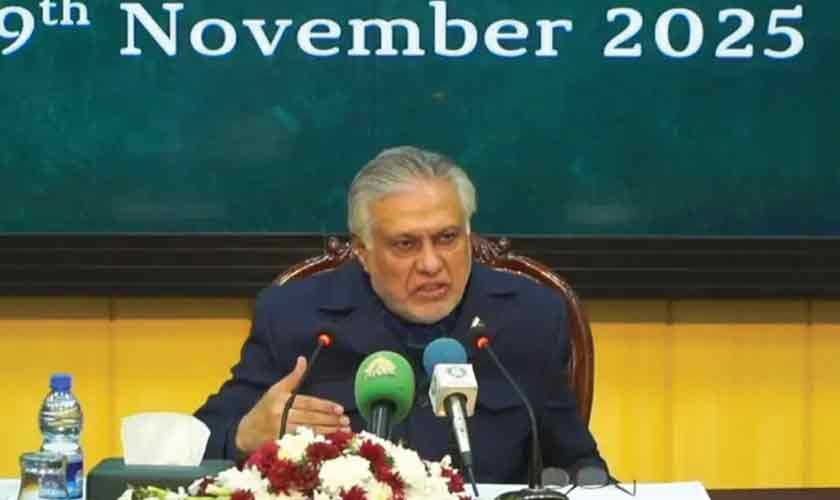
n November 29, Deputy Prime Minister and Foreign Minister Ishaq Dar stated that Pakistan was ready to commit its troops to the Gaza peace force, but not for disarming Hamas.
Addressing a press conference at the Ministry of Foreign Affairs, the foreign minister said the matter of disarming Hamas first came up during a meeting in Riyadh on the Two States Solution. “We are not ready for that. This is not our job, but of the Palestinian law enforcement agencies. Our job is peacekeeping, not peace enforcement. We are definitely ready to contribute to the force; the prime minister has already announced after consultation with the field marshal that we will contribute; but this decision cannot be taken until it is decided what its [ISF] mandate and TORs (terms of reference) will be. If it includes disarming Hamas, then my Indonesian counterpart, too, has informally expressed his reservations.” Dar said he was present at the initial talks when the matter of the force was raised, adding that Indonesia had offered 20,000 troops and Prime Minister Shahbaz Sharif had also indicated that Pakistan would consider participation.
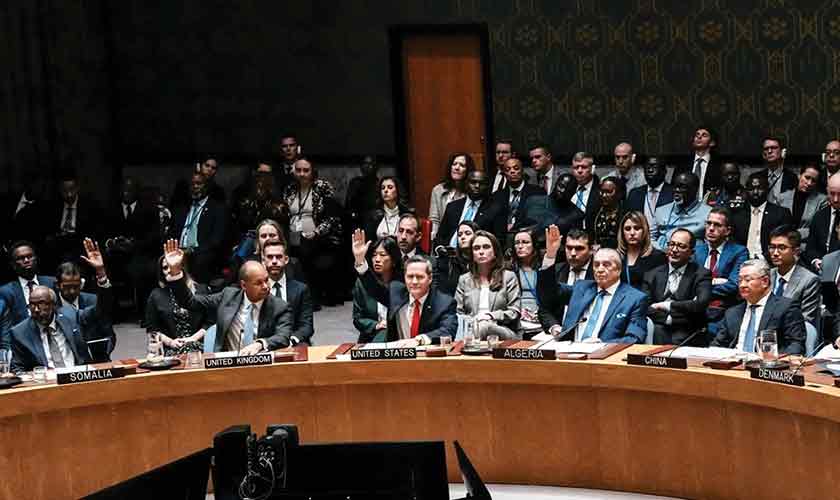
Earlier, the UN Security Council had endorsed a new framework for Gaza. The UN Security Council had voted to adopt a US-drafted resolution endorsing President Donald Trump’s plan to end the war in Gaza and authorising an International Stabilisation Force for the Palestinian enclave. Thirteen UNSC members, including Pakistan, voted in favour of the resolution, while Russia and China abstained. The Russian abstention was significant given that earlier there had been signs that Moscow might veto the text.
Analysts are warning that the new peace plan not only falls short of delivering genuine peace but also risks perpetuating violence and effectively restoring colonial-era mechanisms of external control over Palestinian territory.
The first is the absence of credible Palestinian representatives from the process. This absence is significant as the lack of serious and legitimate Palestinian involvement in previous “peacemaking” efforts contributed to their eventual demise.
It is for this reason that Asim Iftikhar Ahmad, Pakistan’s permanent representative to the United Nations, underscored that the right to self-determination is “inherent and unconditional” and that “peace cannot be achieved by bypassing the Palestinians.” He also highlighted that several uggestions made by his and other delegations did not appear in the text. These included a clear political path to Palestinian statehood; an affirmation of the Palestinian Authority’s central role in governance and reconstruction; and clarification regarding the Force’s mandate. “Those are all crucial aspects with a bearing on the success of this endeavour,” he said.
This alignment is why former foreign secretary Salman Bashir characterised Pakistan’s endorsement as a “necessary diplomatic step in solidarity with the Muslim world.” However, he characterised the expectation that this will improve the plight of the Palestinians and advance their statehood as “wishful thinking.”
Talking to The News on Sunday, former ambassador Javed Hafiz said, “Muslim countries backed the Trump plan for pragmatic reasons. With Palestinian influence declining after years of losing land and with Arab states divided, the Muslim and Islamic countries see a negotiated deal as the only way left to secure whatever concessions may be available.”
He said he believed that a plan led by a determined US president, with support from other Western powers, was more likely to succeed than one from a less powerful country. “Above all, their decision was driven by the urgent need to use any political option available to stop the bloodshed in Gaza.”
Former foreign secretary Salman Bashir identified four steep barriers on the path to Palestinian statehood. First, the plan lacks critical details on final borders, the status of Jerusalem and the right of return for Palestinian refugees, leaving fundamental disputes unresolved. Furthermore, statehood negotiations are contingent on stringent, long-term preconditions requiring Palestinian deradicalisation—a process that could span decades, particularly in view of continuing IDF attacks and ceasefire violations and the historic persecution of Palestinians. The Israeli government, under its hardline leadership, remains opposed to a viable Palestinian state, supporting only the elements of the plan that ensure a demilitarised Gaza. Bashir described the prospects of reconstruction in Gaza as a “faint silver lining”— only if Israel does not sabotage it.
Asim Iftikhar Ahmad, the permanent representative of Pakistan to the United Nations, underscored that the right to self-determination is “inherent and unconditional” and that “peace cannot be achieved by bypassing the Palestinians.”
This combination of unattainable preconditions and Israeli opposition creates a framework that some international experts have denounced as an “illegal trusteeship” over Gaza, reviving colonial-era practices outlawed by modern international law. The resolution grants two-year supreme authority to an individual head of state (e.g., Donald Trump) and a Board of Peace (including people such as Tony Blair), effectively handing Gaza to outsiders to rule Palestinians deemed incapable of self-governance—a racist trope rooted in 19th-Century European imperialism.
This model, which Bashir describes as “smacking of trusteeship,” mirrors the paternalistic ‘civilising missions’ of the scramble for Africa and the League of Nations mandates that made powerful nations guardians over supposedly immature peoples. However, the post-WWII era codified self-determination in the UN Charter, establishing such external control as a violation of national sovereignty. Bashir argued that the resolution also breaches the UN Charter by bypassing Palestinian consent, rendering it legally invalid and without binding force—echoing the flaws of the earlier British mandate.
The UNSC resolution is also being criticised for deliberately ignoring past UN resolutions that establish the legal foundation for Palestine. International legal experts note that the new resolution breaks with the Council’s established practice of “constant reaffirmation” of the legal acquis, notably ignoring key resolutions including Resolutions 242 and 338 (on the inadmissibility of acquiring territory by force and 1967 borders), 2334 (on the illegality of settlements), 1860 (on a Gaza ceasefire and ending the occupation), the recent humanitarian trio of 2712, 2720 and 2728, and UNGA 67/19 (recognising Palestine’s statehood and right to self-determination). Traditionally, the Security Council has upheld this established body of law through repeated affirmation. Bashir says these omissions do not invalidate prior resolutions, which remain legally binding and continue to form the normative foundation for Palestinian rights. While Bashir maintains the legal foundation remains intact, former ambassador Hafiz highlights the political peril, noting that a new resolution ‘carries more weight than the previous ones and is also referred to more.” This dynamic will allow the US and Israel to interpret resolutions to marginalise the core of Palestinian issues. “They dilute legal standards, creating a more flexible political context that aligns the UN with an occupation-sustaining narrative.”
The resolution’s deliberate shift away from affirming the UN’s and UNRWA’s central roles in Gaza, alongside its omission of core international law prohibitions, is compounded by its mealy-mouthed language on Palestinian statehood. This ambiguous wording in the US resolution was intentionally crafted, reflecting apparent heavy Israeli input, says Hafiz. He says that with this, the goal of an independent Palestinian state has receded. Furthermore, PM Netanyahu and the right wing have recently once again expressed their strong opposition to Palestinian statehood.
This Israeli opposition is directly served by the resolution’s text, which mandates the ISF to demilitarise Gaza, potentially requiring military confrontation with Hamas if they refuse to comply—echoing concerns that it outsources Israel’s failed security efforts to regional troops.
This mandate, Bashir contends, would place Muslim nations in a deeply perplexing position, making them highly reluctant to contribute troops. The prospect of being drawn into direct conflict with Hamas is a scenario that the government of any Muslim country or army would assiduously avoid. Egypt advocates for a negotiated “decommissioning” of heavy weapons to avoid conflict, stating bluntly it “will not do the job that Israel was unable to do.” Turkey has criticised the draft for casting the ISF as a domestic security arm rather than neutral peacekeepers. Ankara demands the force focus on preventing clashes, securing borders and training Palestinian security forces—not acting as an “arm of occupation.” Pakistan’s position on the issue is in line with Turkey and Egypt, said Bashir.
The force’s UNSC mandate and its command structure have compounded the ambiguity. Unlike traditional UN peacekeeping operations, which fall under the clear authority of the UN secretary-general, this force seems to be modelled on a framework like the one deployed in Haiti, where authority resides with a Board of Peace, a potentially problematic chain of command.
This stance aligns with a grim assessment of Israel’s tactics. Ambassador Hafiz said Israel would continue to use everything in its toolbox to force out Palestinians from Gaza. He pointed to a recent, clandestine operation as a prime example of such tactics, where Israel quietly dispatched 153 Gazans from a secluded Israeli air base to South Africa. “This is part of a broad strategy to thin out the Palestinian population in both the West Bank and Gaza to secure a decisive demographic upper hand,” Hafiz says.
As Israel pursues this long-term demographic strategy, the resolution fails to provide any counterweight. In the final analysis, the resolution is being criticised not for what it achieves, but for what it deliberately undermines. It weakens the legal acquis on Palestine, sidelines the UN’s humanitarian role and offers a “stabilisation” force that destabilises regional diplomacy. For the Palestinians, the message is clear: under this framework, their problems are not being solved, but managed. Their statehood has been pushed further out of reach.
The writer is a senior The News staffer in Karachi.