Print Story
X




Neglect, bad governance and unscrupulous money-making are behind the worsening water crisis of metropolis
| I |
t was midnight in Orangi Town when Saima Khan finally heard the quiet hiss of water coursing through old pipes. She got out of bed, picked up all her buckets and pots and ran to the tap to collect water. 20 minutes later, the discharge had thinned to a sad trickle. Soon afterwards, the flow stopped altogether.
That was her cue to take stock of the situation. She had about 30 litres; not enough for her family of five; not even close.
Karachi, a city of 30 million people, is going through a water crisis that did not come upon it suddenly. It’s been a long time in the making — years of mismanagement, corruption and complicity by people who had the opportunity to fix things but did not.
Summer heat is what has changed. It is making the situation truly alarming. Karachi’s summer has grown more intense and more protracted.
Keeping score
From May to August Karachi resembles an oven. The maximum daily temperature in the shade regularly exceeds 40°C. Sea breeze is reliable until it isn’t. The need for water increases during the long hot spells.
The amount of water the city can draw on has not increased significantly since 2005. Take a moment to consider the situation. There has been no advancement in water infrastructure in the city. It is as if there has been no population growth and no rise in atmospheric temperature for 20 years.
The most recent significant project to add water to the supply was the Karachi 3rd (K-III) project. Completed in 2005, it had brought 100 million gallons per day (mgd) of water. Since then, nothing.
The K-IV project was announced in 2006. It will supply 650 million gallons per day.
Half a city and half the water
Karachi gets 646 million gallons of water per day from Keenjhar Lake. However, by the time the water arrives at Dhabeji pumping station 130 kilometres away, the quantity is down to 458 million gallons.
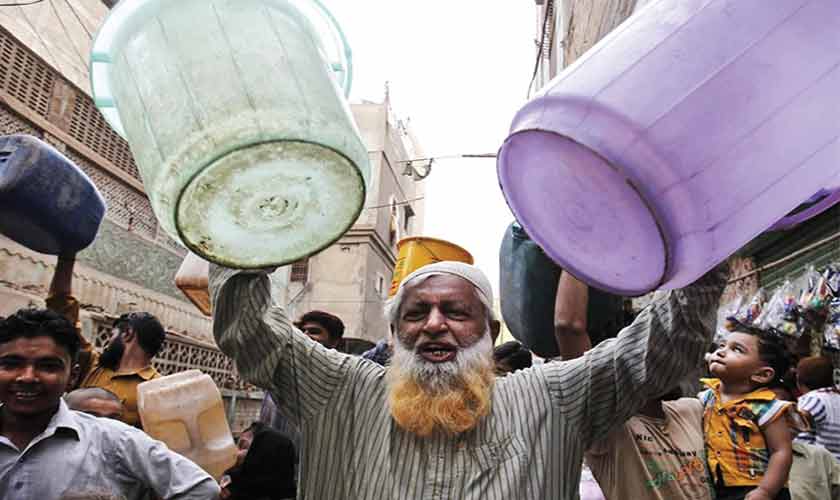
The available water is not divided evenly. Households in Gulshan and Nazimabad get tap water for 5 to 6 hours a day. Meanwhile, some households in Orangi, Baldia and Bhatta village in Kemari, haven’t had any water in six months. Some people in Bostan-i- Rafi, Malir, claim that the pipes supplying them have been dry for ten years. They’re still paying their monthly water bills.
Low income neighborhoods such as Orangi, Gadap and Baldia get less than 40 percent of the officially allocated water supply. The people here use an average of 67 litres of water a day, which, according to the United Nations, is a third of the amount needed for a dignified life.
This means that all existing water has been re-distributed to those who can pay the most for it.
Tankers
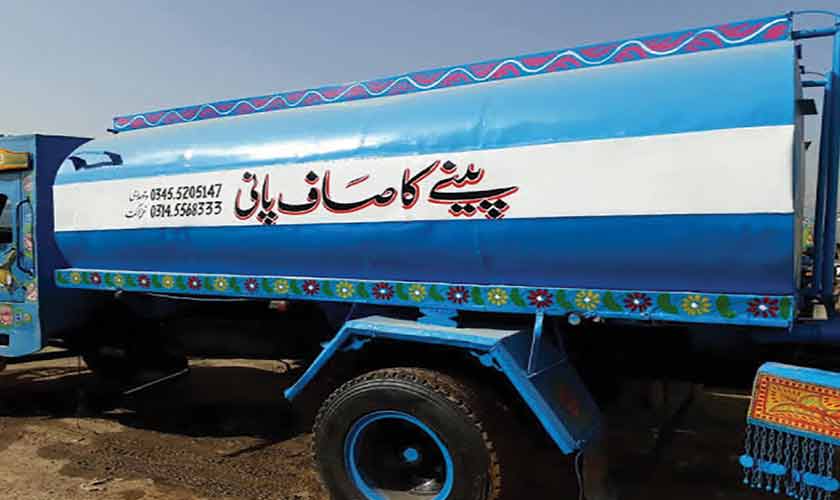
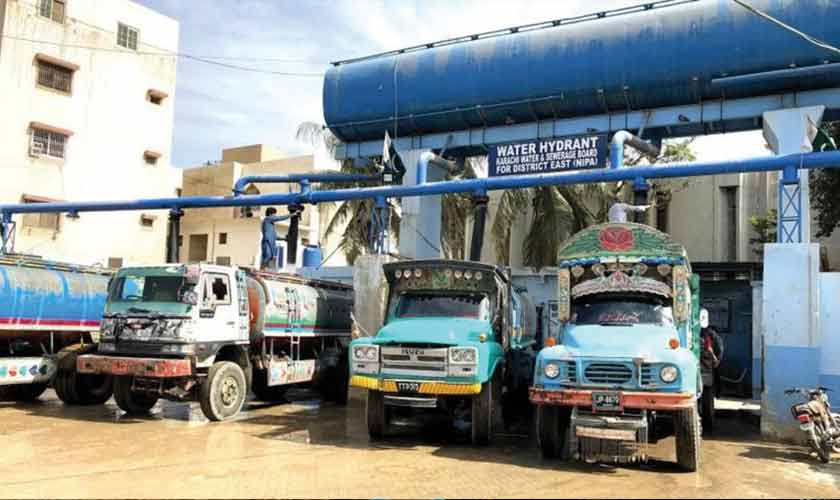
Karachi’s water supply failure is best symbolised by the water tanker. In an odd way, it is the most truthful of all symbols. It shows that water is seen as a marketable commodity, not a basic right.
There are more than 10,000 water tankers. They make nearly 50,000 trips a day. Do the math. The tanker trade makes Rs 150 million a day at an average price of Rs 3,000 per delivery. That is more than $500 million per year. The economy is based on the failure of a public institution to do its job.
Shafiq Ahmed, a resident of Liaquatabad, says, “Sometimes the water there is no water in the taps and we have to purchase it from expensive water tankers. Many people cannot afford that. Every time we hear that the supply system has developed a fault, we cannot help but wonder how much longer we will have to continue living like this?”
A popular term used for water tankers, half out of admiration, half out of contempt, is “white gold.” A family in Orangi has to pay Rs 3,000-4,000 per delivery. They require 2-3 tankers every month. That is not a budget expense for a family that earns a daily wage. It is a crisis.
But let this be enough for the poorest, those who do not have money for even the tankers. They go to the nearest awami nalka [public tap] and wait, sometimes for hours. A private vendor collects water from the same tap and sells it at Rs 2 per litre - higher if one lives on an upper floor.
Governance
Every couple of years there is an announcement that K-IV will be completed soon. The project has been around for 17 years and is “almost ready.”
The delay is a governance issue as well as a political economy issue. Repairing the water system will put an end to the tanker business. Disrupting the tanker industry will impact the income of the people profiting off the water crisis.
In May 2026, following power failures, ten out of 21 pumping units in Dhabeji pumping station were rendered useless. This caused a serious water shortage immediately after Eid in the city. The KWSC had no indication when it would get its supplies back. It asked the public to “use water carefully” as if a family that had to buy water from the tanker and use borehole water would not do so already.
Social justice
In the realm of urban planning, there is a term explicitly for the unevenness of opportunity and deprivation in space: “spatial injustice.” In no other country water crisis is as textbook as in Karachi.
Karachi, a city of 30 million people, is going through a water crisis that did not come about suddenly. It’s been a long time in the making.
Low income neighborhoods such as Orangi, Gadap and Baldia get less than 40 per cent of their official water supply allocation. The people here use an average of 67 litres of water a day, a third of the amount the United Nations says one needs for a dignified life.
The poor do not pay less for water; they pay more. The cost to a family living in a low-income community can be as much as 30 to 40 per cent of the family income for buying water from tankers, vans, cart and filters. A family living in a typical middle class neighbourhood spends no more than its piped water bill. The bill is tiny and water is actually supplied.
The people carrying the heaviest burden are women and children. Women in the poorest neighbourhoods and slums rush to public taps before dawn. Many children, mostly girls, frequently miss school to go fetch water. According to the 2023 census, there are 1.8 million out of school children in Karachi, almost two thirds of them residing in slums. That number cannot be separated from the daily work of collecting water.
For households that can afford it, boreholes now cost Rs 600,000. They can be drilled to a depth of 122 metres (400 feet). Most families cannot afford one on their own. Typically, three or four families pool their resources. Water from the boreholes is frequently brackish. It can be used for washing but not for drinking. Hence, they still have to purchase drinking water.
Who is getting water, how much and when can be answered by installing meters – individual meters and main distribution line meters. The lack of measurement is not a coincidence.
The contributor is a Karachi-based urban planner and geographer