Print Story
X

| T |
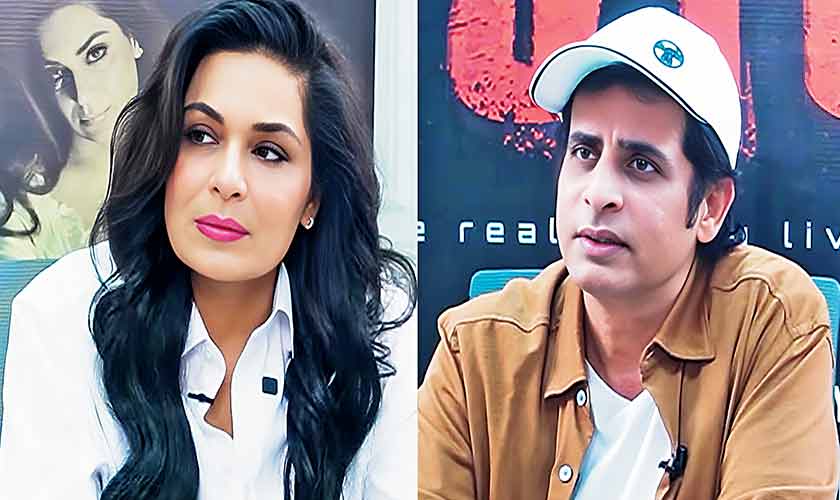
he recent walkout by actor Meera from a podcast inter-view with journalist Irshad Bhatti has once again brought into focus the uneasy boundaries between journalism, entertainment and personal intrusion in Pakistani media.
What was intended as a routine promotional appearance for her upcoming film Psycho quickly shifted into far more personal territory. Instead of centring on the film or her professional trajectory, the conver-sation moved towards long-standing controversies associated with her public life. These included references to alleged past relationships, old rumours circulating within the industry and questions surrounding a hospital project reportedly linked to her family. At one point, the line of questioning intensified to the extent of asking which of the individuals mentioned had caused her the most emotional distress.
Meera’s response, as seen in widely circulated clips, was restrained. She attempted to redirect the discussion towards her work, repeatedly urging viewers to focus on her film. “I don’t know what you are saying. Just watch my film Psycho. I am really excited for it,” she said.
When the questioning persisted, she removed her microphone and exited the interview. In a media environment where unverified claims are often amplified against women and their private lives frequently become subjects of public scrutiny, it is perhaps unsurprising that Meera, like many working in the field, has developed a considerable degree of resilience.
Irshad Bhatti, instead of apolo-gising, stood his ground, maintaining that his interviewing style is direct and grounded in asking uncom-fortable questions where necessary.
His position rests on the view that journalists are not obliged to confine themselves to promotional narratives and that guests retain the option to withdraw if they find the line of questioning unacceptable.
Actor and host Ahmed Ali Butt also weighed in, supporting Bhatti’s position and pointing out that these stories were already in the public domain. He further suggested that while Meera was within her rights to end the interview, the public was being too hard on the host.
Internet reaction, however, was far less divided. Many users criticised both the tone of the interview and the justification that followed, arguing that neither the “public domain” argument nor the possibility of a paid appearance excused the line of questioning.
Many zeroed in on the paid podcast argument, calling it a weak justification for what happened on air. “But how come it’s okay to humiliate someone for something which is already on the net,” one user wrote. Another pushed back directly, “She was there to promote her movie. Even if you have paid, she can still decide not to talk about certain things.”
Others questioned where basic respect fit into Butt’s logic. “Meera acted with grace and decency while you proved yourself an imbecile,” one person wrote bluntly. Many also called for greater restraint in public discourse, while expressing hope that Psycho performs well upon its Eidul-Azha release. Meera stars in the film alongside Shaan Shahid, Sonya Hussyn and Javed Sheikh.
But this situation really makes you wonder: what has happened to the celebrity interview? The line between serious reporting and the race for clicks has become increasingly blurred. Promoting a movie should not mean walking into an ambush, yet these boundaries are crossed more often in the case of women than for men.
It leaves us with a difficult question: how do we balance the pursuit of a candid story with the basic duty to respect someone’s private life? At present, it is often the women in the spotlight who are paying the price while the rest of us watch.