Print Story
X




The third edition of the Diriyah Contemporary Art Biennale 2026 is a tangible translation of relational times, spaces and sounds
| A |
s soon as our plane touched down at the Riyadh airport, I looked out of my window seat at what seemed like an unusual sight. Instead of the expected vast spread of regulation runways, the aircraft was slowly descending on a narrow stretch of concrete, next to a highway on which vehicles sped in the opposite direction. In that moment, the birds in the sky and the beasts on the ground both appeared to be in an uncanny proximity.
The passengers of the plane were reaching their destination, yet connected to the place they took off from. Likewise, those travelling in cars, buses and lorries were heading somewhere, carrying their memories from familiar settings to new destinations.
This momentary encounter made me realise that we perpetually stay in this wide universe consisting of nothing but purgatory. A concept, further cemented as I visited the third edition of the Diriyah Contemporary Art Biennale 2026 (January 30 - May 2, JAX District of Riyadh).
Curated by Nora Razian and Sabih Ahmed, the biennale is named In Interludes and Transitions. Distributed into four sections, all over the site (Disjointed Choreographies; A Hall of Chants; A Collective Observation; A Forest of Echoes), the display turns into a tangible translation of relational times, spaces, sounds and species; concepts that migrate through multiple routes and histories, beyond and before human awareness, control and existence.
The two curators have employed a range of strategies to produce an inclusive exhibition that comprises not only the language of art but also extends to other modes of communication. A biennale, or for that matter any large-scale curated exhibition, is a means to collectively experience a small segment of the multifaceted reality around and within us.
Both curators of the Diriyah Biennale 2026 provide that lens, hence inviting practitioners of diverse disciplines across the globe. The curators have made sure that the physical boundaries of the show are not limited to regions, practices or aesthetic vocabularies, but are archives of inherent connections that Razian and Ahmed have discovered and displayed in four separate, yet interrelated spaces.
The presence of meeting and migration clicks immediately, as the curators inform in their essay, “The Biennale’s title in Arabic, fil hil wal terhal, draws from a phrase often used colloquially to evoke connection and continuity within a state of constant flux… The English title, In Interludes and Transition, carries these meanings, but also connects to registers of music, composition and theatre. It is an invitation to think rhythmically, to approach time as layered, pulsating and collectively embodied.”
There is work that alludes to the interlaced diction of collective forms of production embedded in the histories of a region, as well as the reincarnation of functional stuff to relay a significant side of the ordinary. Untitled (2018), by Rajesh Chaitya Vangad, “created in ritual settings, to commemorate weddings, harvests and festivals,” documents how the world is viewed by the Warli people. For them, land is not horizontally laid, nor is time linear. Seasons do not follow a sequence, but rotate in a cyclic movement.
Elias Sime’s Lines in Nature 2 and Lines in Nature 3 (2005) are constructed with woven electrical wires on panels. An industrial and mundane article is transformed so that the joined sections of each board, while resembling the aerial maps of villages, fields and pastoral patches, also expose “the global systems of production, consumption and waste.”
The two curators have employed a range of strategies to produce an inclusive exhibition that comprises not only the language of art but also extends to other modes of communication.
Another dimension of material consumption is tied to global politics. Wars, genocides, invasions and conflicts have erupted at various points on planet Earth. Varying in nature, these might be on a grand scale, or within circles of national, tribal, ethnic, religious or trade confrontations. In Flag (2022), KP Reji, born in Kerala, refers to a mass demonstration. Reji’s diptych could echo a passage from VS Naipaul’s essay about his travel to Calcutta in 1963, in which the publisher was lamenting the wasted time of his arrival, because “the dear old city is slipping into bourgeois respectability almost without a fight.” Failing to comprehend, the author asked: “Didn’t they burn a tram the other day?” “True,” was the reply, “but that was the first tram for five years.”
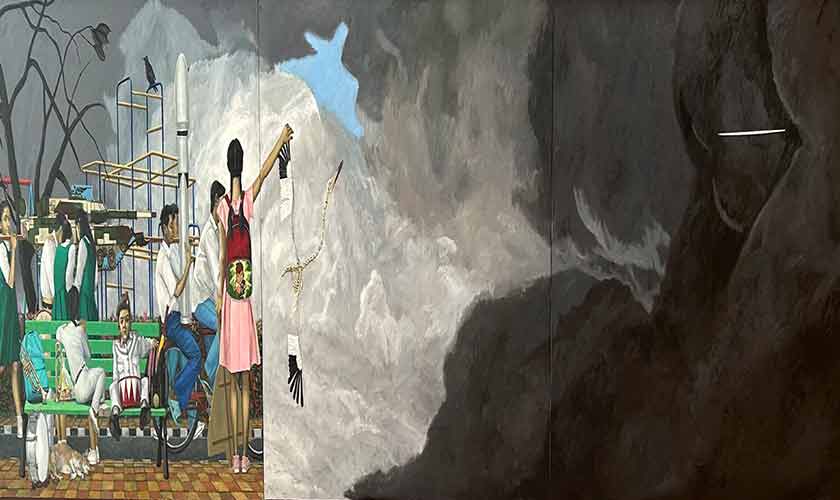
Calcutta and Kerala, though far apart in geography, seem close to each other in political consciousness and human bonding. Thus, one can associate with tightly joined outlines of black and white figures brandishing huge, fluttering black flags; fabrics of unfaltering struggle. Next to this, the artist’s other piece, The Tin Drum (2026), renders an untoward scenario identical to the decayed atmosphere of a Gunter Grass novel. The oil on canvas represents an (almost grown-up) child encased in a band uniform and a drum in his lap. A strange world unfolds around him. School-going young boys and girls are positioned in the puzzle of transitory structures with hints of bearing a battle tank to its final rest.
Compared with these paintings in the Hall of Chants, the compositions by Samia Halaby, one of the most celebrated artists from the Middle East, appear to be sensitive and subtle. Born in 1936, Halaby’s series comprises paintings in oil, gouache and pencil or pastels, along with her pioneering kinetic paintings (1987-88), programmed in C on Amiga 1000, sound.
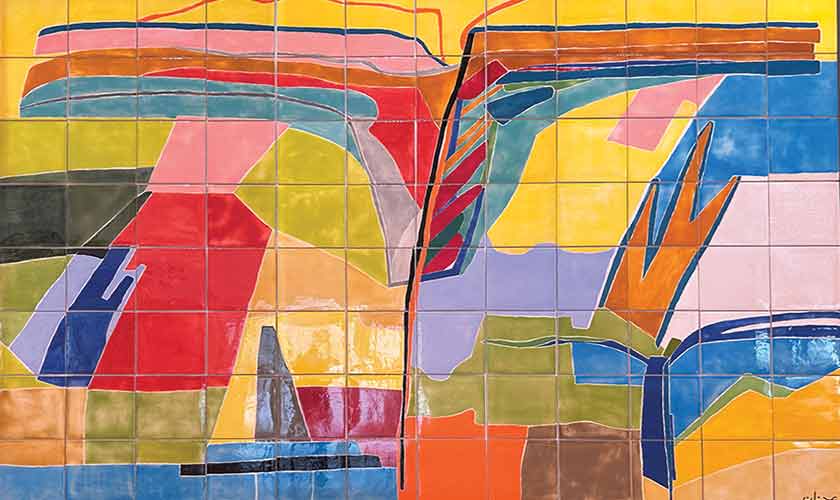
Despite the disparity in mediums, both categories of work bring forth the artist’s reflection and recreation of parallel hemispheres around her. A similar idiom is found in the ceramic mural by Etel Adnan (1925-2021), with her crisp colour divisions accentuated through the choice of glazed tiles. Adnan, along with pictorial imagery, produces delicate pieces of prose and poetry, too. Thus, her painting contains figments of a sensibility that translates harsh facts into eternal truths.
The unbearable realities are confronted by members of other societies, particularly those denoted – rather demoted – by using a current catchphrase, the Global South. This reaffirms the hegemony of Western nations who, ironically, refuse to believe in the globe as a round body, and still try to split it into four corners of a compass, a demarcation that meets, but never merges; always in the categories of haves and have-nots.
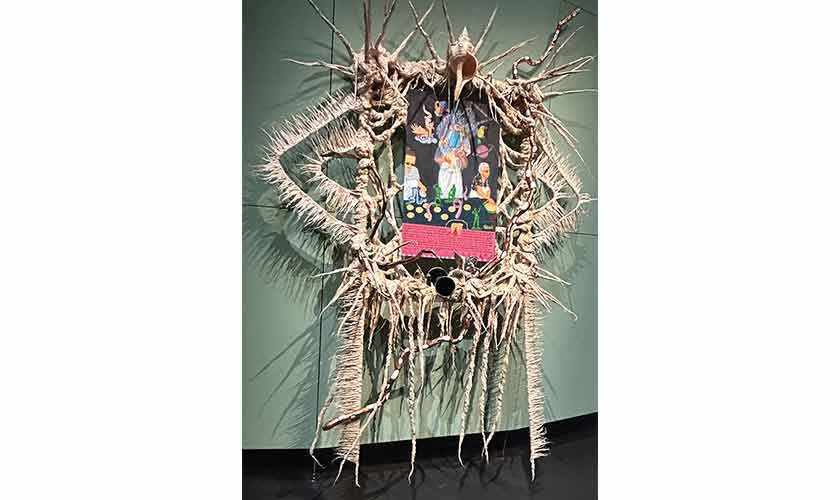
The mixed media sculptures of Daniel Lind-Ramos from Puerto Rico indicate this contradiction by unearthing two possibilities for scattered parts of dysfunctional items. Either to rust away, or be converted into a comment upon the current and collective experiences of a community. In his Ambulancia (Ambulance) (2020), a cart-like sculpture of emergency lights, a megaphone and a shovel in dark blues and purples (shades seen at Puerto Rican funerals) fixed together, signifies how the discarded things can survive independently and may turn into a hard disk of harsh memories. The work was produced during the Covid-19 pandemic, which left a devastating stain on Puerto Rican society.
Guadalupe Maravilla, from El Salvador (a territory not too distant from Puerto Rico), also creates functional combinations by incorporating steel, wood, glued mixture, plastic and other substances. Titles of these objects suggest their practical and personal sides too, like Disease Thrower: Purring Monster with a Mirror on Its Back (2022); Once A Fish Saved My Life (2024); The Joy of Fire (2023). These curing machines can be read as “symbols of renewal while pointing to indigenous knowledge systems and modes of healing.”
As the political world is focusing on the Middle East and the South East in tackling complex and continuous conflicts, simultaneously, it is escalating the shift that happened almost a decade ago; a turning point when the alternative centres of art emerged from Kochi to Qatar, from Kathmandu to Riyadh, and several other marks on the atlas of the art world.
(To be continued)
The writer is a visual artist, an art critic, a curator and a professor at the School of Visual Arts and Design, Beaconhouse National University, Lahore. He can be contacted at [email protected].