Print Story
X




The very character of Lahore, which boasts many a World Heritage Site, is being changed in the name of ‘progress’
| T |
he story of Ewing Christian School began in Ludhiana, where it was originally known as Mission High School. In those days, it was rumoured that the school excelled in converting its students. My grandfather, an alumnus, enrolled my father there. Neither of them converted.
Originally situated in the Timber Market, the school later moved to the Mission Enclosure into a building uniquely designed in the shape of the letter E— as a tribute to its principal, Mr Ewing, a tall man of impressive personality.
The school’s rhythms were undeniably spiritual. Every morning, the assembly mirrored the religious devotion found in other institutions: while Arya Vernacular students sang bhajans, Ewing students gathered in the main hall for Christian prayers. As teachers watched from their chairs, a master would open the Bible and recount the parable of the lost sheep. He would close the holy book, kissing it with a reverence that has stayed with me.
The soundtrack to these mornings was provided by the music master, affectionately called Langa owing to his limp. Langa was a man of quiet ingenuity; when cycling, he would clamp his non-functional leg to the pedal, riding so efficiently that onlookers never suspected disability.
I can still see his fingers dancing over the harmonium keys as he played “Lord Jesus has come to defeat the Satan.” While the Christian students sang along, we — the Muslim, Sikh and Hindu students — listened with rapt attention.
This appreciation for the instrument runs in my family, though my grandmother famously protested whenever my father practiced on my grandfather’s expensive harmonium, claiming that it gave her headaches. Tragically, that instrument met a violent end during the Partition, stripped of its brass pipes by looters.
In 1955, the paths of the Ewing family and my own crossed again in Lahore. My father met Mr Ewing, who had been appointed principal of Forman Christian College just as it moved to its expansive canal-side campus.
A grand building had been erected in his honour near Neela Gumbad and named the Ewing Hall. Today, it serves as a boys’ hostel for Formanites.
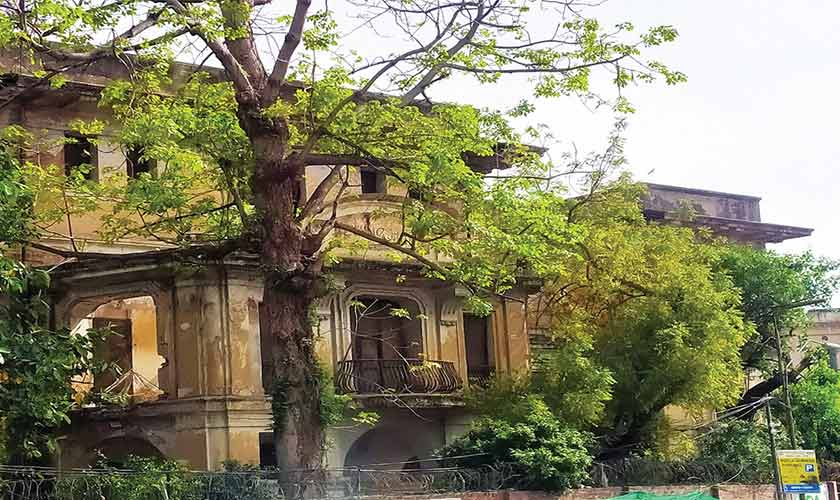
The area in front of the Ewing Hall has been excavated to build an underground parking lot, its foundations vibrating under the weight of ‘progress.’ The authorities have removed some ancient trees and bicycle shops to make room for petrol-guzzling vehicles.
The Neela Gumbad area, named for the iconic blue tiles of the tomb of Sheikh Abdur Razzaq, is steeped in lore. It was once said that a lion would sweep the tomb’s floor with its tail. I had the singular honour of painting this monument in oils and watercolors, capturing the ancient trees that stood as silent witnesses to history.
Today, the heritage is under threat. While the tomb of Sheikh Musa Ahangar on McLeod Road retains its original character — protected by the devotion of local blacksmiths — it is choked by illegal construction. The Antiquities Act of 1975, which prohibits building within 200 feet of a historical monument, is being ignored.
The city-lords appear resolved to let this pedestrian-friendly city be trampled by automobiles. The area in front of the Ewing Hall has been excavated to build an underground parking lot, its foundations vibrating under the weight of ‘progress.’ The authorities have removed ancient trees and bicycle shops to make room for petrol-guzzling vehicles. In sharp contrast, a clip doing the social media rounds shows the outgoing prime minister of the Netherlands leaving his office riding a bicycle.
From the Railway Station to the historic Morchi (not Mochi) Gate, open spaces are being usurped by parking lots. The Metro Bus and the Orange Line Train have bifurcated Lahore like the Berlin Wall, a move frequently protested by the Lahore Conservation Society. My friend, writer Mustansar Hussain Tarar is hopeful that one day these “intruding structures” will be removed.
Amidst this concrete expansion, there is one small mercy: the revival of original street names. This news surely thrills the old-timers and the postmen. As the saying goes, a postman is never transferred; the only letter he ever truly receives is the one that says, “You are allowed to retire.”
In short, the very character of Lahore, which boasts many a World Heritage Site, is being changed.
Dedicated to Qudratullah, who was educated at a missionary school and later converted to Islam
The writer is a painter, a founding member of Lahore Conservation Society and Punjab Artists Association, and a former director of NCA Art Gallery. He can be reached at [email protected]