Print Story
X




The anti-encroachment drive in katchi abadis has displaced thousands and triggered protests all over the federal capital
| M |
assive evictions in settlements across Islamabad have been reported over the past few weeks. Thousands of families are being displaced without any alternative arrangements for their accommodation. Some claim that they were not given enough time to vacate the homes they had been living in for decades.
Last week, the capital territory administration intensified its anti-encroachment operations in several zones of the city, particularly targeting informal settlements, triggering violent clashes, protests and fresh concerns over displacement of thousands of low-income citizens.
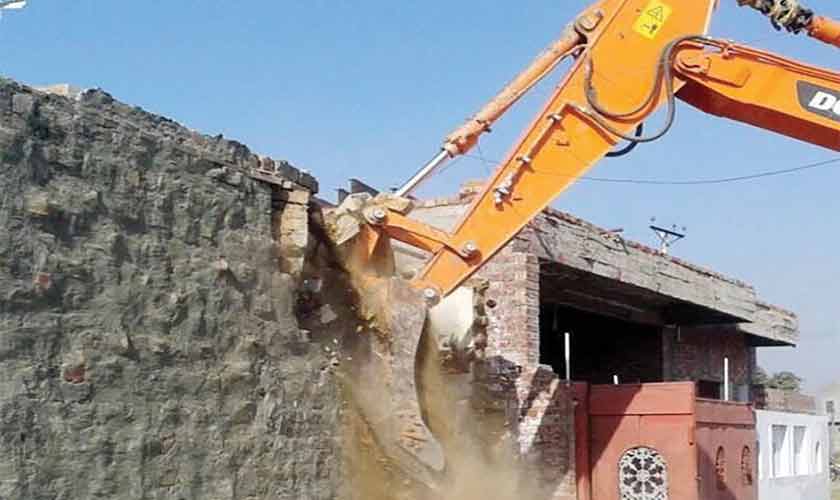
The Capital Development Authority demolished hundreds of houses in the area around the Bari Imam shrine, situated next to the Prime Minister’s House. A similar number of houses was demolished a few weeks ago.
In a recent speech, Interior Minister Mohsin Naqvi said that the government had plans to transform the area into a “new city.” He cited Manhattan and Shanghai as examples.
There were clashes between police and the residents last week when the CDA bulldozed several houses in Noor Pur Shahan. Teargas was used to disperse protestors. Police cases were lodged against some of the protestors.
Some of the residents claimed that parts of the settlements where the anti-encroachment drive was going on had existed even before the 1947 partition.
The operation is part of a broad campaign by the CDA to remove illegal structures and reclaim state land following court orders that allowed the civic agency to proceed with enforcement actions.
The Bari Imam-Noor Pur Shahan belt has recently been the focal point of the crackdown. CDA teams, backed by police, have used machinery to demolish houses and other structures in the area. Officials say the land had been “illegally occupied.”
Officials say the residents were issued notices and many had moved out before the operation. Many residents contest this claim. Some insist that many families had lived there for decades and were given little time to make alternative arrangements.
Nearly 200 structures were demolished in the latest phase. FIRs have been registered against around 350 people following the clashes. These include charges under anti-terror laws.
The protestors allege use of excessive force. The authorities maintain that the “miscreants” attacked enforcement teams and set some vehicles on fire.
“We have been living here for many years. They did not give us proper notice or enough time,” Muhammad Saeed, one of the protesting residents said. “My house was demolished so quickly, I wasn’t even able to salvage household items.”
According to some housing rights groups, around 25,000 people from Muslim Colony alone were displaced in earlier demolitions. Many of them continue to live in precarious conditions.
Islamabad is estimated to have a katchi abadi population of around four hundred thousand, reflecting the scale of informal housing in the capital.

Islamabad is estimated to have a katchi abadi population of around four to five hundred thousand, reflecting the scale of informal housing in the capital and the potential impact of eviction drives.
Residents affected by the demolitions have reported loss of homes, livelihood and access to basic services. Many say they have been forced to move to peripheral areas or live with relatives.
The CDA maintains that its actions are legal and justified, citing court rulings that cleared the way for anti-encroachment drives. Officials say the operation is necessary to reclaim public land, enforce urban planning laws and remove encroachments that have expanded over years due to weak enforcement.
The legal situation remains complex. Some of the court orders direct the authorities to pause their operations in certain areas. In other areas, the anti-encroachment drive was given a green signal.
Human rights organisations and civil society groups have strongly criticised the operation, calling it “anti-poor” and warning of a deepening housing crisis.
The Human Rights Commission of Pakistan, along with several advocacy groups, has urged the authorities to halt forced evictions and comply with legal safeguards, including earlier court orders against summary demolitions of katchi abadis.
“We have organised against evictions of working class households in Islamabad since 1999. The Pakistani state, the CDA in particular, have always employed the language of violence to deal with katchi abadis. The present regime is unhinged in a way we have never seen before,” activist Aasim Sajjad Akhtar commented.
“City planners never provided for working class migrants from rural areas in search of a better life. Now recent migrant workers and those who have lived here for decades are being subjected to a frontal assault on their homes and livelihoods.”
“Islamabad is the most expensive city in Pakistan. Where does the state think these people will go? Amidst a global crisis with prices of basic commodities soaring - when will the state fulfil its basic obligations? These evictions are anti-people, cruel and inhumane. They should be halted at once,” said Tooba Syed.
“CDA officials are bulldozing houses, evicting working class people and creating a humanitarian crisis in Islamabad. Any mediators available to save poor citizens from the wrath of these corrupt officials?” Senator Sherry Rehman asked on social media.
With pressure from the civil society building up, the CDA faces a critical challenge — balancing enforcement of law with humanitarian considerations in a city where thousands remain a demolition away from homelessness.
The Federal Constitutional Court, last week, directed the CDA to finalise regulations for Islamabad’s informal settlements.
The National Commission for Human Rights, has expressed grave concern over the demolitions in Bari Imam.
“Forced evictions without due process, rehabilitation and compensation violate fundamental rights. Authorities must comply with law and ensure lawful, humane resettlement,” the NCHR stated.
The author is a staff reporter. He can be reached at [email protected].