Print Story
X




The Taliban authority in Afghanistan was established through rapid military takeover of major cities
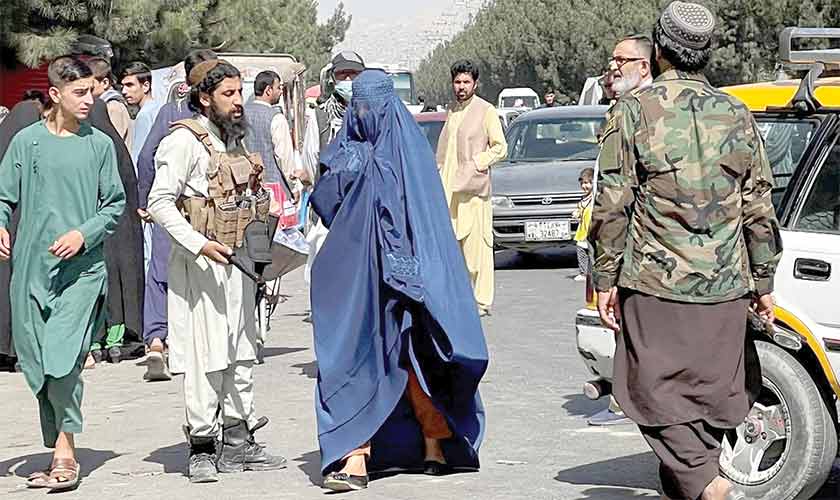
The system established by the Taliban in Afghanistan is sometimes described as Islamic. A close critical examination suggests that this is a contested claim. The current model of governance is anything but consultative and just. It is a rigid and isolationist order centred around the authority of its supreme leader, Hibatullah Akhundzada. In this system, religion is deployed not as a moral framework for governance, but as a tool to justify control, suppress dissent and consolidate power. What is framed as divine law often functions, in practice, as a mechanism of domination.
The foundation of a legitimate political system rests on ethical principles such as justice, consultation and public consent. Historically, Islamic governance has emphasised accountability and voluntary allegiance of the governed. The Taliban’s return to power in 2021, however, did not emerge from an electoral process or public consultation. Instead, authority was established through a rapid military takeover of major cities, following the collapse of the Ghani government. The public silence since then cannot be interpreted as acceptance. Rather, it reflects an environment characterised by fear and coercion. A governance system imposed through force stands in direct contradiction to the Islamic ethos of justice and voluntary allegiance.
Structurally, the Taliban regime is marked by extreme centralisation of authority. Ultimate power is in the hands of a single leader. Formal institutions such as the cabinet, judiciary and advisory councils function largely as instruments of compliance rather than independent bodies. Decision-making is confined to a narrow clique, reportedly based in Kandahar, practically disconnected from much of the Afghan population. The absence of a functioning parliament, an independent judiciary and a free media further underscores the authoritarian nature of the system. There is little transparency in governance and virtually no mechanisms for accountability. Rules are made mostly through arbitrary decrees rather than laws developed through consultative deliberation.
One of the most striking features of the current system is its exclusionary nature. Afghanistan is a diverse country, with no single ethnic group forming an overwhelming majority. While Pashtuns constitute a significant portion of the population, they do not represent the entirety of Afghan society. However, power in the Taliban regime appears heavily concentrated among Kandahar-based Pashtun leaders. This concentration has resulted in the marginalisation of other ethnic groups, including Tajiks, Hazaras and Uzbeks, who form a substantial portion of the population. Even where representation exists, it is often limited to symbolic roles without real influence. This imbalance reflects a structure of ethnic concentration rather than inclusive governance, raising serious questions about national unity and equity.
The regime has imposed strict control over intellectual life and public discourse. Dissent is not merely discouraged but also criminalised. Criticism of leadership is often equated with rebellion. Independent thought is systematically suppressed. Journalists operate under severe constraints, scholars are silenced and disagreements within the system are tightly controlled. A climate of fear has replaced open dialogue with enforced obedience. This approach stands in contrast to the rich tradition of intellectual debate and scholarly diversity, where differing interpretations have historically coexisted. By enforcing a singular, rigid interpretation, the Taliban have effectively turned religious law into an instrument of ideological control.
Legal structures under the Taliban reinforce patterns of inequality and repression. Their criminal justice system has been criticised for lacking consistency and fairness. Reports suggest that similar offenses can result in vastly different outcomes depending on an individual’s status or connections. Vague legal provisions allow for arbitrary enforcement, creating an environment where the law can be used selectively to target critics or suppress opposition. In this context, the law functions less as a tool for justice and more as a means of control. Such practices undermine the fundamental Islamic principle that all individuals are equal before the law.
The broad social and political framework of the Taliban regime reflects systemic exclusion. Power remains concentrated within a narrow ideological band and an ethnic group. Large segments of the population are effectively excluded from meaningful participation in governance. Diversity is constrained and alternative voices are often silenced. This approach contrasts sharply with the concept of the Ummah, which emphasises unity, inclusiveness and mutual respect among diverse communities.
Governance challenges under the Taliban are evident in the country’s deteriorating socio-economic conditions. Afghanistan continues to face severe economic hardship, with rising poverty and widespread food insecurity. Instead of pursuing policies aimed at economic recovery and international engagement, the regime has adopted a largely isolationist stance. Restrictions on education—particularly for girls—have compounded the crisis, limiting access to knowledge and undermining the country’s long-term development prospects. The deliberate narrowing of intellectual and educational spaces is pushing the society toward stagnation.
Daily life under the Taliban is characterised by pervasive surveillance and control. Freedom of expression is severely curtailed. Public participation in governance is virtually nonexistent. Citizens live under constant scrutiny, fear being a central tool of governance. In such an environment, compliance is often driven by necessity rather than conviction. A system that relies on intimidation rather than legitimacy struggles to claim moral authority, regardless of the language it uses to justify itself.
The Afghan political system under the current Taliban regime raises profound questions about the relationship between religion and power. While it is presented as an embodiment of Sharia, its practice often diverges from core Islamic principles such as justice, consultation, equality and accountability. Instead, the system reflects centralised authority, exclusion and repression. What emerges is not a model of faith-based leadership, but a structure where power is maintained through coercion and religious symbolism is used to mask the authoritarian reality.
The author works for The News. He can be contacted at [email protected].