Print Story
X




They keep life in the city vibrant and fragrant
| R |
alph Waldo Emerson, in his poem Hamatreya, underscored the transience of human life and the vanity of land ownership, reminding people that nature remained the ultimate master. He famously wrote, “The earth laughs in flowers.” In the subcontinent and beyond, that ‘laughter’ has always been at the heart of our most sacred ceremonies. We share flowers to express affection, convey empathy and honour the moments that make life bloom.
Beyond the grand festivities, there is a quieter, more humble ritual woven into the fabric of Lahore: the selling of the gajras — or rosaries.
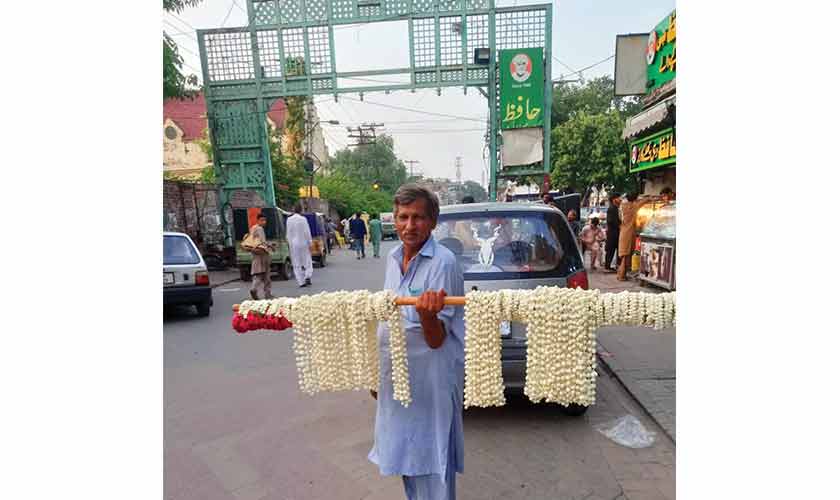
The vendors of these floral ornaments are typically soft-spoken and down-to-earth, embodying the very gentleness of their wares. For those away from the city, the memory of the gajra seller is what lingers most. A gajra — a fragrant garland of jasmine or roses worn by a woman around her wrist or entwined in a hair bun — is more than an accessory; it is seasonal heartbeat.
Nowhere in Pakistan is this presence more felt than in Lahore. At every turn, every traffic signal and every bustling bazaar, these vendors are ubiquitous. They are masters of their craft, often approaching young couples with a knowing smile, leaving the men with little choice but to grace their beloveds’ wrists with a circle of fragrance.
In Old Anarkali, two figures stand out: Salamat Ali and Rashid Ahmed. I often find Ali at the Artisans’ Park around Maghrib. A middle-aged man with a dusky complexion and ruffled hair, he usually sports a shalwar qamees with a few buttons undone and a day or two of stubble. A half-finished cigarette often dangles from the corner of his mouth — a stark contrast to the delicate Arabian jasmine he has sold for 30 years.
Ali is a man of few words and rarely beckons to the crowd. Yet, when he sees a familiar face, his demeanor shifts. “Come and see for yourself,” he’ll call out to me, “I’ve got very fresh gajras today.”
At every turn, every traffic signal and every bustling bazaar, these vendors are ubiquitous. They are masters of their craft, often approaching young couples with a knowing smile.
He knows I find solace in the scent of fresh roses; when I compliment his skill in selection, his eyes crinkle with a quiet, genuine joy.
| O |
n a different afternoon, near the General Post Office, I watch a flock of pigeons pecking at mounds of pearl millet. The sudden flutter of their wings at a passerby’s movement feels like a scene lifted straight from Ahmed Ali’s Twilight in Delhi. It is in these leisurely moments of observation that I often encounter Ahmed.
“I have spent half my life selling these [gajras] in Old Anarkali,” he tells me.
Ahmed hails from the Kasur district. He makes the journey to Lahore every day. Even as the hour grows late, his dedication doesn’t waver. “There are only four gajras left,” he noted during our last encounter. “After these, I head towards Chauburji to catch the last bus to Lalyani.”
Ahmed speaks of a changing world. He remembers a time when five pairs of gajras cost a mere ten rupees and people bought them in “hordes.” That trend, he fears, is on the wane.
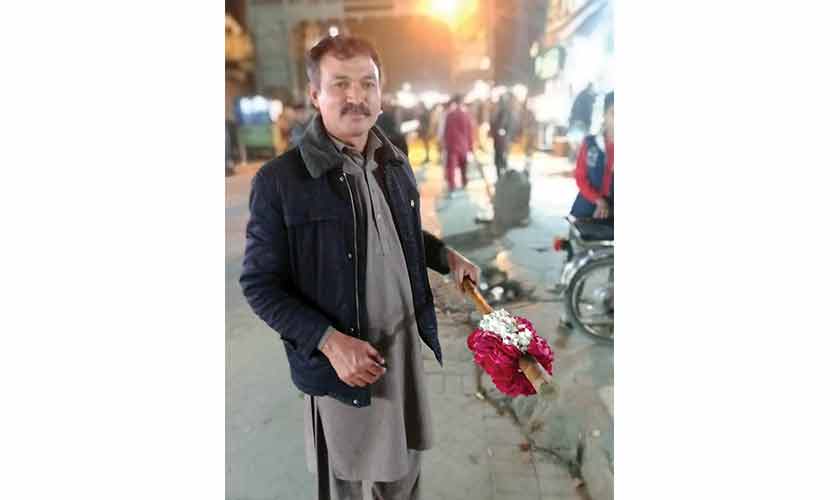
“If only boys could see and understand the glint that appears in girls’ eyes the minute you buy them fresh flowers,” he remarked as I prepared to leave. “Alas, the new generation is crazy about machines and knows little of what fellow humans feel and desire.” I nodded, promising to share his wisdom.
Lahore is a city of concrete and history kept vibrant and fragrant by the men in its nooks and corners — the gajra sellers who remind us, one wrist at a time, that the earth is still laughing.
Usama Malick is a storyteller. He can be reached at usama.malick183@gmail.com