Print Story
X

| O |
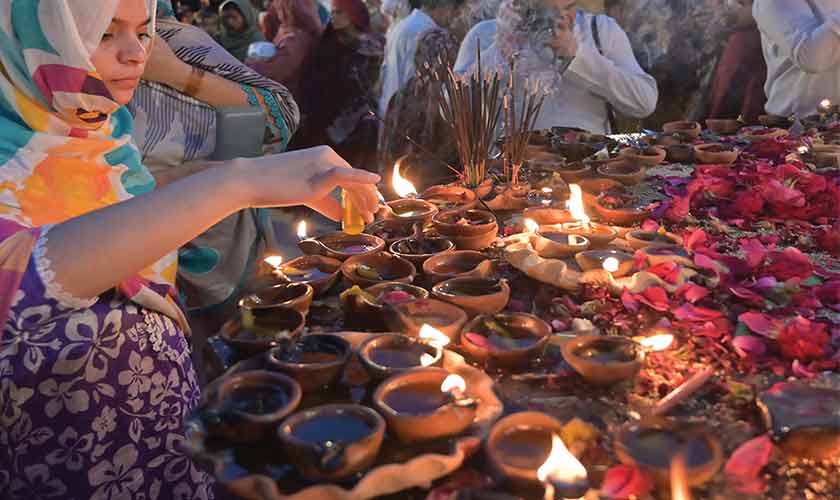
ne will not witness Lahore keeping time through clocks or calendars, but with crowds, smells, lamps and the old pull of ritual. Mela Chiraghan is one of the occasions when the city seems to exhale and remember itself.
This year, too, the Punjab government announced a local holiday in Lahore on March 28 for the annual festival. Media reports said the administration had been preparing to ensure a peaceful environment for devotees.
What makes Mela Chiraghan matter in Lahore? More than a shrine event, a spring fair, a packet of qawwali and food stalls wrapped in nostalgia, the event is about Lahore asserting its cultural identity. It is one of the city’s oldest public gatherings, one that has long drawn people of different backgrounds. Historians describe it as a festival that once brought together people of all religions at Shalimar Gardens, with the Mughals, the British and Maharaja Ranjit Singh all part of its long public memory.
The saint at its centre, Shah Hussain, was born in Lahore some four and a half centuries ago. He is remembered as a Punjabi Sufi poet, but Lahore has never remembered him in a straight line. He is widely regarded as a pioneer of the Punjabi kafi, a form that stripped poetry down to something closer to song and lived speech, circling themes of longing, surrender and a quiet defiance of social hierarchies.
Shah is also known as Madho Lal Hussain, on account of Madho Lal, the Hindu Brahmin boy associated with him. Some accounts describe their bond in spiritually charged language; others, more cautiously, try not to pin it down too neatly. Their chance encounter that turned into companionship is seen as layered enough to resist a single explanation. In many tellings, Madho becomes both disciple and lover, someone through whom Shah’s own message of love and disregard for rigid boundaries found form.
There is something telling in how comfortably this ambiguity feels to a regular desi. We do not rush to fix their relationship into rigid categories, perhaps because pre-modern South Asia allowed for more fluid expressions of attachment, ones that do not fit neatly into the sharper, more codified relational frameworks that came later from the West. Either way, the pairing has become part of Punjab’s cultural imagination.
That old syncretic pulse is part of why the festival still feels bigger than its present-day arrangements. In 2025, reports said Mela Chiraghan had been revived at Shalimar Gardens after a 67-year hiatus, with events at both the gardens and the shrine, and with lectures, poetry sessions, qawwali, food stalls and handicrafts included. Another report noted that the mela had been held at the Shalimar Gardens until 1958, when it was moved away from there. The shape of that story matters. It tells you that the festival was not simply preserved by time. It was interrupted by the state, then slowly stitched back into common person’s memory.
Like most living traditions, it has not only evolved; in some ways, it has also thinned. The old openness of the mela, its rougher and freer life, now sits beside security arrangements, managed access and the usual modern instinct to supervise anything that gathers too many bodies in one place.
That is not a complaint so much as a sign of the times. Lahore still comes, still lights its lamps, still sways to the dhol, but the festival now has to move through the language of permissions, crowd control and official reassurance.
Maybe the true measure of Mela Chiraghan is not in how faithfully it recreates the past, but in how much unpredictability and roughness it still allows. This is not a festival built for the curated, English-speaking, global-citizen version of people; the one that prefers its heritage filtered, branded and easy to display. It belongs more naturally to the devotees who arrive as they are — the lower-income Lahori, the pilgrim, the vendor, the family carrying its own food, the desi crowd that does not fit into polished templates.
That is what gives the mela its rough dignity. It is crowded, a little unruly, sometimes unsafe, often unfiltered, but also unmistakably alive. Perhaps that is why Lahore keeps returning to it; because it’s anything but fake.
Kiva Malick, writer and academician, focuses on education, philosophy, music and culture