Print Story
X




How will the poorest Pakistanis survive the economic shock emerging from the Middle East conflict?
| O |
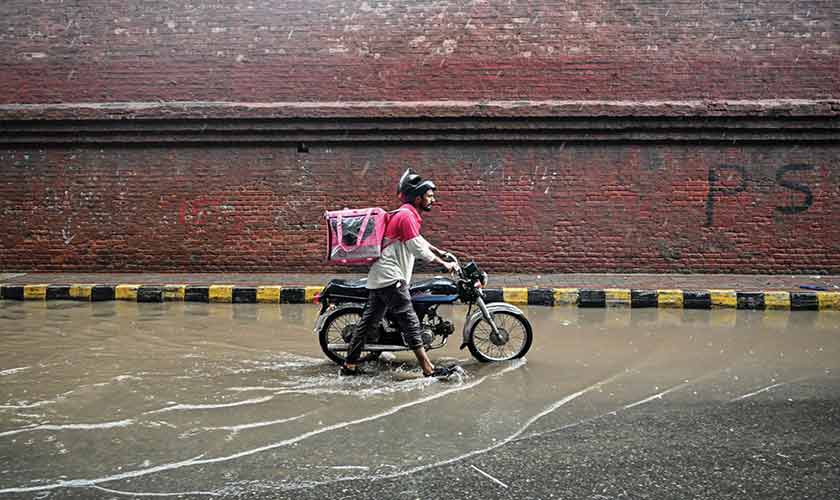
n a narrow street in Lahore, not far from the factory where he used to clock in six days a week, a motorcycle rattles by, long outliving its dignity. One of the tyres has lost its alignment, pulling the frame into a persistent wobble that the rider corrects by instinct. The exhaust trails a plume thick enough to taste. The engine, starved and inefficient, burns more fuel per kilometre than any machine in reasonable health would demand—every kilometre now costs a measurable fraction of a day’s wage. The factory in which he works has cut shifts; export orders have dried up since the Middle East crisis began tearing through supply chains. The school his children attend is shut; the government has ordered a blanket closure and the school cannot pivot online—most children in the school neither have access to the internet nor devices to connect to it. His most pressing thought is not geopolitics but whether he can afford to start his motorcycle tomorrow.
The war between Iran and the United States has produced consequences that have reached Pakistan with brutal efficiency. In the space of days, petroleum prices have risen by Rs 55. Supply chains have fractured. Export competitiveness has eroded. Factories have begun cutting workers. The government has responded by shutting schools and universities; reducing the working week to four days; and more recently, deregulating petroleum pricing. This means there is now no ceiling on what comes next.
If the conflict deepens, the prices move with it. Nobody in Islamabad is holding the lever any longer.
In a televised address, Finance Minister Muhammad Aurangzeb outlined the government’s response: Rs 69 billion in fiscal resources to absorb part of the burden; daily meetings to secure fuel supply; and diplomatic hope that the conflict would end soon. He said something telling: “hope is not a strategy”— but he said that about supply chains, about the risk of fuel shortages, if the conflict persists.
On the more immediate question of how the poorest Pakistanis will survive this shock, the government has not yet named a delivery mechanism for that money nor identified who, precisely, it is meant to reach.
That absence is not incidental.
It reflects a structural limitation that surfaces every time an external crisis strikes Pakistan: the government’s social protection tools were built for a different kind of poverty than the one now spreading through factories and across streets. Pakistan’s safety architecture—anchored in the Benazir Income Support Programme—was designed to address chronic, static deprivation: households that have been poor for years and whose poverty can be measured through a scorecard administered in calmer times. When crises hit—whether floods, earthquakes or an oil shock born of a distant war—BISP tends to become the default delivery channel, not because it was designed for such moments but because it is the most organised targeting infrastructure the state possesses.
The problem is that acute shocks do not respect the boundaries of a chronic-poverty registry. What the country faces now is an income disruption transmitting its damage through fuel prices, transport costs, factory layoffs and shuttered schools, hitting people who were not poor last year and do not appear on any scorecard today. Deploying a chronic-poverty instrument against an acute crisis is not merely a logistical problem, it is a category error, and defaulting to BISP—or any similar registry-based tool—without modification will reproduce that error.
The mismatch between BISP’s design and the current crisis is, therefore, worth naming precisely. BISP identifies beneficiaries through a static poverty scorecard. Its primary recipients are women, appropriate for its original purpose of addressing long-run household deprivation.
What this crisis is exposing, with unusual precision, is the gap that has always existed in Pakistan’s social protection architecture: there is no instrument designed for acute economic shocks.
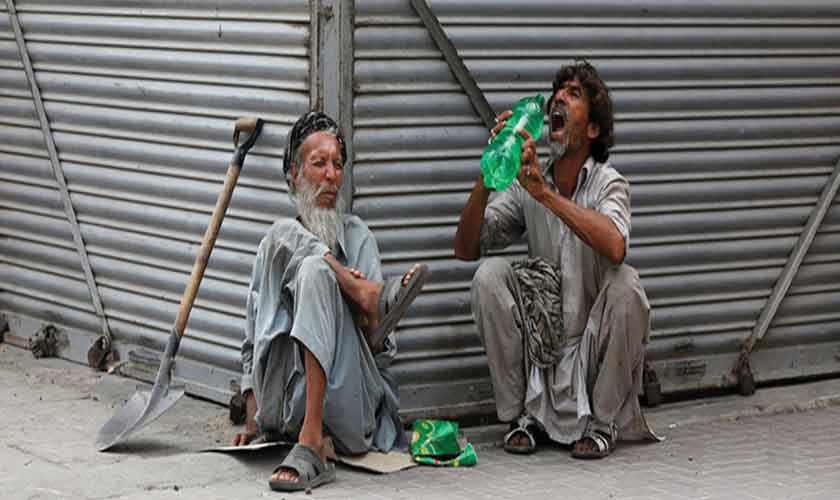
But the Middle East crisis is hitting through entirely different channels. The factory worker whose shifts have been cut, whose children are home because schools are closed, whose commuting costs have doubled may not appear in BISP’s registry at all. He was not poor enough last year to qualify but he is poor enough now; yet the scorecard has not moved.
A targeted fuel subsidy on two-wheelers, another option that has been floated, fares no better. Motorcycle ownership does not correlate reliably with poverty, meaning such a subsidy would leak toward households that do not need it. And the Rs 69 billion the government has committed carries no announced mechanism for reaching people whose distress began last week rather than the last decade.
The mismatch between Pakistan’s existing tools and the nature of this crisis is not only a problem; precisely because it is so visible, it could serve as a catalyst—if the government has the clarity to treat it as one. What this crisis is exposing, with unusual precision, is the gap that has always existed in Pakistan’s social protection architecture: there is no instrument designed for acute economic shocks; no time-bound programme; no trigger mechanism linked to verified income disruption or confirmed job loss; no channel that reaches working people—men and women—whose livelihoods have been destabilised not by chronic poverty but by an event entirely beyond their control. Such an instrument would not replace BISP. It would complement it, addressing the acute while the BISP addresses the chronic, and activating only when a defined threshold of disruption is crossed.
Crucially, a well-designed shock-response instrument of this kind should also be structured to leave something behind once the crisis passes. A programme that simply transfers consumption support, then expires, buys time without building anything. The same instrument, if conditioned on skills training or linked to employment pathways, would address today’s emergency while beginning to construct the infrastructure for surviving the next. This is not a distant consideration. Schools have been shut; the working week shortened; and the question of what people will do with their involuntary free time is an immediate policy variable that is currently going to waste.
None of this is to dismiss the moral urgency of immediate relief.
People are hungry now, not in five years. But a well-targeted, time-bound instrument with clear triggers and a defined sunset clause is not in tension with fiscal discipline; it is an expression of it. Pakistan’s IMF programme leaves limited room for open-ended expenditure. A shock-response programme with specified beneficiary criteria and a built-in end date is precisely the kind of intervention that survives that scrutiny, and is far more justifiable than a large fiscal commitment disbursed through unspecified channels to unspecified recipients.
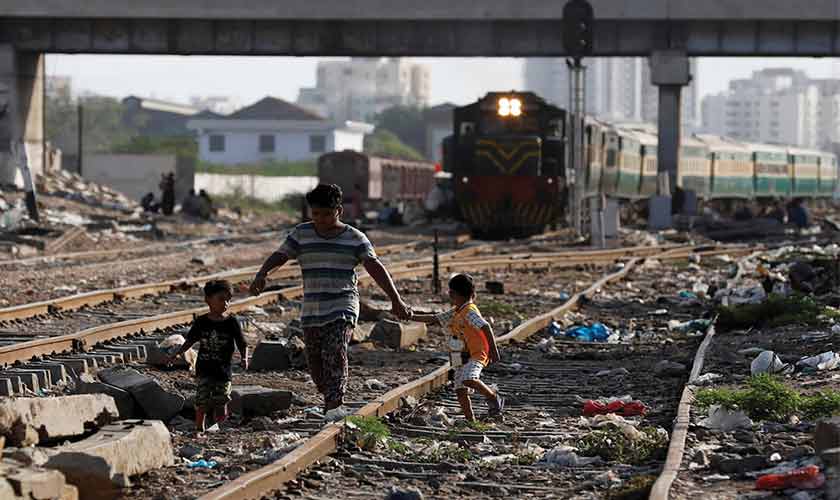
The finance minister was right: hope is not a strategy. But neither is a chronic-poverty playbook applied to an acute crisis. The Middle East conflict will hopefully end through diplomatic channels Pakistan is trying to facilitate or through exhaustion or some resolution not yet visible. When it does, the streets across Pakistan will look almost as they do now. The question is what will have changed for the man sitting on a motorcycle with a wobbly tyre, calculating whether he can afford to start it. Whether Pakistan will have built something that actually reaches him or whether it will wait, playbook in hand, for the next distant war to arrive.
The writer is a tenured associate professor and chairperson of the Department of Economics, COMSATS University Islamabad, Lahore Campus.